WhatsApp Business Pricing: App, API, and Platform Costs
TL;DRWhatsApp Business pricing depends on which WhatsApp product you mean. The WhatsApp Business app is available for free, but a growing store may still pay for mobile data, optional verification, ads, WhatsApp Business Platform message fees, provider fees, or software that connects WhatsApp to ecommerce workflows.
That distinction matters for Shopify teams. A store that only replies to incoming customer questions has a different cost model from a store that wants abandoned checkout recovery, COD confirmation, order updates, review requests, winback campaigns, and repeat purchase reminders.
This guide breaks down the real cost layers so you can compare the free Business app, the WhatsApp Business Platform, broad WhatsApp tools, and a Shopify-focused automation app like Retentionly without mixing them into one confusing price.
Quick Verdict
If you only need manual customer chats, product catalog sharing, quick replies, and a business profile, start with the WhatsApp Business app. It is the simplest path for small teams that personally manage conversations.
If you need automated, approved, high-volume messages triggered by customer or store events, you are moving into WhatsApp Business Platform pricing. That means delivered-message charges from Meta, plus any provider, platform, or app fees.
If you are a Shopify store trying to use WhatsApp for retention revenue, the best pricing question is not "What does WhatsApp cost?" It is "What does it cost to run the flows that recover revenue and reduce support load?"
| Option | What you usually pay for | Best fit |
|---|---|---|
| WhatsApp Business app | Free app download and use, mobile data, optional paid features or ads | Manual chats, small teams, early customer conversations |
| WhatsApp Business Platform/API | Meta delivered-message fees, provider or hosting fees, technical setup | Scalable messaging, templates, integrations, custom workflows |
| Broad WhatsApp platform | Subscription, message fees, inbox users, campaigns, chatbots, AI, add-ons | Teams using WhatsApp for support, sales, marketing, and operations |
| Shopify WhatsApp app | App subscription, Meta fees, Shopify automation features, reporting | Stores focused on cart recovery, COD, order updates, reviews, winback, and repeat purchases |
What WhatsApp Business Pricing Actually Includes
The phrase "WhatsApp Business pricing" can refer to four different cost buckets.
The first bucket is the WhatsApp Business app. This is the mobile app built for small businesses that want a business profile, catalog, labels, greeting messages, away messages, and one-on-one customer chats.
The second bucket is the WhatsApp Business Platform, often still called the WhatsApp Business API. This is the programmatic product used for approved templates, automation, integrations, and larger scale messaging.
The third bucket is the provider or platform layer. If you use a Business Solution Provider, API hosting provider, ecommerce WhatsApp platform, or shared inbox product, that vendor may charge subscription fees, number fees, seats, add-ons, markup, prepaid wallet requirements, or support fees.
The fourth bucket is the ecommerce automation layer. For Shopify teams, this is where the cost becomes practical: does the tool connect to Shopify events, run retention flows, manage templates, stop messages after purchase, and show revenue impact?
Is The WhatsApp Business App Free?
Yes, the WhatsApp Business app is available for free from the Google Play Store and Apple App Store. It is the right starting point when your team wants a business presence on WhatsApp and can handle conversations manually.
The free app can help you:
Create a business profile.
Display products through a catalog.
Use quick replies for common questions.
Send greeting and away messages.
Label customer conversations.
Reply from a phone or connected devices.
Share links, photos, documents, and payment instructions where supported.
For a very small store, that may be enough. If most WhatsApp conversations are customer-initiated and your team can reply manually, the Business app keeps the cost simple.
But the app is not the same as Shopify WhatsApp automation. It does not replace a system that listens for abandoned checkout events, waits the right amount of time, sends approved templates, tracks purchases, suppresses customers who already bought, and measures recovered revenue.
When WhatsApp Starts Becoming Paid
WhatsApp starts becoming a larger pricing question when the store wants scale, automation, or paid acquisition.
For example, costs may appear when you:
Run ads that click to WhatsApp.
Subscribe to optional paid business features.
Use the WhatsApp Business Platform/API for automated outbound messaging.
Work with a provider that charges hosting, subscription, support, or markup.
Add a shared inbox, chatbot, AI agent, campaign tool, or Shopify automation app.
This is why two merchants can ask the same question and get different answers. A solo merchant using the Business app for manual support may pay almost nothing beyond internet access. A D2C brand sending automated cart recovery and winback campaigns will need to model delivered-message fees and software cost.
The turning point is usually automation.
WhatsApp Business Platform Pricing
Meta's current WhatsApp Business Platform pricing is message-based. Businesses are charged when a message is delivered to a user, and the rate depends on the destination market and the message category.
The four categories are:
| Category | Ecommerce examples | Cost planning note |
|---|---|---|
| Marketing | Abandoned checkout reminders, offers, product recommendations, winback messages | Important for revenue campaigns and retargeting flows |
| Utility | Order confirmation, shipping update, delivery update, payment update | Usually tied to a customer action and should stay non-promotional |
| Authentication | One-time passcodes and verification codes | Mostly relevant to account login or identity verification |
| Service | Replies to customer-initiated conversations inside the customer service window | Useful for support replies and handoff conversations |
Meta does not charge for service messages. Meta also does not charge for utility messages businesses send in response to users. When customers message from certain free entry points, such as click-to-WhatsApp ads or Facebook Page call-to-action buttons, Meta describes a 72-hour window where messages across categories are not charged.
Those rules are useful, but they do not mean outbound automation is free. If your Shopify store sends abandoned checkout reminders, promotional winback messages, reorder nudges, or campaign broadcasts, you still need to budget for delivered template messages.
For a deeper breakdown of API-specific fees, read the WhatsApp Business API Pricing Guide.
Why A Single WhatsApp Business Price Is Misleading
A universal "WhatsApp Business costs X per month" answer is usually wrong because it hides too much.
The free Business app and the Business Platform solve different problems. The app is built for personally managed conversations. The platform is built for programmatic access and scale.
Message fees also vary. A marketing message to one market can cost differently from a utility message to another market. Utility and authentication messages can have volume-tier pricing. Service replies behave differently from outbound templates.
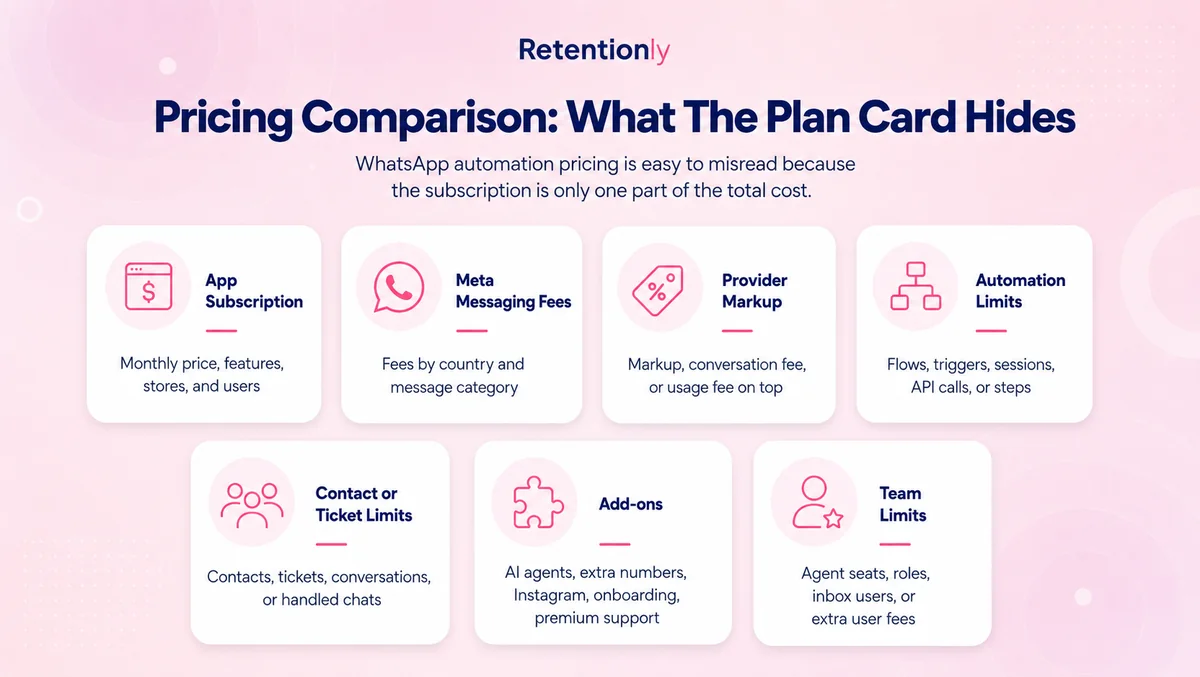
Provider pricing adds another layer. One provider may charge per WhatsApp number plus Meta fees. Another may charge software plans, inbox seats, automation triggers, flow steps, AI agents, or add-ons. Some vendors pass through Meta fees directly. Others may have markup, wallet, or usage rules.
For Shopify teams, the cleanest comparison is by workflow.
Build A Shopify WhatsApp Cost Model By Flow
Start with the first flows you want to launch. Then estimate who enters each flow, which message category applies, how many delivered messages you expect, and what revenue or support outcome justifies the spend.
| Shopify workflow | Typical trigger | Likely cost driver | What to measure |
|---|---|---|---|
| Abandoned checkout recovery | Checkout started but no order placed | Marketing templates and recovery sequence length | Recovered revenue, conversion rate, opt-outs |
| COD confirmation | Cash-on-delivery order created | Confirmation templates, reply handling, cancellation rules | Confirmation rate, fake-order reduction, RTO impact |
| Order updates | Order placed, fulfilled, shipped, delivered | Utility templates and order volume | Fewer WISMO tickets, delivery confidence |
| Review requests | Delivered order | Review request templates and timing | Review volume, reply rate, repeat purchase lift |
| Winback campaigns | No order after a set period | Marketing templates and segment size | Reorders, unsubscribe rate, margin after cost |
| Reorder reminders | Expected replenishment date | Reminder templates and customer eligibility | Repeat purchase rate, revenue per message |
| Post-purchase upsell | Recent purchase or product affinity | Marketing templates and offer margin | Upsell revenue, conversion rate, customer fatigue |
This model is better than counting total messages. It shows which messages are worth sending and which ones need tighter suppression rules.
For example, an abandoned checkout flow may justify a higher message cost if it recovers high-margin orders. A broad promotional broadcast to an unsegmented list may look cheap per message but perform poorly after opt-outs and discounts.
Business App Vs API Vs Shopify App
The practical decision is not only price. It is operating fit.
| Question | WhatsApp Business app | WhatsApp Business Platform/API | Shopify WhatsApp app |
|---|---|---|---|
| Can you send manual replies? | Yes | Yes, through connected tools | Yes, depending on inbox setup |
| Can you automate Shopify events? | No native event automation | Yes, with integration work | Yes, built around Shopify workflows |
| Can you send approved outbound templates? | Limited app behavior, not API-scale automation | Yes | Yes, through the platform connection |
| Do you need developer work? | Usually no | Often yes unless using a provider | Usually no |
| Do you get Shopify revenue tracking? | No | Custom or provider-dependent | Should be built into the app workflow |
| Best for | Small manual teams | Custom or high-scale messaging needs | Shopify retention automation |
Use the Business app when customer conversations are manual and volume is manageable.
Use the Platform/API when WhatsApp needs to connect to systems, templates, events, and higher-volume messaging. This can be direct, through a BSP, or through a software product.
Use a Shopify WhatsApp app when the job is not "own the API" but "launch revenue workflows." That usually means cart recovery, COD confirmation, order updates, review requests, winback, upsells, and repeat purchase reminders.
What Broad WhatsApp Platforms Add To The Price
Broad WhatsApp platforms can be valuable when WhatsApp is a full customer operations channel. Tools such as Wati, Interakt, Zoko, 360dialog, and similar providers package WhatsApp differently.
Some focus on API hosting and number-level access. Some focus on inbox, sales CRM, campaigns, catalog, support, and chatbots. Ecommerce-focused tools may add Shopify integrations, abandoned checkout flows, order updates, AI agents, flow add-ons, or agent seats.
That does not make them bad. It means the buyer should compare the pricing model against the job.
If your team needs WhatsApp for support, sales conversations, catalogs, Instagram, AI agents, and a shared inbox, a broader platform may be the right fit.
If your team mainly needs Shopify retention automation, a broad platform can be more product surface than you need. The price comparison should include setup effort, unused features, add-ons, and whether core Shopify flows are included in the plan you would actually buy.
Where Retentionly Fits
Retentionly is built for Shopify and D2C teams that want WhatsApp to drive retention revenue without turning the project into a broad messaging stack.
Retentionly pricing is simple:
| Plan | Price | Best for |
|---|---|---|
| Basic | $24/month | Core automations and early WhatsApp retention workflows |
| Growth | $49/month | Broadcasts and advanced automations, including winback |
| Scale | $99/month | CRM features and multi-agent chat |
Meta message fees still matter, because WhatsApp Business Platform messaging is a real cost. The difference is that Retentionly connects directly to Meta, does not add a markup on Meta messaging fees, does not charge per-chat fees, and does not charge extra for adding automations.
That pricing structure is useful when a store wants to expand from one WhatsApp test into multiple retention flows. You can start with abandoned checkout recovery or COD confirmation, then add order updates, reviews, winback, reorder reminders, and post-purchase upsells without turning each flow into a separate pricing decision.
How To Estimate Your Monthly WhatsApp Business Cost
Use this checklist before choosing a setup.
| Step | What to estimate | Why it matters |
|---|---|---|
| 1. Product path | Business app, Platform/API, broad platform, or Shopify app | These have different cost models |
| 2. Destination markets | Where customer WhatsApp numbers are located | Meta rates vary by market and category |
| 3. Message categories | Marketing, utility, authentication, service | Each category behaves differently |
| 4. Delivered messages | Messages delivered, not just attempted sends | Meta charges based on delivered messages |
| 5. Provider fees | Number fees, subscription, markup, wallet rules, support | These can change total monthly cost |
| 6. Software limits | Seats, agents, automations, flow steps, campaigns, AI | Low headline prices can hide usage limits |
| 7. Shopify revenue impact | Recovered orders, repeat purchases, support savings | The real metric is profit after WhatsApp costs |
Do the estimate for one flow first. For most Shopify stores, abandoned checkout recovery, COD confirmation, or winback is a better first test than a broad promotional broadcast.
Once one flow works, add the next workflow with the same discipline: trigger, audience, template, timing, fallback, stop rule, and metric.
Common Pricing Mistakes
The first mistake is treating the free Business app as a complete automation solution. It is useful for manual conversations, but it is not built to run Shopify event-triggered retention flows by itself.
The second mistake is comparing only monthly subscriptions. A plan can look cheaper while charging extra for messages, agents, AI, custom flows, usage, support, or provider markup.
The third mistake is budgeting every message the same way. A service reply, shipping update, abandoned checkout reminder, and winback offer have different customer context and different economics.
The fourth mistake is ignoring setup time. A raw API path may look cheaper on paper, but your team still has to build templates, webhooks, suppression rules, retry logic, reporting, and support handoff.
The fifth mistake is measuring cost without revenue. Shopify teams should compare WhatsApp spend against recovered orders, repeat purchases, support reduction, and margin.
Final Recommendation
Start with the WhatsApp product that matches the job.
If your store only needs a professional WhatsApp presence and manual customer conversations, use the WhatsApp Business app.
If your team needs custom API control, programmatic access, and deeper technical ownership, compare WhatsApp Business Platform providers by Meta fee handling, number fees, support, throughput, and developer effort.
If your Shopify store wants WhatsApp to become a retention channel, choose the setup that gets revenue workflows live fastest: abandoned checkout recovery, COD confirmation, order updates, reviews, winback, reorder reminders, and post-purchase upsells.
Retentionly is built around that path. Install Retentionly free on Shopify to launch WhatsApp retention automations without paying for a broad WhatsApp stack before you need one.
Quick FAQs
Is WhatsApp Business free?
The WhatsApp Business app is available for free and works well for manual business conversations. Costs can appear when you use mobile data, optional paid features, ads, the WhatsApp Business Platform/API, providers, or automation software.
What is the difference between WhatsApp Business app pricing and API pricing?
The app is for smaller teams personally managing conversations. API pricing applies when you use the WhatsApp Business Platform for scalable, programmatic messaging with delivered-message fees and any provider or software costs.
Does WhatsApp charge per message?
For the WhatsApp Business Platform, Meta charges businesses on a per-message basis when messages are delivered. The rate depends on destination market and message category.
Do Shopify stores need the WhatsApp Business API?
They usually need an API-backed setup when WhatsApp should be automated from Shopify events such as abandoned checkout, order creation, fulfillment, delivery, inactivity, or repeat purchase timing. A Shopify app can provide that API-backed automation without a custom build.
What should I compare before choosing a WhatsApp Business tool?
Compare Meta fee handling, provider markup, monthly subscription, seats, add-ons, automation limits, Shopify trigger support, reporting, reply ownership, and whether the tool is built for your actual workflows.