Best WhatsApp App for Shopify: How to Choose in 2026
TL;DRThe best WhatsApp app for Shopify is not always the app with the most features. It is the app that owns the job your store needs WhatsApp to do: recover abandoned checkouts, confirm COD orders, send order updates, request reviews, win back customers, or manage daily customer conversations.
That distinction matters because Shopify merchants compare very different products under the same search. Some WhatsApp apps are chat buttons. Some are shared inboxes. Some are broad WhatsApp commerce platforms. Some are built around retention automation.
This guide compares the main Shopify WhatsApp app options, the buying criteria that actually matter, and where Retentionly fits if your goal is WhatsApp automation for repeat revenue rather than a broad support operation.
Quick Verdict
Choose based on the first workflow you want live, not on the longest app listing.
| If your main goal is... | Best-fit app type |
|---|---|
| Recover abandoned checkouts, confirm COD orders, automate order updates, collect reviews, and drive repeat purchases | Shopify retention automation app |
| Run WhatsApp as a sales, support, inbox, catalog, and campaign platform | Broad WhatsApp commerce platform |
| Manage a high volume of support conversations across WhatsApp and other channels | Ecommerce helpdesk or shared inbox |
| Add a simple storefront contact option | WhatsApp chat button app |
| Build custom WhatsApp logic across multiple internal systems | WhatsApp API provider plus developer or middleware setup |
For most Shopify stores that want measurable revenue from WhatsApp, retention automation should be the starting point. A chat button can help customers reach you, but it will not automatically recover checkouts, reduce COD risk, or bring lapsed buyers back.
What To Compare Before You Pick An App
A Shopify WhatsApp app should be judged by the workflows it can run against real store events. The app should know when a checkout is abandoned, when an order is created, when fulfillment changes, when a product is delivered, and when a customer has gone inactive.
Use these criteria before installing anything:
| Buying criterion | What to check | Why it matters |
|---|---|---|
| Shopify event depth | Checkout, order, fulfillment, delivery, product, customer, and tag triggers | Automations need real store context |
| Revenue workflows | Abandoned checkout, COD confirmation, winback, reorder, upsell, and review request flows | WhatsApp should protect or grow revenue |
| Message controls | Timing, segments, stop conditions, opt-outs, and frequency controls | Prevents irrelevant messages |
| Reply handling | Inbox, routing, owner, and support fallback for customer replies | Automations create conversations |
| Pricing model | Subscription, Meta fees, markups, agents, add-ons, and usage limits | The cheapest starter plan may not be cheapest at scale |
| Reporting | Recovered orders, attributed revenue, confirmation rate, reviews, replies, opt-outs, and failed sends | You need to improve flows after launch |
| Setup effort | Whether the app starts from Shopify workflows or a generic WhatsApp platform | Faster launch usually means faster learning |
The important question is not "Does this app support WhatsApp?" The important question is "Can this app run the flows my store will actually maintain?"
For a deeper feature checklist, read the Shopify WhatsApp App Buyer Guide.
Best Shopify WhatsApp App Options By Use Case
There is no single universal winner. These are the categories and options Shopify teams usually compare.
| App or app type | Strongest fit | Watch-outs |
|---|---|---|
| Retentionly | Shopify/D2C retention automation and lifecycle revenue flows | Not meant to replace every broad support, chatbot, or omnichannel operation |
| Zoko | WhatsApp commerce, catalog selling, segmented broadcasts, inbox, and automation | More moving parts if the team only wants retention flows |
| Wati | Broad WhatsApp Business platform for campaigns, inboxes, bots, sales, support, and operations | Shopify retention may be one use case inside a larger system |
| Interakt | WhatsApp and Instagram marketing, support, campaigns, catalogs, and sales workflows | App choice can become platform-led rather than flow-led |
| Dondy | Shopify WhatsApp automation, abandoned cart recovery, campaigns, AI support, and chat | Pricing tier and automation depth should be checked against your exact workflow needs |
| DelightChat | Omnichannel support inbox plus WhatsApp marketing for D2C brands | Best when support/helpdesk is central, not only WhatsApp retention |
| Lightweight chat button apps | Quick storefront WhatsApp contact | Usually weak for automated lifecycle revenue |
This post focuses on buying fit, not a fake ranking. A strong app for a support team can be the wrong app for a retention marketer. A focused retention app can be the wrong choice if WhatsApp is going to be your full support and sales operations layer.
Retentionly: Best For Shopify Retention Automation
Retentionly is built for Shopify stores that want WhatsApp to recover and grow revenue through automated lifecycle flows.
The strongest use cases are abandoned checkout recovery, COD confirmation, order and shipping updates, review requests, winback campaigns, reorder reminders, post-purchase upsells, and welcome flows. These are the moments where WhatsApp is most useful for a Shopify operator because each message is tied to a real customer action or lifecycle stage.
Retentionly is a good fit when the team wants:
Shopify-first triggers and workflows.
Revenue-focused WhatsApp automation instead of generic bulk sending.
Clear ownership for a founder, marketer, or retention manager.
No Retentionly markup on Meta messaging fees.
No extra cost for adding more automations.
No per-chat fee.
Pricing is straightforward:
| Retentionly plan | Price | Best for |
|---|---|---|
| Basic | $24/month | Core automations and basic features |
| Growth | $49/month | Broadcasts and advanced automations, including winback |
| Scale | $99/month | CRM features and multi-agent chat |
Retentionly is not trying to be the broadest WhatsApp platform for every department. That is the point. If your goal is Shopify retention, the app starts closer to the workflows that matter: checkout recovery, COD confirmation, updates, reviews, winback, repeat purchase, and upsell.
Zoko: Best For WhatsApp Commerce And Catalog-Led Selling
Zoko is a strong option for D2C brands that want WhatsApp to operate as a commerce, marketing, support, and catalog channel. Its Shopify App Store positioning emphasizes WhatsApp marketing, automation, support, catalog sync, Shopify segments, broadcasts, cart recovery, order notifications, a multi-agent inbox, and AI bots.
This makes Zoko a good fit when WhatsApp is meant to be a broader business channel, not only a retention automation layer. A team that wants catalog selling inside WhatsApp, shared inbox workflows, segmented campaigns, and AI support can reasonably shortlist Zoko.
The tradeoff is setup focus. When the goal is only retention revenue, the buyer should check how quickly the first Shopify-triggered flows can go live and whether add-ons, agents, custom flows, and conversation charges make the operating cost clear enough.
Zoko's public pricing starts at $49.99/month and includes additional conversation, agent, custom-flow, AI, Instagram, and WhatsApp platform fee considerations depending on plan and usage. That does not make it bad pricing; it means the buyer should compare the full workflow cost, not only the first monthly price.
Wati: Best For Broad WhatsApp Operations
Wati is a broad WhatsApp Business platform. It can support campaigns, team inbox workflows, chatbots, WhatsApp Business API messaging, sales and support use cases, and ecommerce integrations.
Wati makes sense when WhatsApp is a company-wide operating channel. If your support team, sales team, and marketing team all need WhatsApp in one system, a broader platform can be easier to justify than a narrow automation tool.
For Shopify retention specifically, the buying question is different. You should check whether the setup starts from your store workflows or from a larger WhatsApp operations stack. You should also review message fees, add-ons, automation trigger limits, users, Shopify-related charges, and campaign usage.
Wati's public pricing materials describe plans such as Growth, Pro, and Business, plus message charges and optional add-ons. That structure can fit teams with broader requirements, but Shopify merchants should compare total cost at the workflow level: abandoned checkout recovery, COD confirmation, order updates, winback, and repeat purchase.
Interakt: Best For WhatsApp And Instagram Sales Workflows
Interakt is positioned around WhatsApp and Instagram automation for marketing, sales, and support. Its Shopify App Store listings emphasize shared inboxes, automated notifications, catalogs, bulk campaigns, cart recovery, chat automation, and WhatsApp sales workflows.
Interakt can make sense for merchants that want social commerce and messaging operations across WhatsApp and Instagram, especially when catalogs, campaigns, and chat workflows matter alongside Shopify notifications.
The tradeoff is the same as with other broad tools: compare the exact Shopify retention flows before choosing. If the main outcome is recovered checkout revenue or repeat purchase, do not let the broader platform checklist distract from triggers, stop conditions, revenue reporting, and flow ownership.
Interakt's Shopify App Store pricing has recently shown monthly plans around $21, $41, and $51 with additional WhatsApp conversation or message charges depending on plan and region. Because pricing can change, verify the live App Store page before committing.
Dondy: Best For Shopify WhatsApp Automation With AI Support
Dondy is highly relevant for Shopify merchants because it positions around WhatsApp automation, abandoned cart recovery, marketing campaigns, COD, reviews, AI chatbots, and support. Its Shopify App Store listing highlights automated responses for cart recovery, COD verification, discounts, product recommendations, review requests, shipping alerts, order updates, cross-sell, and upsell.
That makes Dondy closer to the Shopify WhatsApp automation category than many generic tools. It can be a good shortlist option if you want a mix of automation, WhatsApp inbox features, and AI support inside a Shopify context.
The buying check is how much of the product you actually need. If AI support and broad campaigns matter, evaluate the higher tiers. If the goal is retention flow clarity, compare Dondy against a focused Shopify retention automation tool on setup effort, pricing, reporting, and flow ownership.
Dondy's public Shopify App Store pricing includes a free plan, a lower-cost Pro plan, and higher automation tiers. Its Power Automation and Elite tiers include more automation and API-oriented capabilities, with WhatsApp rates and plan limits to verify at checkout.
DelightChat: Best When WhatsApp Is Part Of Support
DelightChat is an ecommerce support and helpdesk platform with WhatsApp marketing capabilities. It is a strong fit when customer support is central to the buying decision: multiple channels, team inboxes, support tickets, order data, live chat, email, Instagram, Facebook, and WhatsApp in one operational view.
For D2C teams that want one support system and also want WhatsApp broadcasts, abandoned cart recovery, COD verification, order updates, reviews, winback, reorder, and upsell workflows, DelightChat belongs on the shortlist.
The tradeoff is primary ownership. If the support team owns the channel, a helpdesk-led tool can be the right call. If the growth or retention team owns WhatsApp, a retention automation app may be simpler to launch and optimize.
DelightChat's public pricing starts at $29/month plus WhatsApp charges, with higher plans based on support tickets, contacts, stores, team members, and support needs. As with every WhatsApp app, compare the total cost of the specific flows you plan to run.
Pricing Comparison: What The Monthly Price Hides
Pricing is one of the easiest places to make a bad app decision. WhatsApp app pricing often has multiple layers.
| Cost layer | What to verify |
|---|---|
| App subscription | Monthly plan, annual discounts, features, stores, seats, and support level |
| Meta messaging fees | WhatsApp message fees by country and message category |
| Provider markup | Whether the app adds a margin on top of Meta fees |
| Usage limits | Messages, conversations, contacts, orders, broadcasts, automation triggers, API calls, or tickets |
| Add-ons | AI agents, chatbots, custom flows, extra users, extra WhatsApp numbers, integrations, or premium support |
| Per-chat or per-conversation fees | Whether handled conversations or sessions change the bill |
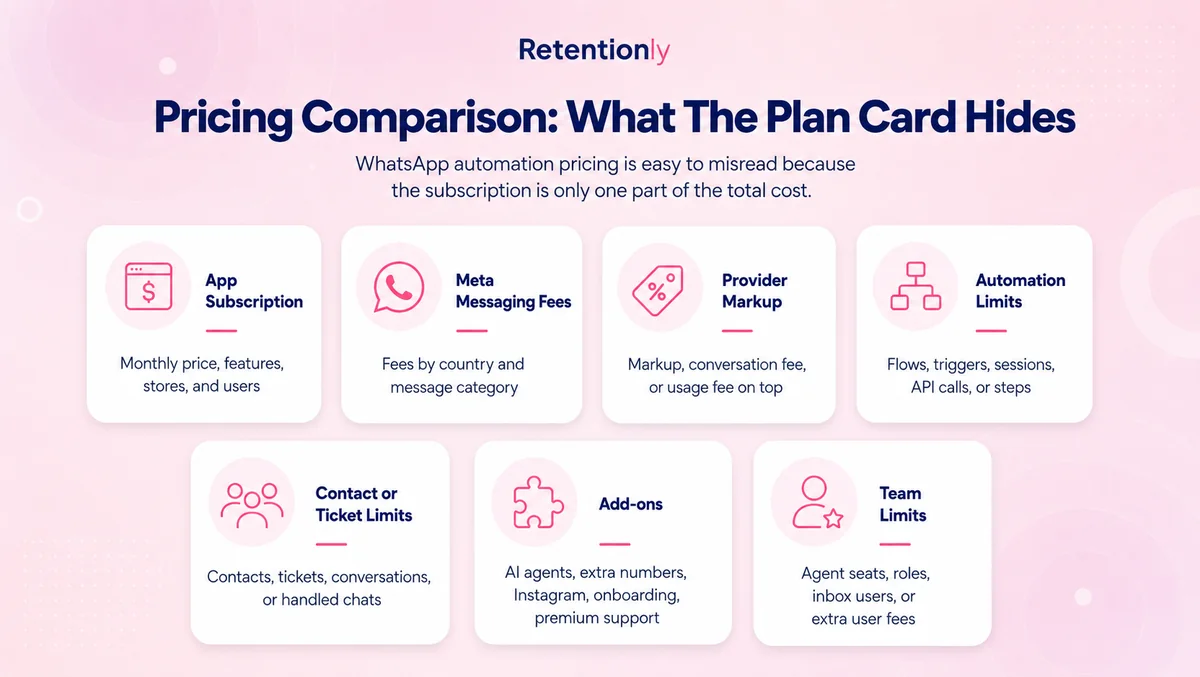
Here is the practical comparison:
| App | Public pricing pattern | What Shopify merchants should check |
|---|---|---|
| Retentionly | $24, $49, and $99/month plans; no Retentionly markup on Meta fees; no extra automation cost | Which plan fits your first workflows and whether Scale is needed for CRM/multi-agent chat |
| Zoko | Starts around $49.99/month; conversation markup or fair-use structure, agents, custom flows, AI, and channel add-ons may apply | Conversation volume, flow add-ons, AI agents, and team size |
| Wati | Growth, Pro, and Business plans; message charges and optional add-ons apply | Message fees, users, automation triggers, Shopify add-on needs, bots, and campaigns |
| Interakt | App Store plans have shown around $21-$51/month plus WhatsApp charges | Region, included channels, campaign needs, and advanced automation requirements |
| Dondy | Free and low-cost entry plans, with higher automation tiers around $79.99 and $159.99/month | Whether the needed automations require the higher tiers and what message rates apply |
| DelightChat | Starts at $29/month plus WhatsApp charges; plans scale by tickets, contacts, stores, and team needs | Whether support ticket/contact limits fit your operating model |
The best pricing model is not always the lowest starting price. It is the one that stays understandable when your flows are working and message volume grows.
Workflow Comparison
If your store is choosing a WhatsApp app for revenue, compare apps by workflow depth.
| Workflow | What the app must handle | Why it matters |
|---|---|---|
| Abandoned checkout | Checkout trigger, cart link, timing, follow-up, stop on purchase, recovery tracking | Fastest revenue test for many stores |
| COD confirmation | COD order trigger, confirm/cancel replies, tags, fulfillment hold, RTO tracking | Reduces fake orders and fulfillment waste |
| Order updates | Order, fulfillment, shipping, delivery, and delay events | Reduces repetitive support questions |
| Review requests | Delivery-based timing, product-use window, review app handoff | Converts fulfilled orders into social proof |
| Winback | Last purchase date, customer segment, offer logic, suppression rules | Brings lapsed customers back |
| Reorder reminders | Product cycle, expected replenishment timing, prior purchase data | Drives repeat purchase for consumables |
| Post-purchase upsell | Product purchased, complementary product, timing, opt-out controls | Raises repeat revenue without blasting everyone |
| Broadcasts | Segments, consent, campaign calendar, reply ownership, opt-outs | Useful later, risky if used before automations |
For setup guidance, read the Shopify WhatsApp Integration Guide. For the broader strategy, read the Shopify WhatsApp Automation Guide.
When A Broad Platform Is The Better Choice
A broad WhatsApp platform is the better choice when WhatsApp is not just a retention channel.
Choose a broader platform when:
Support agents spend most of the day replying on WhatsApp.
Sales teams need lead assignment, chat routing, and manual follow-up.
Catalog selling inside WhatsApp is a major business motion.
You need advanced chatbot infrastructure across many use cases.
Multiple departments need one WhatsApp operations system.
In that case, Wati, Zoko, Interakt, Dondy, or DelightChat may fit depending on your team structure and region.
The key is to make that decision deliberately. Do not buy a broad platform just because it has more features if the first job is a Shopify retention flow.
When A Shopify Retention App Is The Better Choice
A Shopify retention automation app is the better choice when the channel owner is a founder, marketer, lifecycle manager, or ecommerce operator.
Choose this path when:
Your first goal is recovered revenue, not inbox consolidation.
You want WhatsApp messages triggered by Shopify events.
You need clear metrics per flow.
You want to avoid unnecessary chatbot or support setup before the first revenue workflow is live.
You care about retention economics as volume grows.
This is where Retentionly is designed to fit. It helps Shopify stores launch WhatsApp flows tied to customer lifecycle moments instead of turning WhatsApp into a broad operations project.
Final Recommendation
The best WhatsApp app for Shopify depends on the job.
If you want a storefront contact option, start with a chat button. If WhatsApp is a support and sales operation, compare broad platforms and helpdesks carefully. If your goal is Shopify retention, choose the app that makes lifecycle automation easiest to launch, measure, and improve.
For most Shopify stores, the first WhatsApp flow should be one of three things: abandoned checkout recovery, COD confirmation, or order updates. Those flows are concrete, measurable, and close to revenue or operational cost.
Once the first flow works, expand into reviews, winback, reorders, post-purchase upsells, and broadcasts. That is how WhatsApp becomes a retention channel instead of another campaign tool.
Install Retentionly free on Shopify if you want WhatsApp automations built around Shopify retention, repeat purchases, and lifecycle revenue without unnecessary platform complexity.
Quick FAQs
What is the best WhatsApp app for Shopify?
The best app depends on your goal. Retentionly is a strong fit for Shopify retention automation, while broader tools such as Zoko, Wati, Interakt, Dondy, and DelightChat may fit better for commerce, support, inbox, chatbot, or omnichannel operations.
Should I choose a WhatsApp chat button or automation app?
Choose a chat button if you only want shoppers to contact you. Choose an automation app if you want abandoned checkout recovery, COD confirmation, order updates, reviews, winback, reorder reminders, and post-purchase upsells.
Do Shopify WhatsApp apps charge Meta messaging fees?
Most automation-focused WhatsApp apps rely on WhatsApp Business Platform messaging fees in some form. Always check whether the app passes Meta fees directly, adds a markup, charges per conversation, or uses another usage model.
Which WhatsApp workflow should a Shopify store launch first?
Most stores should start with abandoned checkout recovery because it targets existing buying intent. COD-heavy stores may start with COD confirmation. Stores with high support volume may start with order and shipping updates.
Is Retentionly only for small Shopify stores?
No. Retentionly is built for Shopify and D2C teams that want retention automation. Lean setup helps smaller teams, but the main advantage is Shopify-first lifecycle workflows and clearer WhatsApp economics.