Best Zoko Alternative for Ecommerce Teams Needing WhatsApp Sales Automation and Team Inbox
TL;DRThe best Zoko alternative for ecommerce teams needing WhatsApp sales automation and a team inbox is not automatically the platform with more features. It is the platform that decides which customer moments should be automated, which replies need a person, and how both paths lead back to a Shopify order.
Zoko is a credible option for that job. It combines Shopify catalog selling, campaigns, automation flows, AI agents, routing, and a shared inbox in a broad WhatsApp commerce platform. Retentionly is the more focused alternative when the team's priority is Shopify retention: recover checkouts, confirm COD orders, send order updates, win back customers, request reviews, and turn valuable replies into owned conversations.
The practical choice is therefore not “automation or inbox.” Ecommerce teams need both. The real decision is whether WhatsApp should become a broad sales-and-support workspace or a focused retention channel with a clear automation-to-agent handoff.
Quick Verdict
Choose Zoko when your team wants WhatsApp to handle catalog selling, marketing, support, AI-assisted conversations, advanced routing, and sales operations from one platform.
Choose Retentionly when Shopify events should drive the automation strategy and the inbox exists to help agents resolve the replies those retention workflows create.
| Buying question | Zoko | Retentionly |
|---|---|---|
| Primary operating model | Broad WhatsApp commerce, sales, marketing, support, catalog, AI, and team inbox | Shopify and D2C retention automation with inbox workflows |
| Sales automation | Shopify-connected broadcasts, flows, catalog selling, cart recovery, COD, upsells, and AI agents | Shopify-triggered abandoned checkout, COD, order, review, winback, reorder, and upsell workflows |
| Team inbox | Multi-agent inbox with handovers, teams, notes, chat assignment, and routing | WhatsApp Inbox on Growth; multi-agent CRM inbox, assignment, notes, and history on Scale |
| Best-fit team | Teams running WhatsApp as a broad commerce and customer-operations channel | Ecommerce teams that want retention workflows to own the channel strategy |
| Main tradeoff | More breadth to configure, operate, and price | A narrower focus that may not replace advanced commerce, AI, or routing needs |
Why Ecommerce Teams Outgrow Basic WhatsApp Automation
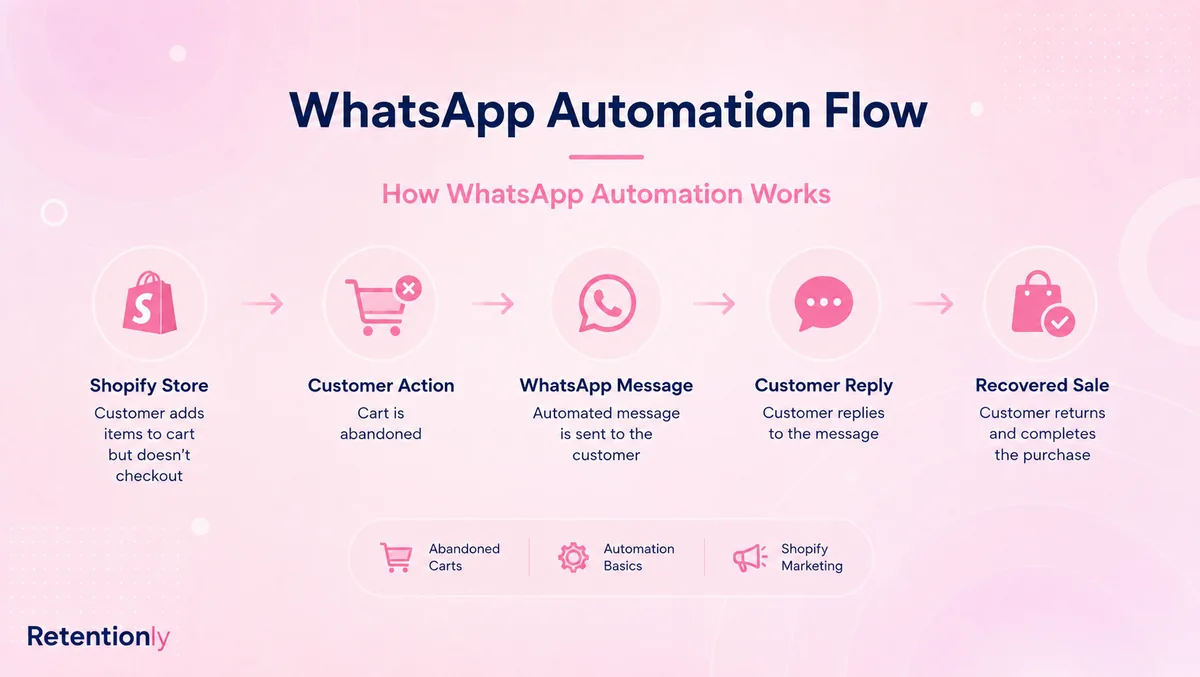
Early WhatsApp automation is usually simple: send an abandoned checkout reminder, confirm a COD order, or notify a customer that an order shipped. The operating problem appears when customers reply.
A shopper may ask whether a size is available before completing a recovered checkout. A COD customer may want to change the delivery address. A winback recipient may need help choosing a replacement product. At that moment, the workflow stops being a message and becomes a sales conversation.
That creates four requirements:
The automation must start from the right Shopify event and stop when the goal is complete.
The reply must appear in a shared inbox instead of one employee's phone.
The conversation must have a clear owner with enough customer and order context.
The team must connect the interaction to the intended commercial outcome.
An automation tool without an inbox leaves valuable replies unmanaged. An inbox without lifecycle automation makes agents do repetitive work. The best system joins the two without forcing the team to operate features it does not need.
Zoko's Strength: A Broad WhatsApp Sales Workspace
Zoko is designed for Shopify and D2C commerce, not merely generic support messaging. Its current Shopify App Store listing describes campaigns built from Shopify segments, abandoned cart recovery, order notifications, catalog purchasing inside WhatsApp, AI bots, and a multi-agent shared inbox.
Its team controls are meaningful. Zoko publicly documents agent credentials, roles, teams, chat assignment, private notes, handovers, priority rules, and automatic chat distribution. That makes it a serious option when sales and support teams share one WhatsApp number and managers need routing depth.
Zoko also goes beyond retention automation. Catalog sync and in-chat purchasing can make WhatsApp part of the storefront. AI agents can handle FAQs, order-status questions, or sales tasks. Click-to-WhatsApp ads, broadcasts, detailed analytics, APIs, and webhooks broaden the operating surface further.
Those are real strengths. They also explain the buying tradeoff. A store that needs a large WhatsApp commerce operation can benefit from that breadth. A team that mainly wants a disciplined set of Shopify retention flows may be buying and administering a wider platform than its first priorities require.
Retentionly's Strength: Automation First, Inbox When It Matters
Retentionly starts with the Shopify customer lifecycle. The product is organized around revenue and retention moments rather than around building an all-purpose WhatsApp operations desk.
That focus changes the setup question. Instead of asking which modules to turn on, the team asks which revenue leak or customer moment to fix first. Common starting points include:
| Shopify moment | Automation's job | When the team inbox matters |
|---|---|---|
| Abandoned checkout | Remind the shopper with the relevant checkout path | Product, delivery, payment, or discount questions block purchase |
| COD order | Request confirmation or offer a prepaid option | The customer needs to change details or explain an exception |
| Order update | Send timely confirmation, shipping, and delivery messages | A delay, address issue, or failed delivery needs human help |
| Winback | Reach an inactive customer with a relevant reason to return | The customer wants advice before choosing the next product |
| Review request | Ask at the right post-delivery moment | Feedback needs acknowledgement or service recovery |
| Reorder reminder | Prompt a repeat purchase based on expected usage | The customer needs a variant, quantity, or subscription answer |
| Post-purchase upsell | Recommend a relevant complementary product | The shopper wants compatibility or usage guidance |
This is a narrower operating model than Zoko's. For the right ecommerce team, that is the advantage. The automations define why conversations exist, and the inbox gives people a place to handle the exceptions and sales opportunities that deserve attention.
WhatsApp Sales Automation Comparison
Both platforms support Shopify-connected WhatsApp automation, so the useful comparison is not a row of generic checkmarks. Compare how each platform expects the team to design and own the work.
| Capability | Zoko | Retentionly | What the buyer should test |
|---|---|---|---|
| Abandoned checkout | Supported through ecommerce flows | Core Shopify retention workflow | Trigger timing, stop conditions, checkout context, and reporting |
| COD confirmation | Supported, including essential and premium flow options | Core ecommerce automation use case | Confirmation paths, no-response handling, and prepaid conversion |
| Order notifications | Supported for shipped, delivered, and cancelled events | Shopify-triggered order updates | Event accuracy and reduction in repetitive support work |
| Broadcast campaigns | Shopify-segmented broadcasts | Available on Growth and Scale | Segmentation, exclusions, consent, and attributed outcomes |
| Winback and reorder | Supported through ecommerce flows | Part of the retention workflow focus | Audience rules, timing, suppression, and repeat-order measurement |
| Catalog and in-chat selling | A core Zoko strength | Not the primary product proposition | Whether customers actually need to browse and buy inside WhatsApp |
| AI sales agents | Available as add-ons for defined jobs | Not a published core proposition | Whether AI autonomy is required now or adds another system to manage |
| Workflow philosophy | Broad commerce automation and extensible flows | Focused Shopify lifecycle automations | Which model matches the team's next 90 days of work |
If catalog selling, AI-led ordering, or custom multi-department automation is central, Zoko may be the stronger platform. If the immediate commercial job is to launch and improve a focused set of retention automations, Retentionly may be easier to operate consistently.
Team Inbox Comparison
A team inbox should be evaluated through a real customer reply, not through the phrase “multi-agent.” Ask each vendor to demonstrate what happens after an automated message creates a conversation.
Zoko's public materials describe a mature inbox model: multiple agents on one number, team assignment, private notes, handovers, manual assignment, roles, priority rules, and auto-distribution. It is the safer choice when queue routing, workload distribution, granular team structure, and agent analytics are firm requirements.
Retentionly includes a WhatsApp Inbox on Growth. Scale adds a multi-agent WhatsApp CRM inbox, chat assignment, internal notes, conversation history, and dedicated account management. That is a good fit when a Shopify retention or support team needs clear ownership and context but does not require Zoko's broader routing and AI surface.
| Inbox decision | Ask during the demo |
|---|---|
| Conversation origin | Can the agent see which campaign or automation caused the reply? |
| Ownership | Can the team quickly identify unassigned and assigned conversations? |
| Shopify context | Can the agent understand the customer, order, and intended workflow outcome? |
| Collaboration | Are notes, history, handovers, and reassignment clear? |
| Routing | Do you need automatic load balancing, priority rules, and several departments? |
| Measurement | Can managers connect handled conversations to orders or retention outcomes? |
The inbox should shorten the path from customer question to resolved purchase. If the team spends more time administering routing than improving customer outcomes, the operating model is too heavy. If important replies regularly sit unowned, it is too light.
Pricing: Compare the Whole Operating Model
Zoko's public pricing currently starts at $49.99 per month. Higher plans add different conversation allowances, calling allowances, included agents, and overage rules. The Starter plan lists a per-conversation markup, while Plus, Elite, and Max list no markup within their allowances. Instagram, premium flows, flow-step usage, and AI agents can add separate costs depending on what the team uses.
Retentionly has three Shopify-billed plans:
| Retentionly plan | Price | Relevant team capability |
|---|---|---|
| Basic | $24/month | Core Shopify WhatsApp automations |
| Growth | $49/month | Advanced automations, WhatsApp Inbox, broadcasts, and advanced analytics |
| Scale | $99/month | Multi-agent CRM inbox, chat assignment, internal notes, conversation history, and dedicated account management |
Meta message fees are separate, and Retentionly does not add a markup to them.
Do not compare only the first subscription number. Build a 90-day cost model that includes the chosen plan, WhatsApp message fees, expected conversation volume, required agents, premium or custom flows, AI usage, channel add-ons, and the internal time needed to operate the system.
Zoko may deliver better value when the team actively uses its catalog, routing, AI, and broad commerce features. Retentionly may deliver better value when the team wants Shopify retention automation plus an inbox without paying for a wider sales platform.
A Practical 90-Day Evaluation
Use the same three workflows in both product demonstrations: abandoned checkout recovery, a winback campaign, and a COD confirmation flow. Then introduce a customer reply into each workflow.
Score what happens from start to finish:
| Stage | Evidence to request |
|---|---|
| Trigger | The exact Shopify event or segment that starts the workflow |
| Timing | Wait periods, quiet hours, and send rules |
| Message | Personalization, template ownership, and checkout or order context |
| Stop rule | What prevents an irrelevant follow-up after purchase or confirmation |
| Reply | Where the response appears and how the right agent sees it |
| Handoff | Assignment, notes, history, and unresolved-conversation visibility |
| Outcome | The order, confirmation, review, repeat purchase, or revenue result |
| Improvement | The report the team will use to change the workflow next week |
The winning product should make these loops easier to repeat after the demo. A polished catalog or dashboard matters less than whether the team can launch the workflow, own the replies, and improve the result without vendor dependence.
For a deeper automation selection framework, read the best WhatsApp automation tool guide. If the inbox is the harder requirement, use the WhatsApp CRM for Shopify guide to define agent ownership and customer context first.
When Zoko Is the Better Fit
Choose Zoko when WhatsApp is meant to be a broad commerce and customer-operations channel. It is particularly relevant when catalog selling, in-chat ordering, AI agents, click-to-WhatsApp campaigns, sophisticated auto-distribution, several agent teams, and detailed agent reporting are part of the near-term plan.
Zoko can also be the better choice when sales and support teams live inside WhatsApp all day. Its routing depth and wider commerce layer can justify the additional operating surface when those capabilities are actively used.
When Retentionly Is the Better Zoko Alternative
Choose Retentionly when the team's WhatsApp roadmap starts with Shopify retention workflows and the inbox serves those workflows.
The fit is strongest when the team wants to recover abandoned checkouts, reduce COD risk, keep customers informed after purchase, collect reviews, bring inactive buyers back, and increase repeat orders. Growth adds the inbox, broadcasts, and advanced analytics; Scale adds multi-agent ownership and collaboration.
Retentionly is not the claim that ecommerce teams never need catalog selling, AI agents, or advanced routing. It is the decision to make retention workflow ownership the center of the system and add human handling where it improves the customer or revenue outcome.
Final Recommendation
Zoko is a strong Shopify WhatsApp commerce platform. Do not replace it because you assume it lacks automation or a capable team inbox; those are central parts of its product.
Evaluate an alternative when your team needs a different center of gravity. Choose Zoko when WhatsApp should become a broad sales, support, catalog, AI, and commerce workspace. Choose Retentionly when Shopify retention automation should determine which messages send, which replies reach the inbox, and which outcomes the team measures.
Install Free on Shopify and launch one workflow with a clear commercial goal. The best proof is not the number of features enabled. It is a relevant automation, an owned customer reply, and a Shopify outcome your team can improve.
Quick FAQs
What is the best Zoko alternative for ecommerce teams?
Retentionly is a strong Zoko alternative for Shopify and D2C teams focused on retention automation, broadcasts, and inbox workflows. Zoko may remain the better fit for broader WhatsApp commerce, catalog selling, AI agents, and advanced routing.
Does Zoko include a team inbox?
Yes. Zoko publicly offers a multi-agent inbox with teams, handovers, private notes, assignment, roles, priority rules, and auto-distribution. Buyers should compare that depth with the simpler inbox ownership their team will actually use.
Can Retentionly handle customer replies from automations?
Retentionly's Growth plan includes a WhatsApp Inbox for customer replies. Scale adds a multi-agent CRM inbox, chat assignment, internal notes, conversation history, and dedicated account management.
Which platform is better for WhatsApp sales automation?
Zoko is stronger when sales automation includes catalog commerce, AI agents, advanced flows, and a broad team workspace. Retentionly is stronger when sales automation means Shopify-triggered retention workflows such as checkout recovery, COD confirmation, winback, reorder, review, and upsell.
What should a team compare before switching from Zoko?
Compare the Shopify triggers you need, inbox ownership, routing depth, agent context, catalog or AI requirements, reporting, total pricing structure, Meta fees, add-ons, and the workflows the team can realistically launch in the next 90 days.