Wati WhatsApp Business API: Is It Right for Ecommerce Automation?
TL;DRWati WhatsApp Business API can be a strong option when your business wants WhatsApp to support sales, support, campaigns, chatbots, and ecommerce conversations from one platform. For Shopify and D2C teams, the decision is more specific: do you need a broad WhatsApp operations layer, or do you need Shopify-triggered retention automation that starts earning back revenue quickly?
That distinction matters. A merchant looking at Wati for WhatsApp Business API is not only buying API access. They are choosing who owns setup, templates, campaigns, inboxes, automations, message costs, customer replies, and performance measurement.
Quick Verdict
Choose Wati if WhatsApp needs to become a broad communication platform for marketing, sales, support, AI chatbots, team inbox operations, campaigns, and ecommerce messaging.
Choose Retentionly if the main job is Shopify retention automation: abandoned checkout recovery, COD confirmation, order updates, review requests, winback campaigns, reorder reminders, post-purchase upsells, and repeat purchase flows.
| Decision area | Wati WhatsApp Business API | Retentionly |
|---|---|---|
| Best fit | Broad WhatsApp operations across teams | Shopify and D2C retention automation |
| Main buyer question | "How do we manage WhatsApp as a business communication layer?" | "How do we recover and grow Shopify revenue with lifecycle flows?" |
| Setup scope | API setup, inbox, campaigns, automations, integrations, users, add-ons | Shopify-triggered WhatsApp flows and revenue workflows |
| Pricing model to inspect | Subscription, message fees, automation limits, users, add-ons, Shopify needs | Fixed plans, direct Meta connection, no Retentionly markup on Meta fees |
| Strongest use case | Multi-team WhatsApp operations | Store-event automation tied to retention revenue |
Wati is not the wrong answer by default. The question is whether its breadth matches the job your ecommerce team actually needs done.
What Wati WhatsApp Business API Actually Means
Wati is a WhatsApp Business API platform. In practical terms, it helps businesses connect to official WhatsApp messaging infrastructure, run campaigns, manage conversations, use chatbots, work from a team inbox, and connect ecommerce or CRM systems.
For ecommerce teams, that can include:
WhatsApp campaigns to opted-in customers.
Abandoned cart and checkout reminders.
Order, shipping, and fulfillment notifications.
Product catalog and commerce workflows.
Support replies through a shared inbox.
Chatbot and automation rules.
Team assignment, reporting, and AI-assisted workflows.
That is useful breadth. But it also means Wati is not just a Shopify retention app. It is a broader WhatsApp operating layer. If your team wants that layer, evaluate it as a platform. If you only need Shopify lifecycle automation, evaluate whether the platform surface is more than you need.
The Ecommerce Automation Test
Before choosing Wati, Retentionly, or any WhatsApp Business API tool, test the product against one real ecommerce flow.
Use abandoned checkout recovery if lost checkout revenue is the main pain. Use COD confirmation if fake or uncertain COD orders create fulfillment cost. Use order updates if support tickets are high. Use winback if repeat purchase is the problem.
| Workflow question | What a strong answer should cover |
|---|---|
| Trigger | Which Shopify event starts the flow: checkout abandoned, order created, fulfilled, delivered, canceled, refunded, or customer inactive? |
| Audience | Which customers are eligible, opted in, suppressed, tagged, or excluded? |
| Timing | When does the first message send, and when should follow-ups stop? |
| Template | Which approved WhatsApp template sends, with which Shopify variables? |
| Reply path | Who sees customer replies, and with what order/customer context? |
| Fallback | Does the flow stop after purchase, reply, opt-out, cancellation, refund, or support escalation? |
| Metric | What proves the flow worked: recovered revenue, confirmation rate, repeat orders, reviews, support reduction, or opt-outs? |
This test keeps the buying decision grounded. A product can offer API access, campaigns, inboxes, and AI, but the ecommerce value comes from whether a specific Shopify workflow runs cleanly.
Pricing And Operating Model: What To Check
Wati pricing should be evaluated as a model, not only as a visible monthly plan. Public Wati materials describe pricing around subscription fees, messaging fees, and optional add-ons. Its current plan structure includes Growth, Pro, and Business plans, with message charges handled separately and usage details such as automation triggers, users, integrations, API calls, AI credits, and Shopify-related functionality varying by plan or billing setup.
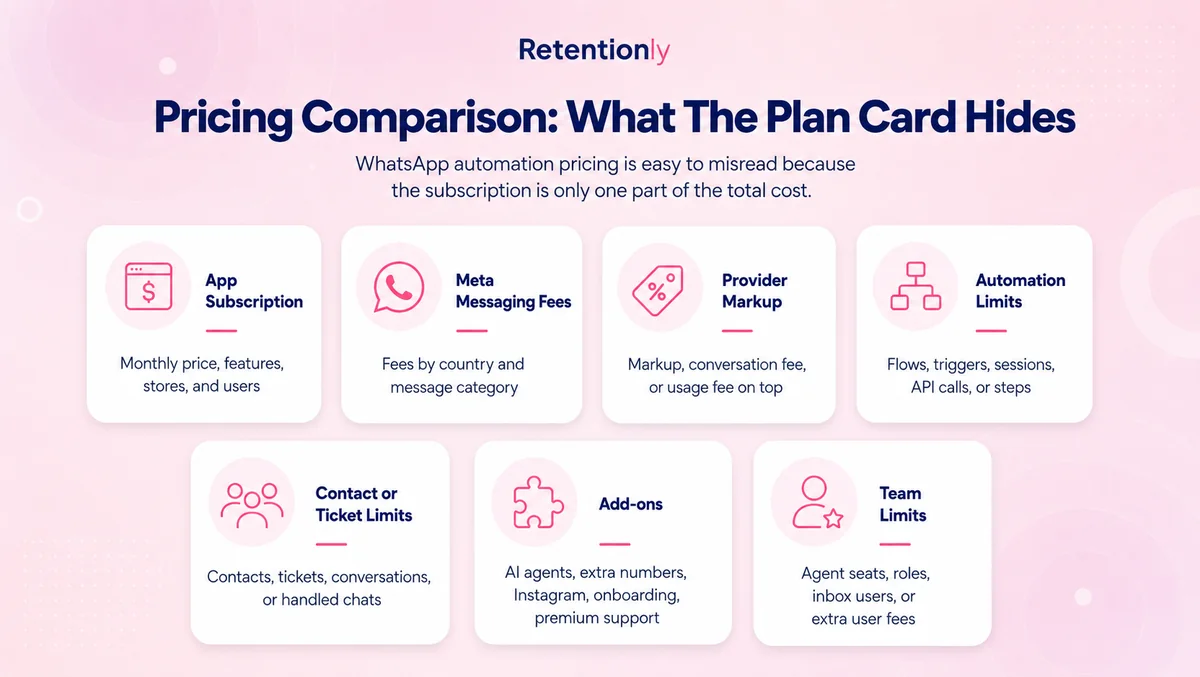
For a Shopify merchant, the important question is not "What does Wati cost on the plan card?" It is "What will our actual WhatsApp automation system cost after messages, users, add-ons, triggers, and Shopify workflows are live?"
| Cost layer | Why it matters |
|---|---|
| Subscription | The base plan affects feature access, users, integrations, support, and workflow limits. |
| WhatsApp message fees | Costs depend on message category, destination market, and volume. |
| Automation triggers | Checkout, cart, order, and campaign automations can trigger frequently once active. |
| Users and teams | Support-heavy teams may need more seats, assignment rules, or reporting. |
| Shopify functionality | Some Shopify commerce features may require the right plan, setup path, or add-on. |
| AI and chatbot usage | Useful for support and sales, but not always required for retention-only workflows. |
| Support and onboarding | API setup and template approval can slow down launch if ownership is unclear. |
This structure is not automatically a drawback. It can be the right model for teams that want WhatsApp across marketing, sales, support, ads, and operations. It is a poor fit only when a merchant mainly wants a few high-value retention workflows and does not want the overhead of a broader platform.
Wati Vs Retentionly For Shopify Retention
Feature comparisons get noisy unless they are tied to the workflows a store will actually run. For Shopify teams, the useful comparison is how each tool supports store-event automation, ownership, and revenue measurement.
| Shopify workflow or buying criterion | Wati | Retentionly |
|---|---|---|
| Abandoned checkout recovery | Supported through ecommerce and Shopify automation capabilities | Core Shopify retention workflow |
| COD confirmation | Useful where configured for ecommerce operations | Core Shopify/D2C workflow |
| Order and shipping updates | Supported as part of commerce messaging | Built into lifecycle automation planning |
| Review requests | Possible through campaigns and automation | Core post-purchase retention use case |
| Winback campaigns | Possible through campaigns, segmentation, and automation | Growth plan includes advanced automations such as winback |
| Post-purchase upsell | Possible through campaigns and customer targeting | Designed as a repeat revenue flow |
| Shared inbox | Strong platform fit | Available where conversation handling is part of the plan |
| Chatbots and AI | Stronger broad platform surface | Not the main reason to choose Retentionly |
| Pricing clarity for retention flows | Requires checking plan, message charges, limits, users, and add-ons | Simpler plans for Shopify retention workflows |
| Best team fit | Marketing, support, sales, and operations teams using WhatsApp widely | Shopify founders, marketers, ecommerce managers, and retention teams |
Retentionly pricing is intentionally simpler:
| Retentionly plan | Price | Best for |
|---|---|---|
| Basic | $24/month | Core WhatsApp automations and basic features |
| Growth | $49/month | Broadcasts and advanced automations such as winback |
| Scale | $99/month | CRM features and multi-agent chat |
Retentionly connects directly to Meta and does not add a markup on Meta messaging fees. It also does not charge extra for added automations and does not charge per-chat fees.
That changes the buying frame. With Wati, you should model the broader platform cost. With Retentionly, you should model the revenue impact of the retention flows you want to launch.
When Wati Is The Better Fit
Wati can be the better choice when WhatsApp is central to several teams, not only the retention team.
It is worth serious consideration when you need a shared inbox, chatbots, campaigns, sales follow-up, support operations, AI assistance, click-to-WhatsApp ads, multiple integrations, and ecommerce messaging in one broader system. If support agents, sales reps, marketers, and operations staff all need to work from WhatsApp every day, Wati's platform breadth can be valuable.
Wati also makes sense when your team wants more control over multi-channel communication logic. For example, some brands may want WhatsApp, RCS, and SMS fallback decisions across markets, with more conditional automation and team routing.
In those cases, compare Wati by total platform value. The subscription and add-ons matter, but so does the cost of stitching together separate systems for inbox, campaigns, chatbot, and ecommerce notifications.
When Retentionly Is The Better Fit
Retentionly is the better fit when the job is narrower and more revenue-specific: launch Shopify WhatsApp automations that recover checkouts, reduce COD risk, keep customers updated, drive reviews, win back inactive buyers, and increase repeat purchases.
That matters for lean ecommerce teams. A founder or marketer may not want to become an API operator, inbox admin, chatbot architect, and pricing analyst before launching the first flow. They need clear lifecycle automations tied to Shopify events and revenue outcomes.
Retentionly is strongest when the first question is:
| Store problem | Retentionly workflow |
|---|---|
| Too many abandoned checkouts | WhatsApp checkout recovery with stop-on-purchase logic |
| COD orders create avoidable fulfillment risk | COD confirmation before dispatch |
| Customers ask "Where is my order?" | Order and shipping update automations |
| Happy customers do not leave reviews | Review request flows after delivery |
| Customers buy once and disappear | Winback and repeat purchase campaigns |
| Post-purchase revenue is underused | Upsell and reorder reminders |
If those are the workflows your team cares about first, a Shopify-first retention tool is usually easier to justify than a broad WhatsApp platform.
A Practical Evaluation Checklist
Before committing to Wati WhatsApp Business API, run this checklist with your actual store numbers.
| Question | Why it matters |
|---|---|
| Which three Shopify flows must launch first? | Prevents buying a broad platform before proving retention value. |
| How many messages will those flows send monthly? | Message fees scale with volume and category. |
| How many team members need inbox access? | Seat limits can change the real plan requirement. |
| Which automations need advanced conditions? | Trigger limits and workflow features affect plan fit. |
| Do you need chatbots or AI agents now? | Helpful for support, but not always needed for retention workflows. |
| Does Shopify functionality require a specific plan or add-on? | Avoids underestimating the setup cost. |
| Who owns template approval and troubleshooting? | API setup delays can block the first campaign. |
| What metric decides success in 30 days? | Recovered revenue, confirmation rate, repeat orders, review volume, or support reduction should be clear. |
If you cannot answer these questions yet, start with a single workflow. A focused abandoned checkout, COD, or order update flow will teach you more than a long platform feature comparison.
Recommended Path For Ecommerce Teams
For most Shopify stores, the best path is not "buy the biggest WhatsApp Business API platform." It is "choose the smallest complete system that can run the next revenue workflow properly."
Use Wati when WhatsApp needs to become a company-wide communication platform. Use Retentionly when WhatsApp should become a Shopify retention channel first.
That is the honest decision. Wati has breadth. Retentionly has focus. The better choice depends on whether your next 90 days are about building a broad WhatsApp operations stack or launching retention workflows that can pay for themselves.
If your priority is Shopify-triggered WhatsApp automation, install Retentionly and start with the flows closest to revenue: abandoned checkout recovery, COD confirmation, order updates, winback, review requests, and repeat purchase campaigns.
Quick FAQ
Is Wati WhatsApp Business API good for ecommerce?
Wati can be good for ecommerce teams that want a broad WhatsApp platform covering campaigns, inboxes, chatbots, support, sales, and ecommerce messaging. Shopify teams should still check whether the specific retention workflows they need are easy to launch and measure.
Is Wati the same as WhatsApp Business API?
No. WhatsApp Business API, now commonly discussed as the WhatsApp Business Platform, is Meta's infrastructure for scalable business messaging. Wati is a platform that helps businesses use that infrastructure through product features such as inboxes, campaigns, automation, and integrations.
What should Shopify stores compare before choosing Wati?
Compare the plan requirement, message fees, automation trigger limits, users, Shopify functionality, add-ons, onboarding, template support, reply handling, and reporting. Then map those costs against the exact flows you plan to launch.
When is Retentionly a better Wati alternative?
Retentionly is a better fit when the main goal is Shopify retention automation rather than a broad WhatsApp operations platform. That includes abandoned checkout recovery, COD confirmation, order updates, reviews, winback, post-purchase upsells, and repeat purchase campaigns.
Do I need a WhatsApp Business API platform for one Shopify flow?
Not always. If you only need one Shopify-triggered retention flow, a focused Shopify WhatsApp automation app may be faster to launch. A broader platform makes more sense when multiple teams need campaigns, inboxes, chatbots, AI, and support operations in one place.