Best Wati Alternative for Shopify Stores in 2026
TL;DRIf you are looking for a Wati alternative for Shopify, the real question is not which WhatsApp product has the longest feature list. It is which tool is built around the customer moments that grow revenue for a D2C store.
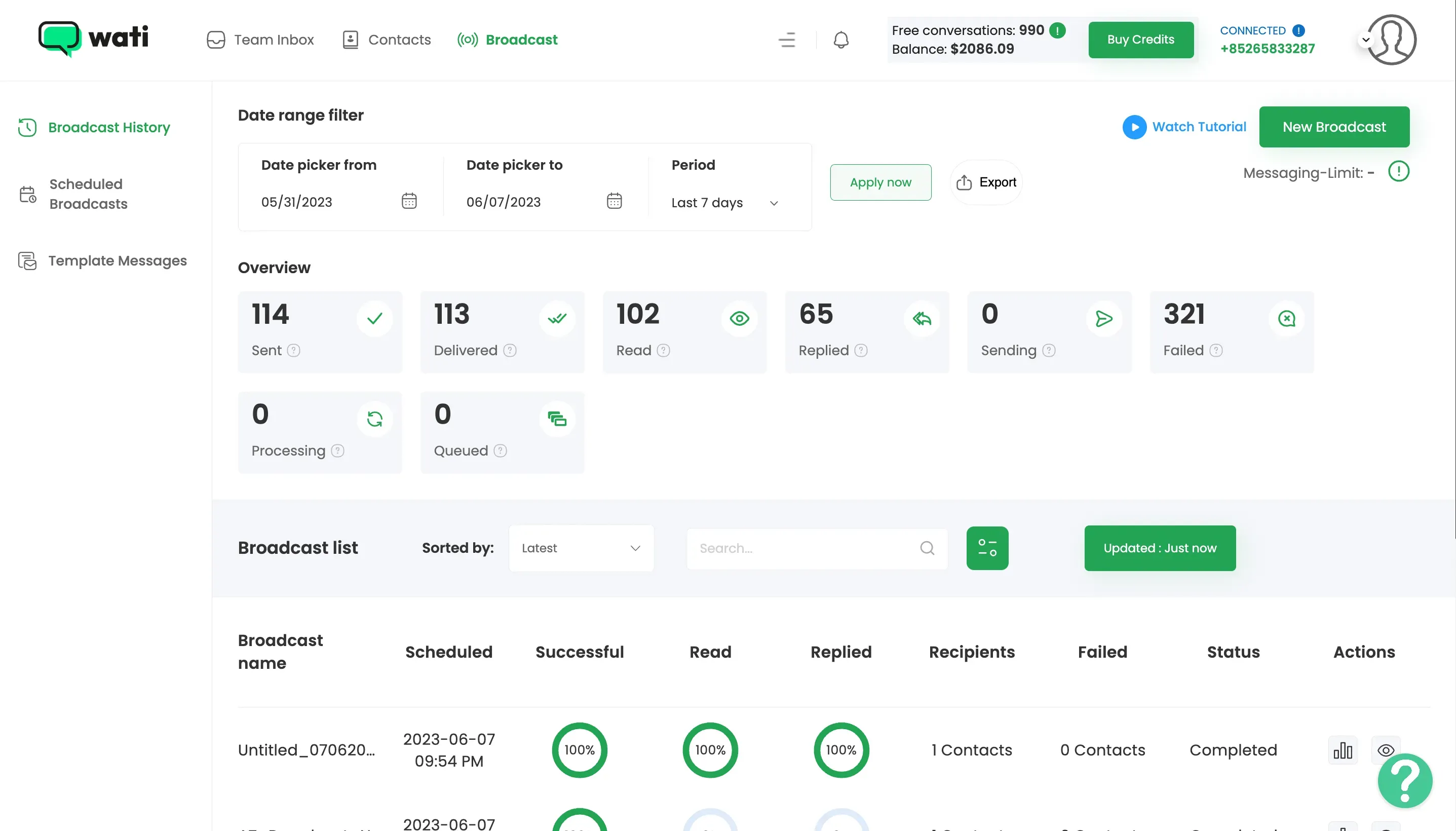
Wati is a serious WhatsApp Business platform. It can make sense when WhatsApp is a support inbox, chatbot layer, campaign tool, and sales channel for the whole business. But if your main goal is Shopify retention - abandoned checkout recovery, COD confirmation, order updates, winback, reviews, upsells, and repeat purchase - the buying criteria should be different.
Retentionly is built for that second job. It is Shopify and D2C-first, with WhatsApp automations designed around lifecycle revenue instead of broad WhatsApp operations.
Quick Verdict
Choose Wati if you want a broad WhatsApp operations platform with shared inboxes, chatbots, campaigns, add-ons, and multi-use communication workflows across teams.
Choose Retentionly if you want Shopify-triggered WhatsApp automation for retention, repeat revenue, and D2C lifecycle flows without turning WhatsApp into another complicated system to manage.
| Best fit | Wati | Retentionly |
|---|---|---|
| Primary use case | Broad WhatsApp support, sales, campaigns, and operations | Shopify/D2C retention automation |
| Strongest buyer | Support, sales, and operations teams using WhatsApp widely | Shopify founders, marketers, and retention teams |
| Core question | "How do we manage WhatsApp conversations and campaigns?" | "How do we recover and grow Shopify revenue with WhatsApp flows?" |
| Main advantage | Breadth of WhatsApp platform features | Focused Shopify workflows and clearer revenue use cases |
Pricing Comparison: Look Beyond The Monthly Plan
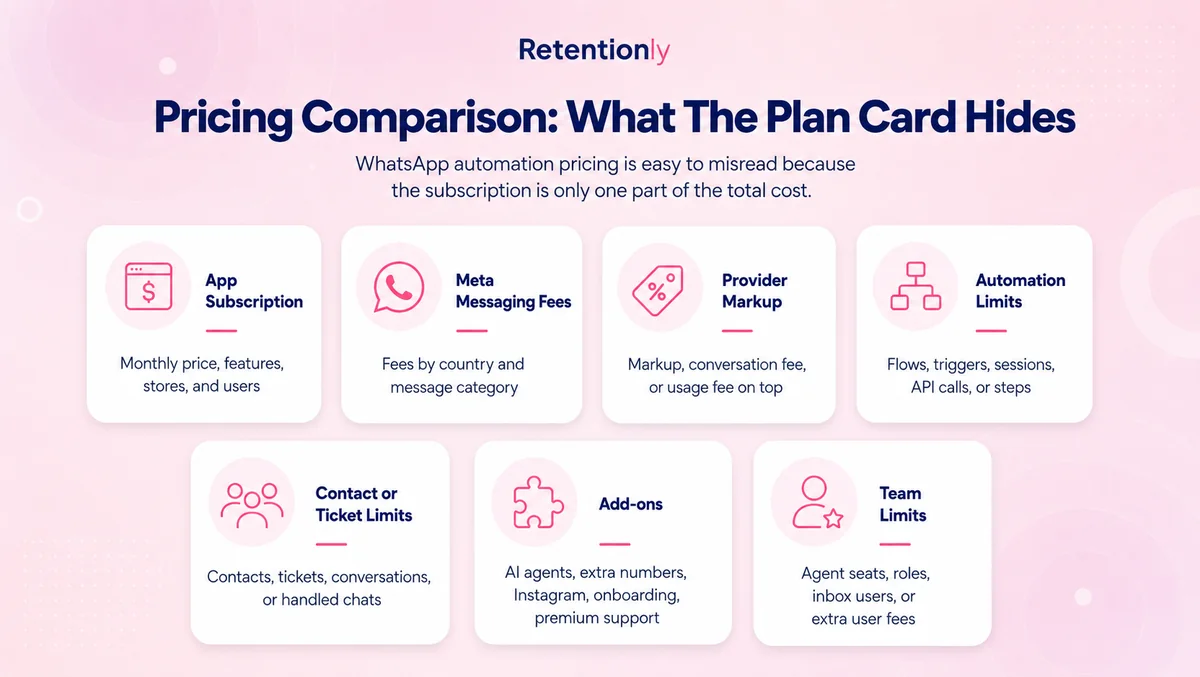
Pricing matters because WhatsApp costs scale with volume. A plan that looks fine at low usage can feel very different once you add messages, automations, users, add-ons, and Shopify-specific workflows.
Retentionly pricing is intentionally simple:
| Retentionly plan | Price | Best for |
|---|---|---|
| Basic | $24/month | Core WhatsApp automations and basic features |
| Growth | $49/month | Broadcasts and advanced automations such as winback |
| Scale | $99/month | CRM features and multi-agent chat |
Retentionly connects directly to Meta and does not add a markup on Meta messaging fees. There is also no added cost for more automations and no per-chat fee. For D2C teams, that makes the bill easier to understand as WhatsApp becomes a serious retention channel.
Wati pricing has more moving parts. Its help center describes three core components: subscription fee, messaging fees, and optional add-ons. Wati also uses message-based pricing, requires credit balance for paid messages, and offers add-ons such as chatbot sessions, keyword automation, AI KnowBot, team or user expansion, custom domain, and dedicated hosting. Wati's current plans include Growth, Pro, and Business.
That structure is not automatically bad. It can be useful when a company wants to customize a broad WhatsApp setup. But Shopify and D2C brands should compare the total operating cost, not just the first plan card.
| Pricing question | Wati | Retentionly |
|---|---|---|
| Base subscription | Growth, Pro, and Business plans | Basic $24, Growth $49, Scale $99 |
| WhatsApp/Meta fees | Message-based fees and credit balance | Direct Meta connection, no Retentionly markup on Meta fees |
| Add-ons | Optional add-ons can affect total cost | No extra cost for added automations |
| Per-chat fees | Buyer should verify based on plan and usage | No per-chat fees |
| Shopify/D2C cost clarity | Depends on plan, add-ons, users, automation volume, and message usage | Easier to forecast for retention automation |
The practical pricing takeaway is simple: if you need a full WhatsApp operations system, Wati's modular pricing may fit. If you want Shopify retention flows with cleaner economics, Retentionly is the more focused comparison.
Feature Comparison
Feature lists can get noisy. A Shopify brand does not need every possible WhatsApp feature first. It needs the right features for the flows it will actually run.
| Feature or buying criterion | Wati | Retentionly |
|---|---|---|
| Shopify focus | Supports Shopify use cases and integrations | Built around Shopify and D2C retention |
| Abandoned checkout recovery | Supported through Shopify-related workflows | Core retention workflow |
| COD confirmation | Useful for ecommerce operations where configured | Core Shopify/D2C workflow |
| Order updates | Supported as part of commerce communication | Core lifecycle automation |
| Winback automation | Possible through campaign and automation setup | Growth plan includes advanced automations such as winback |
| Post-purchase upsell | Possible with campaigns and segmentation | Designed as a retention/repeat revenue flow |
| Review requests | Possible through WhatsApp campaigns | Built into lifecycle retention thinking |
| Broadcasts | Strong broad campaign capability | Included in Growth plan |
| Shared inbox | Strong fit for support teams | Available with CRM and multi-agent chat on Scale |
| Chatbots | Stronger broad chatbot platform fit | Not the main buying reason |
| Pricing clarity for D2C retention | More variables to forecast | Simpler plans, no Meta markup, no automation add-on cost |
| Best-fit team | Support, sales, operations, and WhatsApp-heavy teams | Shopify founders, marketers, retention teams, and D2C operators |
The difference is focus. Wati is broader. Retentionly is narrower in the way a growth tool should be: it is designed around the Shopify events that create or protect revenue.
Strengths And Weaknesses
Wati's strength is breadth. If your business wants WhatsApp as a company-wide communication layer, Wati gives you a shared inbox, campaigns, chatbot capabilities, commerce features, integrations, and add-ons that can support multiple departments. It is a credible choice for teams that want to centralize WhatsApp operations.
The weakness is that breadth can become overhead for a Shopify retention use case. A D2C brand may end up evaluating chatbot sessions, users, credits, automation trigger limits, add-ons, and inbox workflows before it has even launched the flows that matter most: checkout recovery, COD confirmation, delivery updates, winback, and repeat purchase.
Retentionly's strength is focus. It starts from the Shopify lifecycle and asks which WhatsApp messages should trigger at which revenue moments. That makes it a better fit when WhatsApp is not just a support channel, but a retention channel.
The tradeoff is that Retentionly is not trying to be the broadest WhatsApp platform for every department. If your team needs a large support inbox operation, general chatbot infrastructure, and broad sales/support workflows outside Shopify, Wati may still belong on the shortlist.
Shopify And D2C Workflow Comparison
The best Wati alternative for a Shopify store should be judged by the workflows it helps the team launch, not only by the feature names on the pricing page.
| Workflow | What the tool needs to understand | Better fit when retention is the goal |
|---|---|---|
| Abandoned checkout | Checkout state, cart context, stop conditions, recovered revenue | Retentionly |
| COD confirmation | COD order status, confirmation replies, cancellation paths, RTO risk | Retentionly |
| Order updates | Fulfillment state, delivery context, support fallback | Retentionly |
| Winback | Last purchase date, product cycle, buyer segment, repeat revenue | Retentionly |
| Post-purchase upsell | Product purchased, timing, complementary offer, attach rate | Retentionly |
| Reviews | Delivery timing, customer satisfaction path, review collection | Retentionly |
| Support inbox | Agent assignment, manual replies, shared team operations | Wati |
| General chatbot flows | Bot sessions, keyword triggers, multi-step conversations | Wati |
This is the clearest way to compare the two products. If the job is "manage WhatsApp as an operations channel," Wati is strong. If the job is "grow Shopify retention with lifecycle automation," Retentionly is the sharper choice.
Setup And Team Fit
Shopify and D2C teams move fast. The founder, marketer, retention manager, or ecommerce lead usually wants the first revenue flow live quickly, then wants to improve it with better timing, segmentation, and message copy.
Wati can work well when a team has broader WhatsApp requirements and someone owns setup across support, sales, campaigns, and automation. It gives the business more room to build a larger WhatsApp stack.
Retentionly fits when the team wants the starting point to be Shopify revenue. Instead of asking the team to build a general WhatsApp system first, the product starts closer to the actual D2C workflows: recover the checkout, confirm the COD order, update the buyer, win back the customer, ask for the review, and drive the next purchase.
When Wati Is Still The Better Fit
Wati can still be the better choice if WhatsApp is a broad operational channel for your business. That is especially true if your support team spends all day in WhatsApp, you need extensive chatbot setup, or multiple departments want to use the same WhatsApp platform for different jobs.
Wati is also worth evaluating if your team wants a flexible WhatsApp Business platform first and Shopify retention is only one use case inside a larger communication system.
When Retentionly Is The Better Wati Alternative
Retentionly is the better Wati alternative when your WhatsApp strategy is tied directly to Shopify and D2C growth.
The reason is not that Wati lacks features. It is that Shopify stores do not grow because a tool has more menu items. They grow when the right automation fires at the right customer moment and the economics are clear enough to scale.
Choose Retentionly when you want WhatsApp flows for abandoned checkout, COD confirmation, order updates, winback, post-purchase upsell, reviews, and repeat purchase without paying extra for added automations or managing unnecessary platform complexity.
Final Recommendation
If you need a broad WhatsApp support, sales, campaign, and chatbot platform, Wati is a strong product to evaluate.
If you are choosing a Wati alternative because your real goal is Shopify retention and D2C repeat revenue, Retentionly is the more focused challenger. It gives you simpler plan economics, no markup on Meta messaging fees, no per-chat fees, and automations built around the lifecycle moments that matter to a Shopify brand.
Start with the flows that can pay for themselves first: abandoned checkout recovery, COD confirmation, winback, reviews, and repeat purchase. That is where WhatsApp becomes a growth channel, not just another inbox.
Quick FAQs
Is Retentionly a direct replacement for Wati?
Retentionly is a Wati alternative for Shopify and D2C retention use cases. It is not trying to replace every broad WhatsApp support, chatbot, and operations workflow that Wati can support.
Which is better for Shopify abandoned checkout recovery?
Retentionly is the stronger fit if abandoned checkout recovery is part of a broader Shopify retention strategy. Wati can support Shopify-related workflows, but Retentionly is built around Shopify lifecycle automation from the start.
Does Retentionly charge a markup on Meta messaging fees?
No. Retentionly connects directly to Meta and does not add a markup on Meta messaging fees. That matters as WhatsApp message volume grows.
Is Wati better for support teams?
Often, yes. If your main need is a shared WhatsApp inbox, chatbot flows, and broad support operations, Wati may be the better fit. If your main need is retention revenue from Shopify events, Retentionly is more focused.
What should Shopify stores compare before choosing?
Compare the total cost structure, Shopify workflow depth, setup effort, automation limits, add-ons, Meta messaging fees, and whether the tool is built for broad WhatsApp operations or D2C retention automation.