Best Zoko Alternative for Shopify Stores in 2026
TL;DRIf you are looking for a Zoko alternative for Shopify, you are probably not asking whether WhatsApp can help your store. You are asking which WhatsApp tool should own your revenue workflows without making the stack harder to run.
Zoko is a credible Shopify-native WhatsApp platform. It covers marketing, sales, support, catalog sync, cart recovery, broadcasts, AI bots, and a multi-agent inbox. For some teams, that breadth is exactly the point.
But many Shopify founders, marketers, and ecommerce managers are not trying to build a broad WhatsApp commerce operation. They want abandoned checkout recovery, COD confirmation, order updates, winback, post-purchase upsells, review requests, and repeat purchase reminders to run cleanly. That is where Retentionly is the sharper Zoko alternative.
Quick Verdict
Choose Zoko if you want a broader WhatsApp commerce platform with catalog sync, shared inbox workflows, broadcasts, AI bots, and team conversation management alongside Shopify automations.
Choose Retentionly if your priority is Shopify retention automation with simpler pricing, no Retentionly markup on Meta messaging fees, no per-chat fees, and workflows built around repeat revenue.
| Best fit | Zoko | Retentionly |
|---|---|---|
| Primary use case | WhatsApp commerce, support, marketing, inbox, catalog, and automation | Shopify/D2C retention automation |
| Strongest buyer | Teams that want WhatsApp as a full commerce and conversation platform | Shopify founders, marketers, and ecommerce managers focused on lifecycle revenue |
| Core question | "How do we manage WhatsApp commerce and conversations in one place?" | "How do we recover and grow Shopify revenue with retention flows?" |
| Main advantage | Broad Shopify WhatsApp platform coverage | Focused retention workflows and cleaner operating economics |
Pricing Comparison: Compare The Full Cost Structure
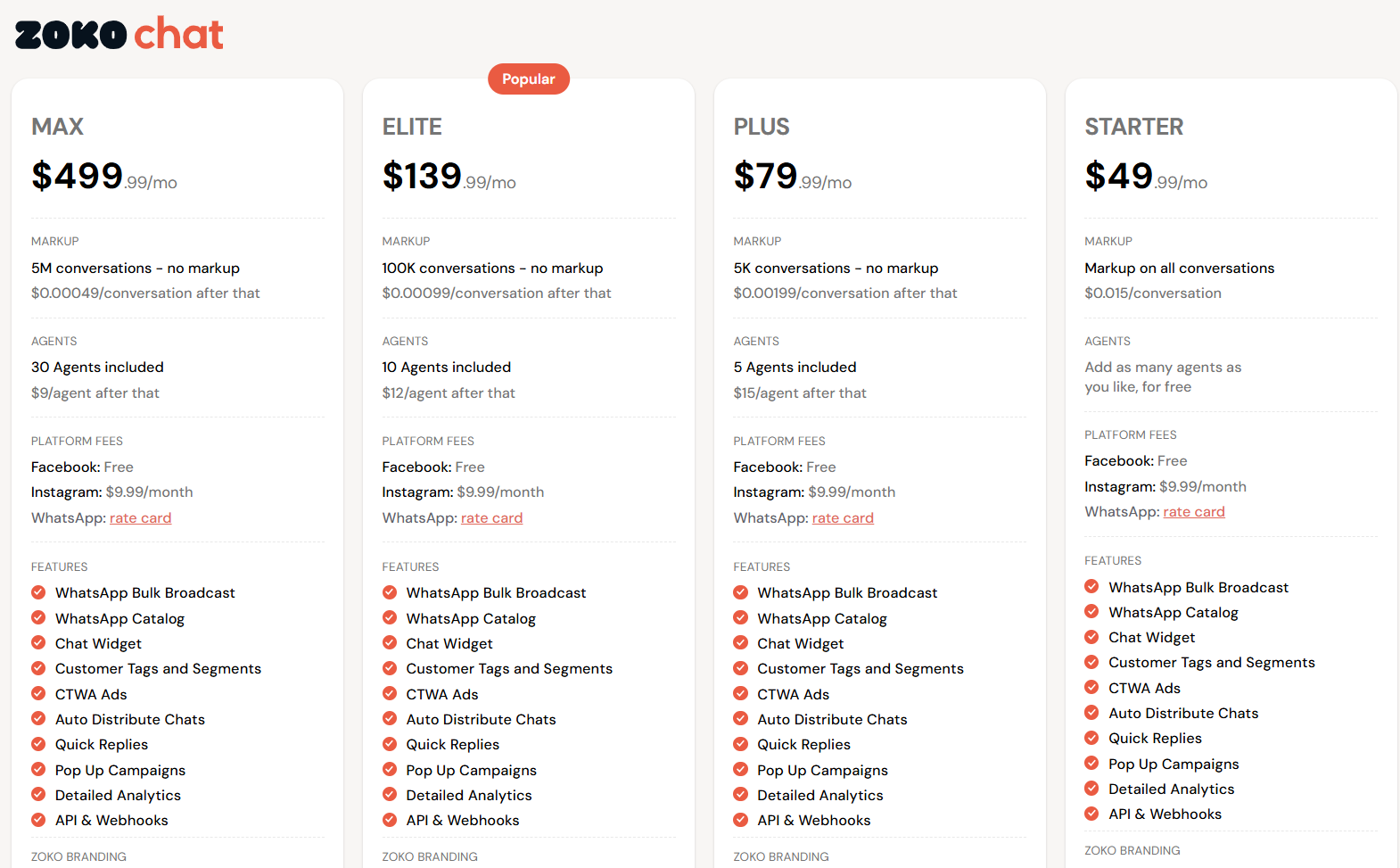
Zoko's Shopify App Store listing shows plans starting at $49.99/month, with higher tiers at $79.99/month, $139.99/month, and $499.99/month. The listing also mentions Meta rates, Zoko conversation fees that vary by plan, Instagram add-ons, custom flow charges, AI bot add-ons, and agent limits or extra agent pricing on some plans.
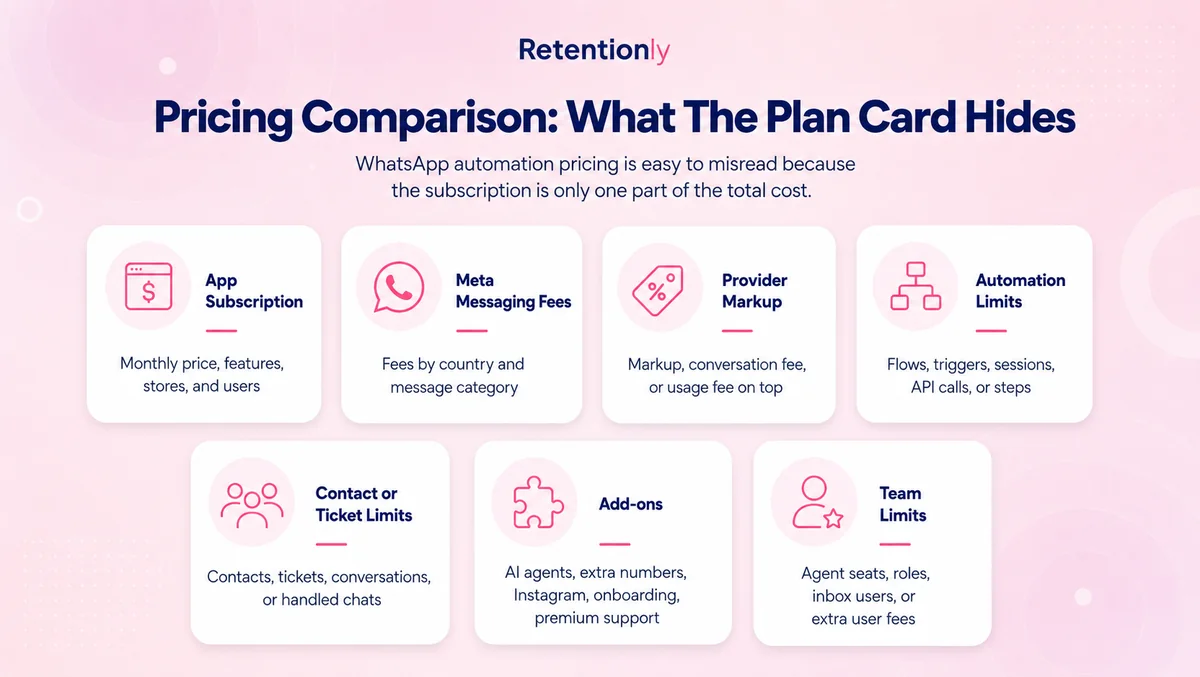
That does not make Zoko a bad choice. It means buyers should compare the total cost structure, not only the first monthly price. A Shopify store using WhatsApp at scale should understand subscription fees, Meta messaging fees, conversation charges, add-ons, custom flows, AI bots, and agent needs before deciding.
Retentionly pricing is intentionally simpler:
| Retentionly plan | Price | Best for |
|---|---|---|
| Basic | $24/month | Basic automations and core features |
| Growth | $49/month | Broadcasts and advanced automations, including winback workflows |
| Scale | $99/month | CRM features and multi-agent chat |
Retentionly connects directly to Meta and does not add a markup on Meta messaging fees. It also does not charge extra for added automations and does not charge per-chat fees. For D2C teams, that makes WhatsApp easier to forecast as automation volume grows.
| Pricing question | Zoko | Retentionly |
|---|---|---|
| Entry plan | Starts at $49.99/month on the Shopify App Store | Basic at $24/month |
| Higher plan range | Listed up to $499.99/month | Growth $49/month, Scale $99/month |
| Meta fees | Meta rates apply | Meta rates apply with no Retentionly markup |
| Platform conversation fees | Buyer should review plan-specific conversation fees | No per-chat fees |
| Add-ons | Instagram, custom flows, AI bots, and extra agents can affect cost | No extra cost for added automations |
| Best pricing fit | Teams that want a broader WhatsApp commerce platform | Teams that want simpler Shopify retention automation economics |
Where Zoko can get expensive is the number of separate pricing meters a store may need to model:
| Cost layer to check | What Zoko lists | Why it can add up |
|---|---|---|
| Conversation markup | Starter charges markup on all conversations at $0.015/conversation; Plus includes 5K conversations then $0.00199/conversation; Elite includes 100K then $0.00099/conversation; Max includes 5M then $0.00049/conversation | A growing store can pay more as WhatsApp conversation volume rises, even before Meta WhatsApp fees |
| Agent seats | Starter includes free agents; Plus includes 5 agents then $15/agent; Elite includes 10 then $12/agent; Max includes 30 then $9/agent | Support and sales teams can outgrow the included seat count |
| Platform fees | Facebook is listed as free, Instagram is listed at $9.99/month, and WhatsApp follows Meta's rate card | The WhatsApp bill is not only the SaaS subscription |
| Premium flows | Essential flows are free, but premium/custom flows are listed at $5.99/month/flow | Automation-heavy teams can accumulate several paid flows |
| Flow step usage | 500K steps/month are included, then $0.0002/step after that | High-volume journeys can create another usage-based charge |
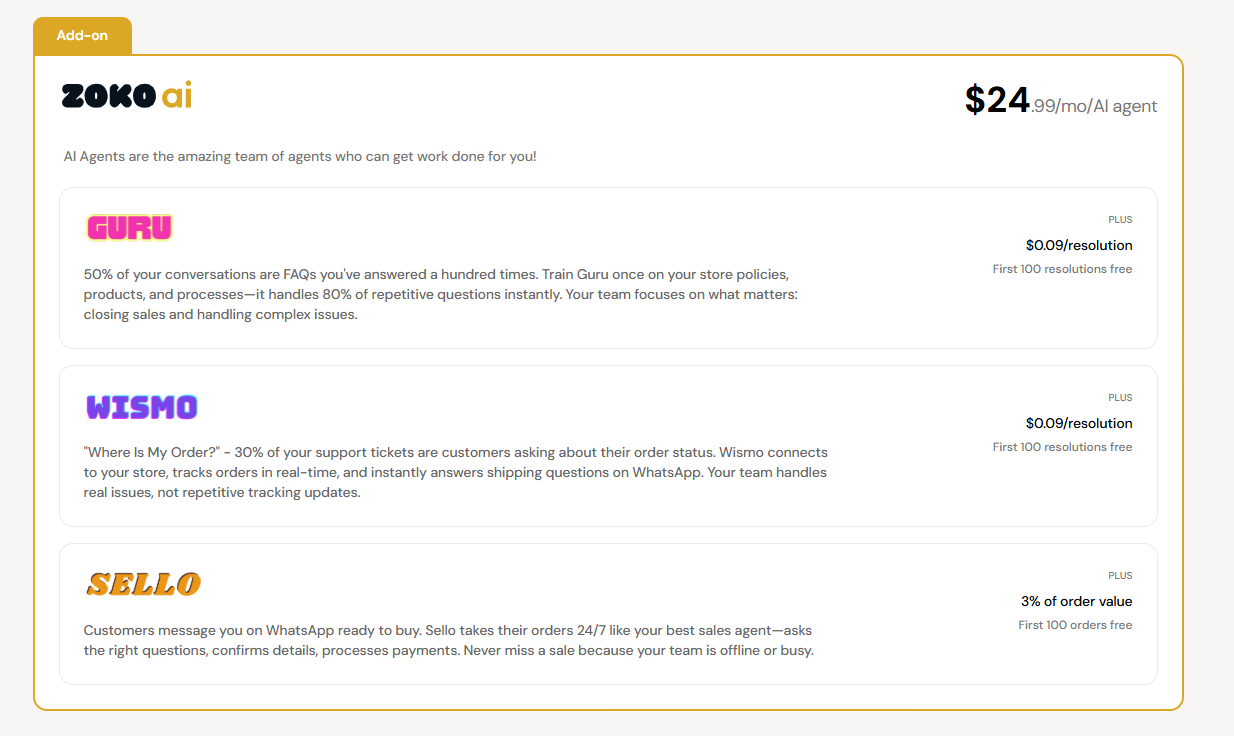
| Zoko AI | AI agents are listed at $24.99/month/AI agent | AI automation adds a separate monthly line item |
| AI resolutions and orders | Guru and Wismo list $0.09/resolution after the first 100; Sello lists 3% of order value after the first 100 orders | AI support and AI sales can scale with outcomes, not only seats |
For example, a Starter plan store with high conversation volume is not just paying $49.99/month. It also needs to account for per-conversation markup on every conversation, Meta WhatsApp fees, and any Instagram, premium flow, or AI costs it turns on. On Plus or Elite, the monthly subscription includes a conversation allowance, but extra conversations, extra agents, premium flows, AI resolutions, and order-value fees can still change the effective bill.
The pricing takeaway is not "choose the cheapest app." It is "choose the pricing model that matches the job." If you need a broad WhatsApp commerce platform with inbox, catalog, bots, and multiple agents, Zoko may justify the structure. If you mainly want retention flows that can pay for themselves first, Retentionly is easier to reason about.
Feature Comparison
Zoko and Retentionly overlap on Shopify WhatsApp automation, but they are built around different centers of gravity. Zoko leans into WhatsApp commerce and conversation management. Retentionly leans into lifecycle automation for Shopify revenue.
| Feature or buying criterion | Zoko | Retentionly |
|---|---|---|
| Shopify focus | Strong Shopify-native positioning | Built around Shopify and D2C retention |
| Abandoned checkout recovery | Supported | Core retention workflow |
| COD confirmation | Supported | Core Shopify/D2C workflow |
| Order updates | Supported | Core lifecycle automation |
| Winback automation | Possible through automations and campaigns | Growth plan includes advanced automations such as winback |
| Post-purchase upsell | Supported through WhatsApp commerce workflows | Designed as a retention and repeat revenue flow |
| Review requests | Possible through WhatsApp automation | Built into lifecycle retention thinking |
| Broadcasts | Strong campaign capability | Included in Growth plan |
| Shopify catalog sync | Strong fit for in-chat commerce | Not the main buying reason |
| Shared inbox | Strong multi-agent inbox fit | Available with CRM and multi-agent chat on Scale |
| AI bots | Available as a paid add-on | Not the main buying reason |
| Pricing simplicity for retention | More variables to forecast | Simpler plans, no Meta markup, no per-chat fees |
| Best-fit team | WhatsApp commerce, support, sales, and marketing teams | Shopify founders, marketers, retention teams, and D2C operators |
This is a closer comparison than many competitor posts. Zoko is not a generic WhatsApp tool with a thin Shopify integration. It is clearly serious about Shopify commerce. The real question is whether your team wants that full WhatsApp commerce platform, or whether you want a focused retention automation layer.
Strengths And Weaknesses
Zoko's strength is breadth inside Shopify WhatsApp commerce. It can help teams manage conversations, run broadcasts, sync catalog data, recover carts, send order messages, use AI bots, and coordinate replies through a shared inbox. That makes it a strong option when WhatsApp is a sales, support, marketing, and commerce channel at the same time.
The tradeoff is operational weight. A founder or marketer who mainly wants retention automations may have to think through plan tiers, conversation fees, custom flows, AI bot add-ons, agent needs, inbox workflows, and catalog use cases before the first few revenue flows are fully optimized.
Retentionly's strength is focus. It starts from the Shopify lifecycle and asks which automated WhatsApp moments will protect or grow revenue. The product fit is clearest when the team wants abandoned checkout recovery, COD confirmation, order updates, winback, post-purchase upsell, review requests, and repeat purchase flows without building a broader WhatsApp operations stack.
The tradeoff is intentional. Retentionly is not trying to be the broadest WhatsApp commerce CRM for every team. If you need heavy shared inbox operations, deep catalog-led selling inside WhatsApp, and AI bot workflows as a central part of the system, Zoko may still be the better fit.
Shopify And D2C Workflow Comparison
The best Zoko alternative should be judged by the workflows your team will actually run every week.
| Workflow | What the tool needs to understand | Better fit when retention is the goal |
|---|---|---|
| Abandoned checkout | Checkout state, cart context, stop conditions, recovered revenue | Retentionly |
| COD confirmation | COD order status, confirmation replies, cancellation paths, RTO risk | Retentionly |
| Order updates | Fulfillment state, delivery context, support fallback | Retentionly |
| Winback | Last purchase date, product cycle, buyer segment, repeat revenue | Retentionly |
| Post-purchase upsell | Product purchased, timing, complementary offer, attach rate | Retentionly |
| Review requests | Delivery timing, customer satisfaction path, review collection | Retentionly |
| In-chat catalog selling | Product discovery and checkout inside WhatsApp | Zoko |
| Shared team inbox | Agent assignment, handovers, notes, and routing | Zoko |
| AI bot workflows | Bot handling for sales, tracking, FAQs, and support | Zoko |
That table is the core decision. Zoko is strong when WhatsApp is the place where commerce, support, catalog, and conversations come together. Retentionly is stronger when WhatsApp is primarily a retention automation channel connected to Shopify revenue events.
Setup And Team Fit
Shopify teams usually do not have unlimited attention. The tool that looks most powerful in a demo is not always the tool that gets the highest-value flows launched fastest.
Zoko fits teams that want one WhatsApp workspace for marketing campaigns, customer support, catalog selling, bots, and conversations. It is especially relevant when multiple people need to work from the same WhatsApp number and the store wants WhatsApp to become a broader commerce layer.
Retentionly fits teams that want the starting point to be revenue automation. A Shopify founder or ecommerce manager can think in flows: recover checkout, confirm COD, send the order update, win back a lapsed buyer, ask for the review, recommend the next product. That is a narrower system, but narrow is useful when the goal is repeatable retention.
When Zoko Is Still The Better Fit
Zoko can still be the better choice if your team wants WhatsApp to be a full commerce and conversation platform. That is especially true if catalog sync, in-chat shopping, AI bots, team inbox operations, and multi-agent support are central requirements.
Zoko is also worth evaluating if your support and sales teams spend a lot of time inside WhatsApp and need shared inbox controls, handovers, routing, notes, and conversation management alongside marketing automations.
When Retentionly Is The Better Zoko Alternative
Retentionly is the better Zoko alternative when your main job is Shopify retention.
That means your team is less concerned with running a large WhatsApp commerce desk and more concerned with the flows that protect margin and grow LTV: abandoned checkout recovery, COD confirmation, order updates, winback, post-purchase upsell, review requests, and repeat purchase reminders.
It is also the stronger fit when pricing clarity matters. Retentionly's no-markup Meta fee model, no per-chat fees, and no extra cost for added automations make the economics easier to understand as WhatsApp becomes a larger revenue channel.
Final Recommendation
If you need a broad Shopify WhatsApp commerce platform with catalog sync, AI bots, shared inbox, broadcasts, and conversation workflows, Zoko is a strong product to evaluate.
If you are choosing a Zoko alternative because your real goal is Shopify retention and D2C repeat revenue, Retentionly is the focused challenger. It gives you simpler plan economics and automations built around the lifecycle moments that matter most to a Shopify brand.
Start with the flows that can pay for themselves first: abandoned checkout recovery, COD confirmation, winback, reviews, and repeat purchase. Install Free on Shopify and launch the retention workflows before WhatsApp becomes another complicated system to manage.
Quick FAQs
Is Retentionly a direct replacement for Zoko?
Retentionly is a Zoko alternative for Shopify retention use cases. It is not trying to replace every Zoko workflow around catalog selling, shared inbox operations, AI bots, or broad WhatsApp commerce.
Which is better for Shopify abandoned checkout recovery?
Retentionly is the stronger fit if abandoned checkout recovery is part of a broader retention strategy. Zoko also supports cart recovery, but Retentionly is built around Shopify lifecycle automation and repeat revenue from the start.
Does Retentionly charge a markup on Meta messaging fees?
No. Retentionly connects directly to Meta and does not add a markup on Meta messaging fees. That matters as WhatsApp message volume grows.
Is Zoko better for support teams?
Often, yes. If your team needs a shared WhatsApp inbox, handovers, routing, notes, AI bots, and broad conversation management, Zoko may be the better fit. If your main need is retention revenue from Shopify events, Retentionly is more focused.
What should Shopify stores compare before choosing?
Compare total cost structure, Shopify workflow depth, Meta messaging fees, platform conversation fees, add-ons, agents, custom flows, setup effort, and whether the tool is built for broad WhatsApp commerce or focused D2C retention automation.