WhatsApp Advertising: Formats, Costs, and Campaign Setup
TL;DRWhatsApp advertising works best when the ad is only the start of the customer journey. A Facebook or Instagram ad can open a WhatsApp chat, a product promotion can invite shoppers to message the store, and an ecommerce campaign can move high-intent buyers into a more personal conversation. The real question is what happens after the first chat starts.
For ecommerce brands, WhatsApp advertising should not be treated as a cheaper version of normal paid social. It is a conversation-led acquisition and retention channel. The campaign needs a clear promise, a prepared reply flow, customer consent, useful follow-up, and a measurement plan that goes beyond clicks.
This guide explains the main WhatsApp advertising formats, how click-to-WhatsApp ads work, what costs to plan for, and how Shopify and D2C teams should turn ad conversations into revenue without over-messaging customers.
Quick Verdict
Use WhatsApp advertising when a conversation can help the customer decide faster.
| Advertising goal | WhatsApp fit | What to prepare before launch |
|---|---|---|
| Generate product questions from paid social | Strong | Opening message, product answers, human handoff |
| Recover shoppers who need help before buying | Strong | Cart link, offer rules, support owner |
| Promote a limited sale to opted-in customers | Strong if permission is clear | Segment, template, stop rule, opt-out handling |
| Announce every discount to every contact | Weak | Better segmentation and suppression first |
| Replace your whole Meta ads funnel | Weak | Keep WhatsApp as the chat destination, not the only strategy |
| Build long-term customer retention | Strong after the first purchase | Post-purchase automation and repeat purchase flows |
The best WhatsApp advertising plan has two halves: the traffic plan that starts conversations and the retention plan that turns those conversations into orders, reviews, repeat purchases, and loyal customers.
What WhatsApp Advertising Means
WhatsApp advertising can mean a few different things.
For many teams, it means ads on Facebook or Instagram that open a WhatsApp chat. These are usually called click-to-WhatsApp ads. The shopper sees an ad, taps the call to action, and lands in a WhatsApp conversation with the business.
For others, it means using WhatsApp itself as a promotional channel: Status updates, catalog links, broadcast campaigns, product launches, sale reminders, and template-based messages to customers who have opted in.
Both are useful, but they solve different problems.
| Type | Where it starts | Best use | Main risk |
|---|---|---|---|
| Click-to-WhatsApp ads | Facebook or Instagram ad | Start new conversations with prospects | Paying for chats the team cannot qualify or follow up |
| WhatsApp Business profile promotion | WhatsApp profile, link, QR code, website, packaging | Make it easy for shoppers to contact the store | No tracking or slow replies |
| WhatsApp Status and catalog promotion | WhatsApp Business app | Promote products to existing contacts | Low control if there is no segmentation |
| Template or broadcast campaign | WhatsApp Business Platform or app | Reach opted-in customers with a specific offer or update | Over-sending, weak consent, or poor stop rules |
| Lifecycle follow-up | Shopify event plus WhatsApp automation | Recover, update, review, win back, reorder | Weak if the follow-up is disconnected from store behavior |
If your team only plans the ad creative, the campaign is unfinished. The WhatsApp conversation needs a reply path, a purchase path, and a follow-up path.
How Click-To-WhatsApp Ads Work
Click-to-WhatsApp ads are Meta ads that send people from Facebook or Instagram into a WhatsApp chat with your business. In Ads Manager, the setup usually starts with a campaign objective, a messaging or conversation destination, WhatsApp as the messaging app, an audience, creative, budget, schedule, and opening message.
The important operational detail is simple: the ad creates a chat, not a guaranteed sale.
That means the campaign should answer four questions before it goes live.
| Question | Example ecommerce answer |
|---|---|
| Why would someone want to chat? | They need sizing help, product matching, a bundle recommendation, or a limited offer |
| What should the first reply do? | Welcome them, restate the offer, ask one qualifying question, and link the right product |
| Who owns replies? | Founder, support team, sales team, inbox agent, bot plus human fallback |
| What happens if they do not buy? | Add them to a permitted follow-up path with clear stop rules |
A weak campaign sends traffic into a generic "Hi, how can we help?" conversation. A better campaign gives the customer a reason to reply and gives the team a script for the next step.
WhatsApp Advertising Formats For Ecommerce
Ecommerce teams can use WhatsApp across acquisition, conversion, post-purchase, and retention. Separate the formats so every campaign has a clear job.
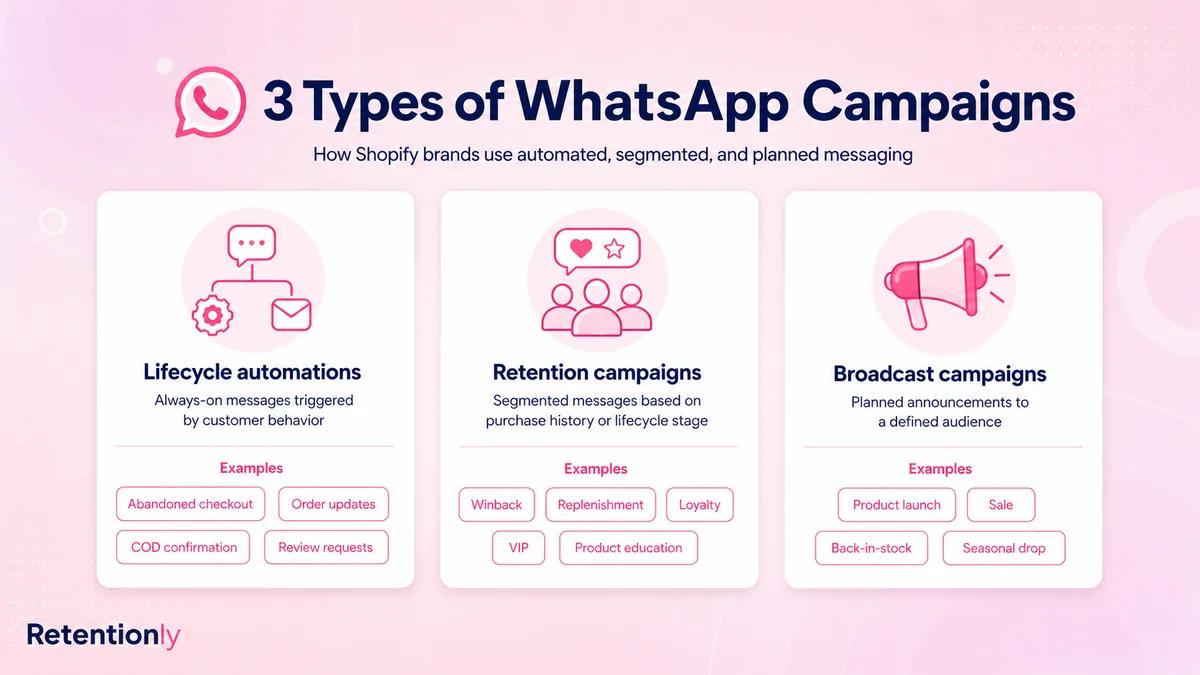
| Format | Campaign idea | Best metric |
|---|---|---|
| Click-to-WhatsApp product ad | "Message us to find your shade/size/bundle" | Qualified chats and assisted orders |
| Click-to-WhatsApp offer ad | "Ask for today's bundle offer on WhatsApp" | Cost per conversation and conversion rate |
| Lead magnet or quiz follow-up | "Get a recommendation in chat" | Contact quality and purchase rate |
| Back-in-stock or launch message | Notify opted-in shoppers when the product is available | Revenue from the segment |
| Abandoned checkout WhatsApp follow-up | Remind shoppers who left checkout | Recovered revenue |
| COD confirmation follow-up | Confirm cash-on-delivery orders before shipping | Confirmation rate and RTO reduction |
| Winback or reorder campaign | Bring previous buyers back at the right time | Repeat purchase revenue |
| Review request after delivery | Turn delivered orders into social proof | Review rate |
This is where WhatsApp advertising becomes more than paid acquisition. The same channel that starts a conversation can also protect the post-click journey.
What WhatsApp Advertising Costs
There is no single WhatsApp advertising cost that applies to every business. Plan the cost stack instead.
| Cost layer | What it means | How to control it |
|---|---|---|
| Ad spend | The budget you set for Facebook or Instagram ads | Start with a controlled daily budget and one offer |
| Cost per click or conversation | What you pay to start traffic or chats | Improve creative, audience, promise, and reply speed |
| WhatsApp conversation or messaging fees | Charges tied to WhatsApp Business Platform conversations or messages where applicable | Understand message categories and avoid unnecessary sends |
| Software subscription | App, inbox, automation, or platform fee | Choose based on the workflows you will actually run |
| Team time | Humans answering chats and closing orders | Use templates, assignment rules, and automation for repeated questions |
| Discount or offer cost | Margin given away to convert shoppers | Use help-first messages before blanket discounts |
The mistake is judging the campaign only by cost per chat. A cheap conversation is not valuable if the shopper is low-intent, the reply is late, the product link is missing, or the team has no follow-up.
Track cost per qualified conversation, cost per first order, recovered revenue, repeat purchase revenue, and opt-out rate together. That gives a more honest view of whether WhatsApp advertising is creating customers or just creating messages.
Campaign Setup Checklist
Before running WhatsApp ads, prepare the funnel like an ecommerce workflow.
| Step | What to decide |
|---|---|
| Offer | What specific reason does the shopper have to start a chat? |
| Audience | Are you targeting new prospects, warm visitors, existing customers, or a product-interest segment? |
| Creative | Does the ad make the chat promise obvious? |
| Opening message | What will the user see or send when the chat opens? |
| Reply owner | Who answers during business hours and after hours? |
| Product path | Which product, collection, cart, or checkout link should the conversation move toward? |
| Consent | Can you follow up, and what type of messages are allowed? |
| Stop rule | When does the campaign stop after purchase, opt-out, complaint, or inactivity? |
| Measurement | Which metric proves the campaign helped revenue or retention? |
Do this before scaling spend. WhatsApp can produce high-intent conversations, but only if the team is ready for those conversations.
Example Click-To-WhatsApp Campaign Flow
Here is a practical ecommerce flow for a skincare brand.
| Stage | Setup |
|---|---|
| Ad promise | "Message us for a 60-second routine recommendation" |
| Audience | Website visitors and lookalike customers interested in skincare |
| Opening message | "Hi, I want help choosing a skincare routine." |
| First reply | Ask skin type, concern, and budget in one short message |
| Product path | Recommend a starter bundle and link the product page |
| Fallback | Send unanswered chats to a human owner |
| Follow-up | If the shopper does not buy, send one permitted reminder with the recommended bundle |
| Post-purchase | Send order updates, usage tips, review request, and reorder reminder |
Notice that the ad is only the entry point. The real system includes qualification, product recommendation, checkout movement, and retention.
For a deeper automation foundation, read the WhatsApp Automation Guide for Ecommerce.
Common Mistakes
The fastest way to waste WhatsApp ad spend is to treat every chat as equal.
A few common mistakes hurt performance:
Sending ad traffic into an unprepared inbox.
Using a broad discount as the only reason to chat.
Taking too long to answer the first message.
Measuring clicks without tracking conversations, orders, or repeat purchases.
Following up without clear consent or relevance.
Sending the same broadcast to customers who already bought.
Ignoring opt-outs, complaints, and support issues.
Running acquisition ads without post-purchase flows.
The best teams treat WhatsApp as a customer journey channel. Acquisition, conversion, support, and retention should work together.
How Retentionly Fits
Retentionly is built for Shopify and ecommerce teams that want WhatsApp to drive retention revenue, not just start more conversations.
Use Retentionly when you want to connect WhatsApp follow-up to real store events: abandoned checkout, order status, COD confirmation, review requests, winback campaigns, reorder reminders, and post-purchase upsells. That matters because ad conversations become more valuable when the next message knows what the customer did in Shopify.
For example, a shopper who clicks a WhatsApp ad and buys should not keep receiving the same acquisition follow-up. They should move into the right post-purchase path. A shopper who abandons checkout should receive a helpful cart reminder. A repeat buyer should receive a different message from a first-time prospect.
That is the difference between WhatsApp advertising as a traffic tactic and WhatsApp as a retention system.
Install Retentionly free on Shopify to build WhatsApp flows that recover checkouts, improve post-purchase communication, and bring customers back after the first order.
FAQs
Is WhatsApp advertising the same as WhatsApp marketing?
Not exactly. WhatsApp advertising usually refers to paid or promotional methods that drive people into WhatsApp, especially click-to-WhatsApp ads on Facebook and Instagram. WhatsApp marketing is broader and can include campaigns, lifecycle automation, broadcasts, customer support, and retention flows.
Can Shopify stores run ads that open WhatsApp?
Yes. A Shopify store can run Meta ads that open a WhatsApp chat if the business has the right WhatsApp and Meta setup. The store should prepare reply flows, product links, and follow-up rules before launching.
How much do WhatsApp ads cost?
The ad budget is set by the business, but the full cost can include Meta ad spend, WhatsApp conversation or message fees where applicable, software fees, team time, and discount cost. Measure the campaign by qualified conversations and revenue, not only by clicks.
What is the best first WhatsApp ad campaign?
Start with one clear conversation promise. Product recommendations, sizing help, bundle advice, limited launch access, or high-intent retargeting usually work better than a generic "message us" ad.
What should happen after someone clicks a WhatsApp ad?
They should receive a fast, useful reply that moves them toward the next step: product recommendation, checkout link, support answer, or opt-in follow-up. If they buy, move them into post-purchase automation instead of continuing acquisition messages.