WhatsApp Campaign Ideas for Ecommerce Brands
TL;DRWhatsApp campaign ideas for ecommerce work best when they are tied to a real customer moment. A shopper abandoned checkout. A buyer is waiting for delivery. A VIP customer is eligible for early access. A repeat buyer is close to a reorder window. Those signals create stronger campaigns than a generic promotional blast.
The channel is direct, personal, and easy to overuse. That is why ecommerce teams need more than a list of ideas. Each campaign needs an audience, a trigger, a message promise, a stop rule, and a metric. Without those pieces, WhatsApp becomes another discount list instead of a retention channel.
This guide gives ecommerce teams practical WhatsApp campaign ideas across acquisition follow-up, conversion, post-purchase experience, retention, and repeat revenue.
Start With The Campaign Moment
Before choosing a campaign, decide what customer moment the message belongs to.
| Campaign moment | Best use | Example |
|---|---|---|
| Acquisition follow-up | Continue a conversation started by an ad, popup, quiz, or chat button | Click-to-WhatsApp ad follow-up |
| Conversion | Help a high-intent shopper finish an order | Abandoned checkout recovery |
| Post-purchase experience | Reduce uncertainty after the order | Order updates and product education |
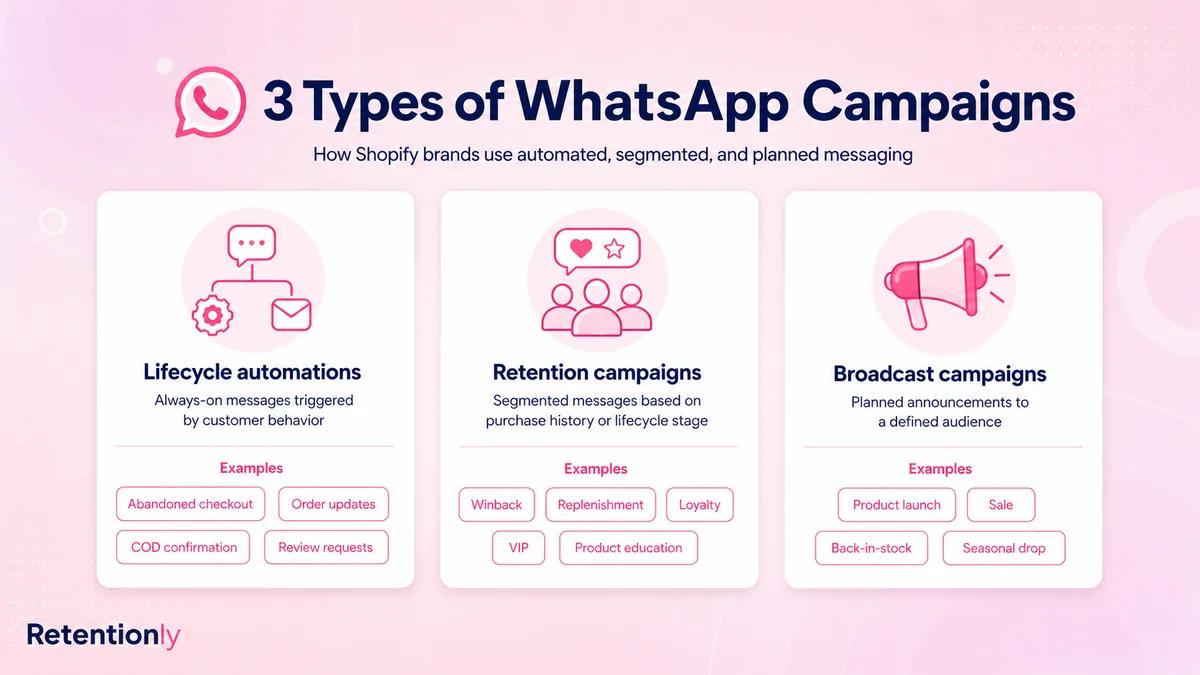
| Retention | Bring known customers back at the right time | Winback, reorder, loyalty, VIP |
| Broadcast | Announce a time-bound store event | Launch, sale, seasonal drop |
The safest launch order is usually conversion first, post-purchase second, retention third, and broad broadcasts last. Conversion and post-purchase campaigns are closer to customer intent, so they usually create fewer complaints and cleaner measurement.
A Good Ecommerce WhatsApp Campaign Has Five Parts
Use this simple framework before writing copy.
| Part | Question to answer | Example |
|---|---|---|
| Audience | Who should receive this message? | Customers who bought a 30-day supplement pack |
| Trigger | Why should the message happen now? | 24 days after delivery |
| Message promise | What useful thing is being offered? | Reorder before running out |
| Stop rule | When should the campaign stop? | Stop after purchase, opt-out, support issue, or campaign end |
| Metric | What proves the campaign worked? | Repeat purchase revenue and opt-out rate |
If the team cannot define the stop rule, the campaign is not ready. WhatsApp is too personal for messages that keep running after the customer has bought, complained, opted out, or moved into another workflow.
1. Abandoned Checkout Recovery
Abandoned checkout is usually the highest-priority WhatsApp campaign because the shopper has already shown purchase intent.
| Campaign detail | Practical setup |
|---|---|
| Audience | Opted-in shoppers who started checkout but did not buy |
| Trigger | Checkout is inactive for 30 to 60 minutes |
| Message angle | Help the shopper return to the saved order |
| Stop rule | Stop after purchase, opt-out, final reminder, or support handoff |
| Metric | Recovered revenue, conversion rate, replies, opt-outs |
Example:
Hi [first_name], your [store_name] checkout is still saved. You can complete it here: [checkout_link]. Reply if you have a question before ordering.
Start with helpful copy before discounting. If performance is weak, test timing, reassurance, product context, and then selective offers. For a deeper Shopify workflow, read the Shopify Abandoned Cart WhatsApp Recovery Guide.
2. Browse Or Product Interest Follow-Up
Some shoppers show intent before checkout. They view a product repeatedly, join a waitlist, click a campaign link, answer a quiz, or ask about an item in chat.
| Campaign detail | Practical setup |
|---|---|
| Audience | Known contacts with recent product or category interest |
| Trigger | Product view, quiz result, waitlist signup, or chat action |
| Message angle | Help them compare or continue the product journey |
| Stop rule | Stop after purchase, no engagement, opt-out, or low-intent signal |
| Metric | Product clicks, assisted orders, replies, opt-outs |
Example:
Still comparing [product_name]? Here are the details customers usually check before buying: [product_link]. Reply if you want help choosing the right option.
Keep this useful. Browse intent is weaker than checkout intent, so the campaign should answer a likely question instead of pushing urgency too early.
3. Back-In-Stock Alert
Back-in-stock campaigns work because the customer already expressed demand. The key is specificity.
| Campaign detail | Practical setup |
|---|---|
| Audience | Customers who requested a restock alert or viewed an unavailable product |
| Trigger | Product or variant returns to stock |
| Message angle | The exact item is available again |
| Stop rule | Stop after purchase, stockout, alert expiry, or opt-out |
| Metric | Restock conversion, sell-through, revenue per recipient |
Example:
[product_name] is back in stock at [store_name]. You can get it here before it sells out again: [product_link]
Variant matching matters. A customer waiting for one size, color, or bundle should not receive a broad restock message for a different item.
4. Price-Drop Alert
Price-drop campaigns can convert interested shoppers, but they need margin discipline.
| Campaign detail | Practical setup |
|---|---|
| Audience | Customers who viewed, wishlisted, or requested updates for a product |
| Trigger | Product crosses a meaningful price threshold |
| Message angle | A product they cared about is now cheaper |
| Stop rule | Stop after purchase, price change expires, stockout, or opt-out |
| Metric | Revenue, margin, conversion rate, discount dependency |
Example:
Good news, [first_name]. [product_name] just dropped to [price]. You can check it here: [product_link]
Do not send every tiny markdown. The price change should be meaningful enough that the customer understands why the message arrived.
5. Product Launch For Category Buyers
Product launches perform better when the campaign goes to people with a reason to care.
| Campaign detail | Practical setup |
|---|---|
| Audience | Prior buyers, browsers, or VIPs tied to the launch category |
| Trigger | New collection, drop, preorder, or bundle goes live |
| Message angle | Early access or relevant new arrival |
| Stop rule | Stop after purchase, launch window ends, inventory runs out, or opt-out |
| Metric | Launch revenue, click rate, repeat purchase rate |
Example:
[first_name], our new [category_name] drop is live. Since you bought from this category before, you can see it first here: [collection_link]
This is stronger than sending every launch to every subscriber. Relevance protects the channel.
6. VIP Early Access
VIP campaigns should feel earned. A normal sale message with "VIP" added to the first line is not enough.
| Campaign detail | Practical setup |
|---|---|
| Audience | High-LTV customers, repeat buyers, loyalty members, or top category buyers |
| Trigger | Private sale, early access window, premium drop, or limited inventory |
| Message angle | Recognition and priority access |
| Stop rule | Stop after purchase, access window ends, stock runs out, or opt-out |
| Metric | VIP revenue, revenue per recipient, opt-outs, margin |
Example:
[first_name], you get early access to [collection_name] before it opens publicly. Your private link: [link]
VIP campaigns do not always need discounts. Early access, limited bundles, priority stock, and human help can protect margin better than another coupon.
7. Winback For Inactive Customers
Winback campaigns should be based on the customer's history, not just the fact that they have been quiet.
| Campaign detail | Practical setup |
|---|---|
| Audience | Customers with no purchase after a defined period |
| Trigger | 45, 60, 90, or 120 days after the last order, depending on product cycle |
| Message angle | Give a relevant reason to return |
| Stop rule | Stop after purchase, opt-out, support issue, or final reminder |
| Metric | Repeat purchase revenue, reactivation rate, offer cost |
Example:
Hi [first_name], we picked a few new arrivals from [category_name] based on your last order. You can see them here: [collection_link]
Segment by first-time buyers, repeat buyers, VIPs, and product category. A one-time buyer and a five-order customer should not receive the same return message.
8. Reorder Reminder
Reorder reminders are strongest for consumable products, refills, subscriptions, supplements, beauty, food, pet care, and products with a clear usage cycle.
| Campaign detail | Practical setup |
|---|---|
| Audience | Customers who bought repeatable products |
| Trigger | Expected replenishment window |
| Message angle | Reorder before running out |
| Stop rule | Stop after purchase, skipped cycle, opt-out, or support issue |
| Metric | Reorder conversion, repeat purchase rate, time between orders |
Example:
Running low on [product_name]? You can reorder from [store_name] in one tap here: [reorder_link]
Use product-specific timing. A 15-day product, a 30-day refill, and a seasonal item need different schedules.
9. Post-Purchase Education
Education campaigns reduce confusion and make the next purchase more likely.
| Campaign detail | Practical setup |
|---|---|
| Audience | Recent buyers of products that need setup, care, sizing, storage, or usage guidance |
| Trigger | Order delivered or product usage window begins |
| Message angle | Help the customer get better results |
| Stop rule | Stop after negative reply, refund request, support issue, or completed sequence |
| Metric | Support reduction, review rate, repeat purchase, replies |
Example:
Your [product_name] should be with you now. Here is the quick guide customers find most useful: [guide_link]
This should not feel like a hidden promotion. Make the first message genuinely helpful. Later upsell or cross-sell messages should only appear when the customer has enough context.
10. Review Request
Review campaigns work when the customer has had enough time to experience the product.
| Campaign detail | Practical setup |
|---|---|
| Audience | Delivered orders, excluding cancellations, refunds, and support-risk customers |
| Trigger | Delivery plus the right usage window |
| Message angle | Ask for a quick review after product experience |
| Stop rule | Stop after review, opt-out, negative reply, or one reminder |
| Metric | Reviews collected, review rate, rating quality |
Example:
Hi [first_name], hope you are enjoying [product_name]. Could you leave a quick review for [store_name]? It helps other shoppers choose with confidence: [review_link]
Wait longer for products that need usage before judgment. Ask sooner for simple products where the experience is immediate.
11. Post-Purchase Upsell Or Cross-Sell
Upsell campaigns should be based on a clear product relationship.
| Campaign detail | Practical setup |
|---|---|
| Audience | Recent buyers with a relevant add-on, bundle, upgrade, or refill match |
| Trigger | Order placed, shipped, delivered, or usage milestone |
| Message angle | Recommend the next useful product |
| Stop rule | Stop after purchase, refund, support issue, campaign expiry, or opt-out |
| Metric | Attach rate, second-order revenue, AOV lift |
Example:
Many customers pair [product_name] with [recommended_product] for [specific_benefit]. You can see it here: [product_link]
Weak recommendations create fatigue. If the connection is not obvious, wait for a stronger signal.
12. Loyalty Reward Activation
Loyalty campaigns should make a real benefit visible.
| Campaign detail | Practical setup |
|---|---|
| Audience | Loyalty members with a meaningful reward, tier, referral, or points event |
| Trigger | Reward unlocked, points near expiry, tier change, birthday reward, or referral eligibility |
| Message angle | Make the benefit easy to use |
| Stop rule | Stop after redemption, expiry, purchase, opt-out, or support issue |
| Metric | Redemption rate, repeat purchase revenue, referral revenue |
Example:
Good news, [first_name]. You unlocked [reward_name] at [store_name]. Use it on your next order here: [reward_link]
Do not send small points balances that cannot be redeemed. The campaign should help the customer act.
13. Seasonal Or Festival Campaign
Seasonal campaigns are common, but they become stronger when segmented by category, region, inventory, or past purchase behavior.
| Campaign detail | Practical setup |
|---|---|
| Audience | Customers whose history matches the season, festival, weather, or gifting need |
| Trigger | Holiday, sale window, delivery cutoff, festival, school season, or local event |
| Message angle | Timely product relevance |
| Stop rule | Stop after purchase, campaign end, inventory issue, frequency cap, or opt-out |
| Metric | Revenue per recipient, margin, opt-outs, campaign revenue |
Example:
[first_name], our [season_name] picks for [category_name] are live. Since you shopped this category before, start here: [collection_link]
The better campaign is not "send the festival sale to everyone." It is "send the relevant festival offer to the segment most likely to need it."
14. Click-To-WhatsApp Ad Follow-Up
If someone starts a chat from a WhatsApp ad, the first follow-up should preserve the ad context.
| Campaign detail | Practical setup |
|---|---|
| Audience | Customers who clicked a WhatsApp ad or started an ad-sourced conversation |
| Trigger | Incoming WhatsApp conversation from the ad |
| Message angle | Continue the offer, quiz, product question, or buying path |
| Stop rule | Stop after purchase, no response, support handoff, or opt-out |
| Metric | Cost per conversation, conversion rate, assisted revenue |
Example:
Thanks for checking out [offer_name]. Want help choosing the right option? Reply 1 for [option_a] or 2 for [option_b].
Do not drop ad-sourced contacts into a generic broadcast list. The campaign should continue the reason they clicked.
15. Customer Feedback Campaign
Feedback campaigns can protect retention when they are short and acted on.
| Campaign detail | Practical setup |
|---|---|
| Audience | Delivered customers, canceled orders, refund customers, or people who replied during a flow |
| Trigger | Delivery, cancellation, refund, support resolution, or campaign reply |
| Message angle | Ask one clear question |
| Stop rule | Stop after response, no response, support escalation, or opt-out |
| Metric | Response rate, issue themes, support recovery, retention impact |
Example:
Quick question, [first_name]: was your [store_name] order experience smooth? Reply 1 for yes or 2 if we should improve something.
If the customer reports a problem, route it to support before sending another promotional campaign.
Which Campaign Should You Launch First?
Pick the campaign that matches the clearest business problem.
| Store situation | Start with |
|---|---|
| High checkout abandonment | Abandoned checkout recovery |
| Frequent out-of-stock products | Back-in-stock alerts |
| Price-sensitive product interest | Price-drop alerts |
| New launches or drops | Category buyer launch campaign |
| Strong repeat purchase behavior | Reorder reminders |
| Low review volume | Review request campaign |
| New buyers need guidance | Post-purchase education |
| High-value customer segment | VIP early access |
| Inactive customer base | Winback campaign |
| Paid traffic starts WhatsApp chats | Click-to-WhatsApp ad follow-up |
Launch one campaign first. Measure it. Then add the next campaign only when the audience, stop rule, and owner are clear.
Frequency And Suppression Rules
WhatsApp campaigns need a global view of the customer. A customer should not receive a cart reminder, launch broadcast, review request, and winback offer in the same short window just because each campaign was created separately.
Use these rules as a starting point:
Stop abandoned checkout messages after purchase.
Pause promotional messages during support issues.
Exclude recent buyers from aggressive discounts.
Exclude refunds, cancellations, and unresolved complaints from review requests.
Suppress winback after any recent order.
Limit broad broadcasts within a defined period.
Prioritize service and delivery messages over promotional messages.
Honor opt-outs before any next send.
Consent also matters. Ecommerce teams should collect clear WhatsApp opt-ins, explain what customers can expect, and make opt-out handling operational before campaign volume grows.
What To Measure
Do not judge every WhatsApp campaign by the same metric.
| Campaign | Primary metric | Guardrail |
|---|---|---|
| Abandoned checkout | Recovered revenue | Opt-outs and support replies |
| Browse follow-up | Assisted orders | Low-intent sends |
| Back-in-stock | Restock revenue | Stockout frustration |
| Price drop | Revenue and margin | Discount dependency |
| Product launch | Launch revenue | Segment fatigue |
| VIP access | VIP revenue | Over-discounting loyal customers |
| Winback | Repeat purchase revenue | Offer cost |
| Reorder | Reorder conversion | Wrong timing |
| Education | Support reduction and reviews | Hidden promotion |
| Review request | Reviews collected | Negative replies |
| Upsell | Attach rate or second-order revenue | Irrelevant recommendations |
| Seasonal campaign | Revenue per recipient | Broad-list fatigue |
| Click-to-WhatsApp follow-up | Conversion after chat | Context loss |
| Feedback | Response rate and issue themes | No support follow-through |
Clicks are useful, but they are not the whole story. A healthy WhatsApp campaign improves revenue, repeat purchase, support experience, or customer understanding without increasing opt-outs.
Common Mistakes To Avoid
The first mistake is sending every campaign to every phone number. Ecommerce WhatsApp performance comes from relevance, not list size.
The second mistake is treating delivery phone numbers as promotional permission. A customer can share a phone number for an order without expecting marketing messages.
The third mistake is using discounts as the default message angle. Availability, reassurance, education, early access, loyalty value, and useful reminders often feel better than another coupon.
The fourth mistake is ignoring replies. WhatsApp campaigns create conversations. Someone needs to own questions, complaints, opt-outs, refund requests, and delivery issues.
The fifth mistake is adding campaigns without suppression. The more campaigns you run, the more important it becomes to prevent collisions.
Where Retentionly Fits
Retentionly is built for Shopify and D2C teams that want WhatsApp campaigns tied to customer events and retention revenue.
Use Retentionly when you want to:
Trigger campaigns from Shopify checkout, order, customer, and product signals.
Launch abandoned checkout, COD confirmation, order update, review, winback, reorder, upsell, welcome, and campaign flows.
Segment customers by purchase count, last order, lifetime value, product interest, and lifecycle stage.
Suppress customers who purchased, opted out, replied with an issue, or entered a higher-priority flow.
Measure campaigns by recovered revenue, repeat purchases, reviews, and customer outcomes.
Retentionly is not only a broadcast tool. It is the WhatsApp retention automation layer for ecommerce teams that want campaigns to fit real customer moments.
Final Recommendation
Start with three WhatsApp campaign ideas:
One conversion campaign, such as abandoned checkout or back-in-stock.
One customer experience campaign, such as order updates, education, feedback, or review requests.
One retention campaign, such as reorder, winback, loyalty, VIP access, or post-purchase upsell.
For each one, define the audience, trigger, message promise, stop rule, and metric before writing copy. Keep broad broadcasts segmented. Give service messages priority. Stop sending when the customer's state changes.
That is how ecommerce brands turn WhatsApp campaign ideas into a retention system instead of another promotional list.
Install Free on Shopify with Retentionly to launch WhatsApp campaigns for abandoned checkout recovery, order updates, reviews, reorders, winback, loyalty, upsells, and repeat purchases.
Quick FAQs
What are the best WhatsApp campaign ideas for ecommerce?
The strongest ideas usually include abandoned checkout recovery, back-in-stock alerts, price-drop alerts, product launches, VIP access, winback, reorder reminders, post-purchase education, review requests, upsells, loyalty rewards, and Click-to-WhatsApp ad follow-up.
How many WhatsApp campaigns should an ecommerce brand launch first?
Start with one campaign where the audience, trigger, stop rule, and metric are obvious. After that campaign is measured, add one retention campaign and one customer experience campaign.
Are WhatsApp broadcasts good for ecommerce?
WhatsApp broadcasts can work for launches, seasonal campaigns, flash sales, and announcements, but they should be segmented. Triggered lifecycle campaigns are usually safer to launch first because they follow recent customer behavior.
What should every WhatsApp campaign include?
Every campaign should have an audience, trigger, message promise, stop rule, owner for replies, opt-out handling, and a primary metric such as recovered revenue, repeat purchase, reviews collected, or support reduction.
Where does Retentionly fit with ecommerce WhatsApp campaigns?
Retentionly fits when a Shopify or D2C team wants WhatsApp campaigns connected to store events, lifecycle timing, segmentation, suppression, reply handoff, and retention metrics rather than only bulk broadcasts.