WhatsApp Retention Marketing Shopify Guide
TL;DRWhatsApp retention marketing for Shopify works when it is built around customer moments that already exist in your store: the first order, delivery, product use, replenishment, review timing, inactive customers, and repeat purchase intent.
It fails when it becomes another discount calendar. A Shopify store does not need to send more campaigns just because WhatsApp gets attention. It needs to send fewer, better-timed messages that help a customer finish a purchase, use the product, come back at the right time, or ask for help before churn becomes permanent.
This guide shows how to use WhatsApp as a Shopify retention channel: which flows matter, how to plan timing, what to suppress, what to measure, and where Retentionly fits.
What WhatsApp Retention Marketing Means
Retention marketing is not only winback. For a Shopify store, it covers every message after a customer has shown purchase intent or placed an order.
That includes:
recovering abandoned checkouts from shoppers who were close to buying
reassuring COD buyers before the parcel ships
sending order, shipping, and delivery updates
helping first-time buyers use the product well
asking for reviews after the product has been received
reminding customers to reorder before they run out
offering bundles, refills, or upgrades based on purchase history
bringing inactive buyers back with a relevant reason
WhatsApp is useful because many of these moments are time-sensitive. Email can still support education and longer content. SMS can still work in some markets. WhatsApp is strongest when the message is conversational, urgent, and tied to an action the customer can take now.
Retention Campaigns Are Not Random Broadcasts
The first planning step is to separate lifecycle automation, retention campaigns, and broadcasts. They can all live inside a WhatsApp strategy, but they should not be measured or operated the same way.
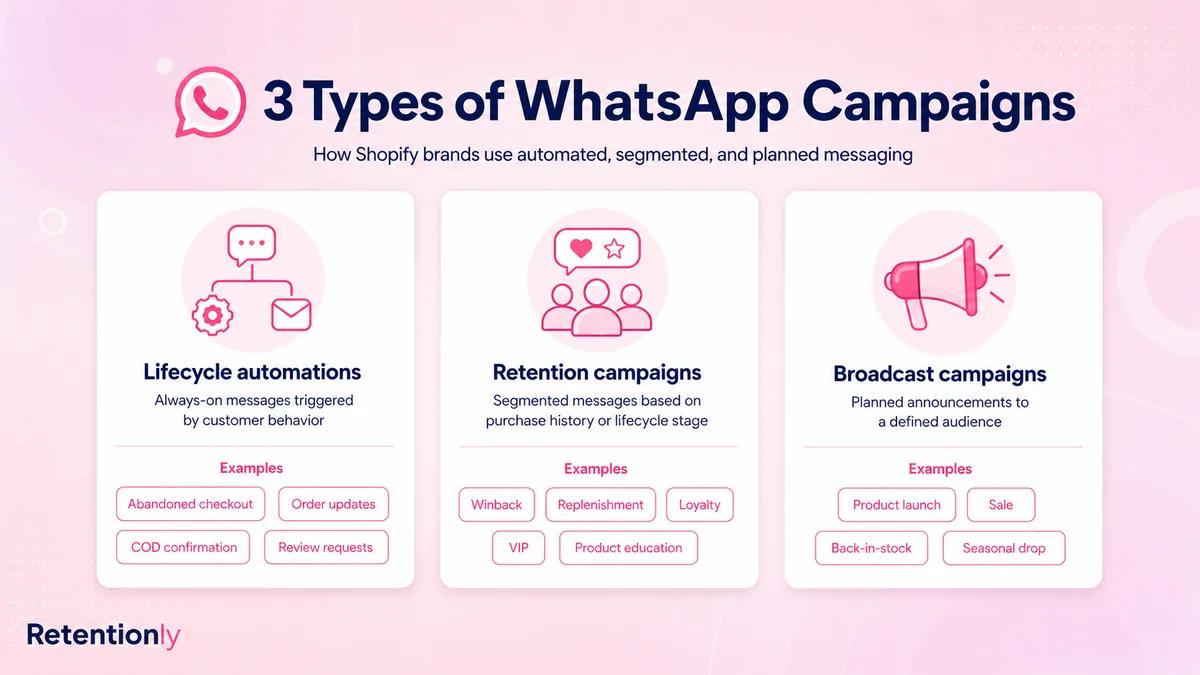
| Message type | When it runs | Example | Main metric |
|---|---|---|---|
| Lifecycle automation | Triggered by Shopify behavior | Abandoned checkout, order update, review request | Recovered revenue, support deflection, reviews |
| Retention campaign | Sent to a defined customer segment | Reorder reminder for buyers likely to run out | Repeat purchase revenue |
| Broadcast campaign | Sent for a store event | Launch, sale, restock, seasonal drop | Revenue per recipient and opt-outs |
Most Shopify brands should start with lifecycle automation. It is easier to justify because it responds to customer behavior instead of asking the whole list to pay attention again.
Retention campaigns come next. They use Shopify data to identify customers who should hear from the brand: repeat buyers, VIPs, product-specific buyers, lapsed customers, subscription candidates, or customers likely to need a refill.
Broadcasts should be used carefully. They can work for a launch, restock, or seasonal sale, but they become expensive and risky when every promotion goes to every contact.
Build The Retention Map From Shopify Events
A practical WhatsApp retention plan starts with the customer journey, not the message editor.
| Shopify moment | WhatsApp retention job | Good first action |
|---|---|---|
| Checkout started, no order | Recover purchase intent | Send a helpful cart reminder with checkout link |
| COD order placed | Reduce cancellation and RTO risk | Ask the customer to confirm the order or address |
| Order fulfilled | Reduce support load | Send shipping or tracking update |
| Delivery completed | Prepare for repeat purchase | Send usage guidance, care tips, or review timing |
| Product cycle ending | Drive reorder | Send refill reminder with product context |
| Second purchase completed | Build habit | Invite bundle, subscription, or VIP segment |
| No purchase after expected cycle | Win back | Send a reason to return, not only a coupon |
| Negative reply or support issue | Protect trust | Pause promotional flow and route to support |
This map keeps the channel disciplined. Every message has a trigger, a reason, and a measurable outcome.
The First Retention Flows To Launch
Do not begin with a complex full-funnel program. Start with the flows closest to money, trust, and customer experience.
1. Abandoned checkout recovery
Abandoned checkout recovery is usually the cleanest first WhatsApp retention flow because the customer already showed buying intent.
A strong first message should not feel like pressure. It should help the shopper finish what they already started:
Hi [first_name], you left a few items in your cart at [store_name]. Want to complete your order? Here is your checkout link: [checkout_url]
For higher-consideration products, the better message may be support-led:
Hi [first_name], still deciding on [product_name]? Reply here if you want help with sizing, delivery, ingredients, or payment before you checkout.
Measure recovered revenue, checkout clicks, conversion rate after click, opt-outs, and replies that reveal purchase objections.
2. COD confirmation
If your Shopify store accepts cash on delivery, WhatsApp can protect retention before fulfillment even begins. A customer who forgets, mistypes an address, or changes their mind creates cost and a poor experience.
Use WhatsApp to confirm intent:
Hi [first_name], your COD order [order_number] from [store_name] is ready to process. Please reply CONFIRM to keep it active or CANCEL if you changed your mind.
COD confirmation is retention work because it protects the first order experience. A smoother delivery makes the second order more likely.
3. Order and delivery updates
Order updates are not promotional, but they support retention by reducing anxiety and support tickets. A customer who knows what is happening is less likely to cancel, complain, or ignore future messages.
Useful updates include order confirmation, shipping confirmation, out-for-delivery, delivery completion, delay alerts, and failed-delivery follow-up.
Keep these messages short. Give the customer the specific update and one clear next step.
4. Review requests
Reviews should be timed after the customer has had a real chance to use the product. Asking too early hurts the response. Asking too late loses the moment.
For a consumable product, wait long enough for usage. For fashion, wait until delivery and initial try-on. For beauty, wait for a usage window that makes sense for the product.
Hi [first_name], hope you are enjoying [product_name]. Could you leave a quick review? It helps other shoppers choose with confidence: [review_link]
Review flows also reveal support issues. If the customer replies with a problem, the automation should route the conversation to a person instead of pushing for a public review.
5. Reorder reminders
Reorder reminders are the most direct repeat-purchase use case. The mistake is sending them on one fixed schedule for every product.
Better timing depends on product type, pack size, order quantity, and actual purchase history. A 30-day refill product, a 90-day supplement, a snack bundle, and a skincare routine should not share one reminder window.
The message should name the previous product and make reordering easy:
Hi [first_name], it may be time to restock [product_name]. Reorder here in one tap: [product_url]
Measure repeat purchase revenue, reorder rate, days between orders, and unsubscribes.
6. Winback campaigns
Winback is useful, but it should not be the first retention flow. By the time a customer is inactive, earlier retention opportunities have already been missed.
Use winback after you define the normal buying cycle. A lapsed coffee buyer may be late after 45 days. A mattress buyer is not lapsed after 45 days.
Good winback reasons include a replenishment reminder, a new product in the same category, a back-in-stock alert, a limited batch, a bundle, or a loyalty benefit. A discount can work, but it should not be the only idea.
Segment Retention Messages By Buying Context
Retention marketing gets sharper when segments are tied to why the customer might buy again.
| Segment | WhatsApp angle |
|---|---|
| First-time buyers | Delivery reassurance, usage help, review timing |
| Second-order customers | Habit-building, bundles, subscription prompt |
| Product-specific buyers | Refill, accessory, cross-sell, care guide |
| VIP buyers | Early access, restocks, loyalty offers |
| COD buyers | Confirmation, delivery readiness, prepaid conversion |
| Lapsed buyers | Relevant return reason based on last category |
| Support-risk customers | Human handoff before any promotion |
| Discount-only buyers | Controlled offer frequency and margin guardrails |
This is where Shopify data matters. Last product, order count, order value, tags, fulfillment status, discount usage, and last purchase date should shape the message.
Use Suppression Rules Before Scaling
Suppression rules protect the customer relationship. Without them, WhatsApp retention can quickly feel intrusive.
Create rules that stop or delay marketing messages when:
an order is currently delayed or unresolved
the customer has an open support issue
the customer recently received another WhatsApp campaign
a refund, return, cancellation, or failed delivery is active
the customer opted out or replied negatively
the next message has no clear customer benefit
Suppression is especially important on WhatsApp because replies are visible and immediate. A customer who is angry about a late order should not receive a product-launch promotion the same day.
Plan Message Timing By Lifecycle Stage
Timing should follow customer intent.
| Lifecycle stage | Good WhatsApp timing | Poor timing |
|---|---|---|
| Cart recovery | Within hours of abandonment | Several days later with no context |
| COD confirmation | Before fulfillment | After dispatch |
| Delivery update | When status changes | Repeating the same tracking link daily |
| Review request | After expected product use | Immediately after purchase |
| Reorder reminder | Before the product runs out | Random monthly campaign |
| Winback | After expected cycle has passed | Too soon after first order |
| VIP campaign | Before public launch | After inventory is gone |
For retention, relevance usually beats volume. A smaller segment with strong timing will often outperform a larger list with a weaker reason to message.
What To Measure
Do not judge every WhatsApp retention message by open rate. Open rate can look impressive while the flow fails commercially.
Track the metric that matches the job:
| Flow | Primary metric | Watch-out metric |
|---|---|---|
| Abandoned checkout | Recovered revenue | Conversion after click |
| COD confirmation | Confirmed orders and reduced RTO | Cancellations caused by unclear copy |
| Order updates | Lower support tickets | Repeated replies asking the same question |
| Review request | Reviews collected | Negative replies needing support |
| Reorder reminder | Repeat purchase revenue | Opt-outs after reminders |
| Winback | Reactivated customers | Discount dependence |
| Broadcast | Revenue per recipient | Unsubscribes and spam signals |
Also watch customer-level frequency. A customer may be eligible for a cart reminder, shipping update, review request, reorder reminder, and sale campaign in the same week. That does not mean they should receive all of them.
Common Mistakes
The biggest mistake is treating WhatsApp like a bulk sender. That may create short-term clicks, but it weakens the channel.
Other common mistakes include:
launching broadcasts before always-on revenue flows
using the same timing for every product category
measuring only opens and clicks
ignoring reply ownership and support handoff
sending promotions during unresolved delivery or support problems
asking for reviews before the customer can form an opinion
sending winback discounts too early
failing to separate utility messages from marketing campaigns
Good retention marketing feels timely. Bad retention marketing feels like pressure.
Where Retentionly Fits
Retentionly is built for Shopify stores that want WhatsApp automation tied to ecommerce events, not a generic messaging setup.
Use Retentionly when you want to launch flows around abandoned checkout recovery, COD confirmation, order updates, review requests, reorders, winback, upsells, welcome messages, and retention campaigns without stitching together a broad WhatsApp stack.
The practical advantage is workflow ownership. A retention owner can define the trigger, timing, segment, message, stop rule, and metric for each flow from a Shopify-first point of view.
Start with one or two revenue flows, then add the retention campaigns that match your product cycle. Install Free on Shopify and make WhatsApp a repeat-purchase channel instead of another noisy promotion list.
FAQ
What is WhatsApp retention marketing for Shopify?
WhatsApp retention marketing for Shopify means using WhatsApp messages to recover carts, improve post-purchase communication, collect reviews, drive reorders, win back inactive buyers, and increase repeat purchases based on Shopify customer and order data.
Is WhatsApp better for retention than email?
WhatsApp is better for urgent, conversational, action-oriented moments. Email is still useful for longer education, brand content, and lower-pressure nurturing. The strongest retention plan often uses both, with WhatsApp reserved for moments where timing and reply handling matter.
What should a Shopify store automate first?
Start with abandoned checkout recovery, COD confirmation if relevant, order updates, and review requests. After those are stable, add reorder reminders, winback campaigns, upsells, and VIP or product-drop segments.
How often should Shopify stores send WhatsApp retention campaigns?
Frequency should depend on buying cycle, customer segment, and recent message history. A customer should not receive every eligible message. Use suppression rules to avoid sending promotions during open support issues, recent campaigns, delivery problems, or opt-out risk.
What is the main metric for WhatsApp retention?
The main metric is repeat purchase revenue, but each flow needs its own metric. Cart recovery should track recovered revenue, review requests should track reviews collected, order updates should track support reduction, and winback should track reactivated customers.