Manychat Alternative for WhatsApp Retention Automation
TL;DRA Manychat alternative is worth comparing when your WhatsApp roadmap is less about social chat automation and more about Shopify retention: abandoned checkout recovery, COD confirmation, order updates, review requests, winback, repeat purchases, and post-purchase upsells.
Manychat can be a strong choice for teams that want one automation workspace for Instagram, Messenger, TikTok, WhatsApp, SMS, and email. But if your team is searching for a Manychat alternative because Shopify workflows feel harder than they should, the decision should not start with chatbot features. It should start with store events.
This guide compares Manychat with a Shopify-first WhatsApp retention tool like Retentionly, so you can decide whether you need broader conversation automation or a more focused way to turn Shopify moments into measurable lifecycle revenue.
Quick Verdict
Choose Manychat if WhatsApp is one channel inside a broader social, creator, or multichannel chat automation system. It is especially relevant when the same team wants to automate Instagram comments, DMs, lead qualification, FAQs, broadcasts, and follow-up conversations.
Choose Retentionly if the main goal is Shopify WhatsApp retention automation. That means store-triggered flows, message templates, stop rules, order context, customer segments, and revenue metrics matter more than managing every social channel from one builder.
| Decision point | Manychat | Retentionly |
|---|---|---|
| Best fit | Social-first and multichannel conversation automation | Shopify/D2C WhatsApp retention automation |
| Primary buyer | Creator, marketer, agency, brand, or team managing engagement across channels | Shopify founder, marketer, or ecommerce manager focused on retention revenue |
| WhatsApp role | One supported channel inside a broader automation account | Core retention channel connected to Shopify workflows |
| Strongest use cases | Lead capture, FAQs, broadcasts, comment-to-DM journeys, campaign replies, inbox routing | Abandoned checkout, COD confirmation, order updates, reviews, winback, reorder, upsell |
| Pricing model to inspect | Plan tier, active contacts, users, channels, WhatsApp conversation costs, wallet funding, add-ons | Fixed app plan plus Meta message fees with no Retentionly markup |
| Main tradeoff | More channel flexibility, more workflow planning for Shopify retention | Narrower platform scope, clearer ownership of Shopify lifecycle flows |
The practical question is not whether Manychat is good software. The question is whether it owns the job you need WhatsApp to do for your store.
Why Teams Look For A Manychat Alternative
Most Manychat alternatives searches start after a team has already seen the appeal of automation. They want faster replies, better follow-up, fewer manual conversations, and a way to convert attention into revenue.
For Shopify teams, the friction usually appears when the first workflow becomes more specific than "send a WhatsApp message."
An abandoned checkout reminder needs the checkout link, timing, template approval, discount decision, and purchase stop rule. A COD confirmation flow needs the payment method, order value, fulfillment decision, confirm/cancel reply path, and no-response handling. A review request needs delivery timing, product context, review destination, and a support handoff if the customer is unhappy.
Those are not generic chat problems. They are Shopify lifecycle problems.
Manychat may still work if your team is prepared to design, connect, and maintain those details. But if the team wants the retention workflow to be the product's center of gravity, a Shopify-first alternative will usually be easier to evaluate.
For the broader category view, read the Manychat WhatsApp Automation guide and the Shopify WhatsApp Automation guide.
Pricing Model: What To Compare Before Switching
Do not compare Manychat and Retentionly only by the lowest monthly price on each website.
Manychat's public pricing is built around plan tiers and active contacts. Its pricing page currently lists Free, Essential, Pro, Business, and Advanced plans with different active-contact allowances, channel limits, user counts, inbox capacity, and AI or broadcast features. The WhatsApp product page also says WhatsApp has separate conversation-based costs, with country-based pricing and wallet funding for WhatsApp automation.
That is not automatically bad. It just means a Shopify team should model the total cost of the first real workflows before deciding.
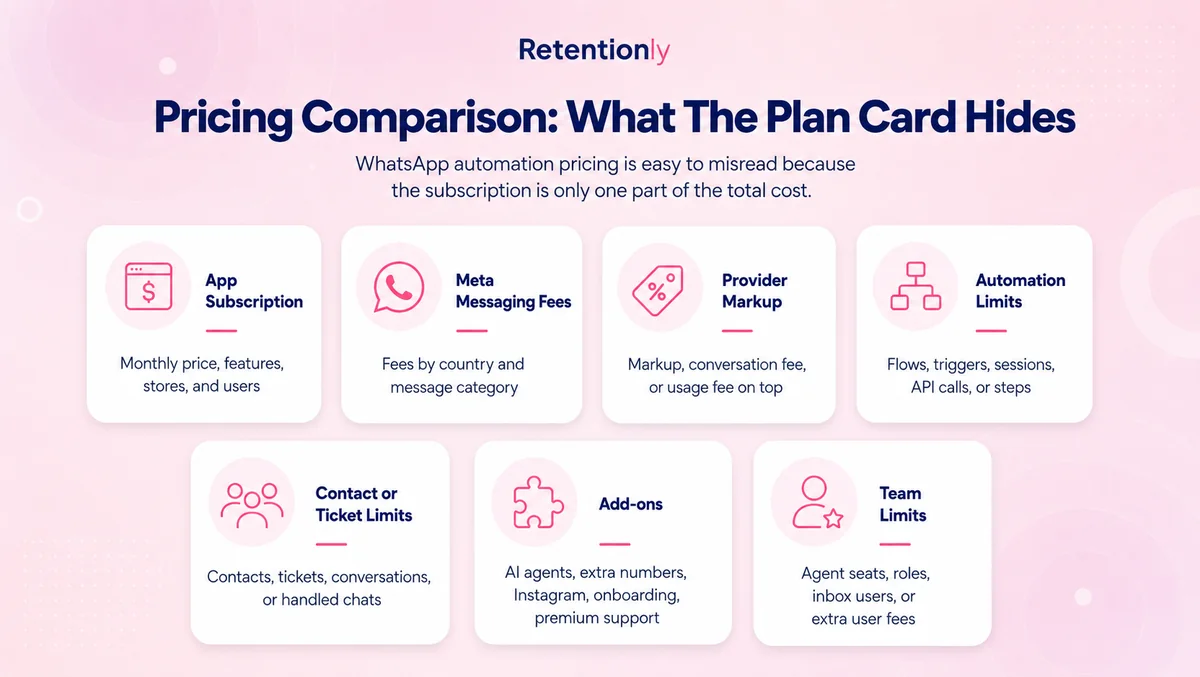
| Cost layer | What to verify with Manychat | What to verify with Retentionly |
|---|---|---|
| Software plan | Which plan unlocks the channels, users, automations, broadcasts, AI, and inbox features you need? | Which Retentionly plan fits your automation scope: Basic, Growth, or Scale? |
| Contact or usage growth | How active-contact billing and overages change as WhatsApp conversations grow | Whether your plan supports the workflows and team needs you expect |
| WhatsApp message costs | Conversation or wallet charges, country rates, template categories, and who bills what | Meta message fees through your direct connection, with no Retentionly markup |
| Shopify workflow setup | Whether Shopify events, variables, stop rules, and reporting need extra setup or middleware | Which Shopify-triggered flows are ready to launch from the app |
| Team time | Who maintains flows, tags, segments, channel logic, and reporting | Who owns message copy, launch decisions, and optimization |
Retentionly's pricing is simpler to forecast for Shopify WhatsApp retention: Basic at $24/month, Growth at $49/month, and Scale at $99/month. Retentionly connects directly to Meta, does not add a markup on Meta message fees, does not charge per-chat fees, and does not charge extra for added automations.
The deciding point is not only price. It is whether the cost model stays understandable as your store adds more retention workflows.
Feature Comparison
Manychat and Retentionly overlap at the surface because both can be part of WhatsApp automation. They differ in what they are organized around.
| Feature or workflow | Manychat | Retentionly |
|---|---|---|
| Instagram, Messenger, TikTok, SMS, and email automation | Strong fit | Not the primary wedge |
| WhatsApp FAQs and lead qualification | Strong fit | Useful around retention flows, but not the core reason to choose it |
| Broadcast campaigns | Strong fit for broad audience engagement | Supported with a Shopify retention lens |
| Abandoned checkout recovery | Possible if Shopify data, timing, template, and stop rules are wired cleanly | Core workflow |
| COD confirmation | Requires order/payment context and reply handling tied to fulfillment decisions | Core workflow |
| Order and shipping updates | Useful if order status and tracking data are connected | Core lifecycle automation |
| Review requests | Needs delivery timing, review link, and unhappy-customer handling | Core post-purchase workflow |
| Winback campaigns | Possible with segments and campaign logic | Growth-plan retention workflow |
| Reorder reminders | Needs purchase-history and product-cycle logic | Built around repeat purchase timing |
| Post-purchase upsell | Possible with product and customer segmentation | Core revenue expansion workflow |
| Shopify revenue attribution | Depends on setup and reporting design | Central buying criterion |
| Best-fit team | Social, creator, agency, or multichannel marketing team | Shopify/D2C team focused on lifecycle revenue |
If your first three WhatsApp workflows are comments, DMs, FAQs, and lead capture, Manychat may be the more natural fit. If your first three workflows are checkout recovery, COD confirmation, and review requests, Retentionly is closer to the job.
Shopify Workflow Ownership Matters More Than Builder Flexibility
A flexible builder is valuable when someone owns the logic. It becomes overhead when a lean ecommerce team only needs a few high-impact WhatsApp workflows to run cleanly.
For Shopify retention, every workflow should have seven parts:
| Workflow component | Example |
|---|---|
| Trigger | Checkout abandoned, order created, item delivered, customer inactive |
| Audience | Eligible customer segment, consent status, order condition, product type |
| Timing | Send after 30 minutes, after shipment, after delivery, after replenishment window |
| Message | Approved template, variables, CTA, tone, fallback |
| Stop rule | Purchase completed, order canceled, opt-out, support issue, reply received |
| Reply path | Bot answer, confirm/cancel action, human handoff, support escalation |
| Metric | Recovered revenue, confirmed orders, fewer tickets, reviews collected, repeat orders |
Manychat can help if your team can map those parts into its automation model and keep them maintained. Retentionly is the better alternative when you want those parts to be native to how the tool thinks about ecommerce retention.
When Manychat Is Still The Better Fit
Manychat is still a good fit when the business wants WhatsApp as part of a broader engagement machine.
That can mean Instagram comment-to-DM campaigns, creator launches, lead magnets, webinar follow-ups, FAQ automation, campaign replies, Messenger journeys, TikTok engagement, SMS or email collection, and a shared inbox for social-led conversations. In that setup, Shopify may be one destination inside a broader customer journey, not the system that defines every message.
Manychat also makes sense when a marketer, agency, or growth operator will actively manage the automation account. The flexibility has value when someone is responsible for tags, segments, flows, broadcasts, inbox rules, AI replies, and cross-channel experiments.
Do not choose a Manychat alternative just because you want something simpler. Choose one because your operating model is different.
When Retentionly Is The Better Manychat Alternative
Retentionly is the better Manychat alternative when WhatsApp is supposed to behave like a Shopify retention channel, not a generic chat layer.
That usually means your team cares about questions like:
Which abandoned checkout messages recovered revenue?
Which COD orders were confirmed before fulfillment?
Which shipping updates reduced support load?
Which review requests reached customers after delivery?
Which winback segment brought inactive buyers back?
Which reorder reminder matched the product's purchase cycle?
Which post-purchase upsell increased repeat revenue without spamming customers?
Those questions require Shopify context. The message is only one part of the workflow.
Retentionly is built for stores that want clear retention automations without assembling a broad WhatsApp operations stack first. It is not trying to replace every social automation or creator workflow. It is built to own the Shopify events that matter for repeat purchase and lifecycle revenue.
Migration Checklist
If you are already using Manychat and considering an alternative, do not migrate everything at once. Start with the workflows where Shopify state matters most.
| Step | What to check |
|---|---|
| 1. List active flows | Separate social engagement flows from Shopify revenue workflows |
| 2. Identify the first retention workflow | Usually abandoned checkout, COD confirmation, order updates, reviews, winback, reorder, or upsell |
| 3. Export the logic | Capture trigger, timing, template, segment, stop rule, reply handling, and metric |
| 4. Check consent | Confirm the opt-in source and message promise for each WhatsApp audience |
| 5. Rebuild one workflow first | Launch the highest-value Shopify flow before moving every automation |
| 6. Compare results | Measure recovered revenue, confirmed orders, tickets reduced, reviews collected, repeat orders, and opt-outs |
| 7. Keep what Manychat does best | Leave social DM, creator, or broad chat workflows where they already work well |
The cleanest migration is not "replace Manychat everywhere." It is "move Shopify retention workflows to the tool that owns Shopify retention best."
Common Mistakes
The first mistake is comparing feature lists before defining the job. A tool with more channels may be worse for a store that only needs Shopify-triggered WhatsApp flows to run correctly.
The second mistake is treating WhatsApp replies as the only metric. Replies matter, but ecommerce teams should also track recovered checkouts, confirmed COD orders, support deflection, review collection, repeat purchases, winback revenue, upsell revenue, and opt-outs.
The third mistake is ignoring total cost. Plan tier, active contacts, WhatsApp conversation charges, wallet funding, message categories, country rates, add-ons, and team maintenance time can all change the real cost of automation.
The fourth mistake is over-migrating. If Manychat is working well for Instagram, creator campaigns, or lead capture, keep those flows there. Move the workflows where Shopify context, stop rules, and retention measurement are the constraint.
Final Recommendation
Manychat is a strong option when WhatsApp is part of a broader social and multichannel conversation strategy. It can help teams automate FAQs, qualify leads, run broadcasts, follow up with prospects, and manage engagement across channels.
Retentionly is the better Manychat alternative when the buying reason is Shopify retention automation. If your WhatsApp roadmap is built around abandoned checkout recovery, COD confirmation, order updates, review requests, winback, reorder reminders, post-purchase upsells, and measurable repeat revenue, choose the tool organized around those workflows.
Install Free on Shopify if you want WhatsApp automation centered on Shopify events, retention revenue, and simpler message economics instead of a broad social automation stack.
Quick FAQs
What is the best Manychat alternative for Shopify WhatsApp automation?
The best Manychat alternative depends on the job. For social and multichannel chat automation, a broad automation platform can make sense. For Shopify WhatsApp retention workflows, Retentionly is a stronger fit because it is built around store events, lifecycle automations, and retention revenue.
Why would a Shopify store switch from Manychat?
A Shopify store may switch when its WhatsApp workflows depend heavily on checkout, order, delivery, review, winback, reorder, or upsell data. If those workflows require too much manual setup or maintenance in a broad chat tool, a Shopify-first retention app can be easier to operate.
Is Manychat bad for ecommerce?
No. Manychat can be useful for ecommerce teams that need chat automation, lead capture, FAQs, broadcasts, social DM journeys, and follow-up conversations. The tradeoff is fit: Shopify retention workflows need clean event ownership, stop rules, and ecommerce reporting.
What should I compare before choosing a Manychat alternative?
Compare Shopify integration depth, workflow triggers, WhatsApp template handling, stop rules, reply routing, revenue reporting, plan limits, active-contact or usage costs, Meta message fees, support needs, and who will maintain the automation logic.
Can Retentionly replace every Manychat workflow?
Retentionly is not meant to replace every social or multichannel automation workflow. It is meant to replace or own Shopify WhatsApp retention workflows such as abandoned checkout, COD confirmation, order updates, reviews, winback, reorders, upsells, and retention broadcasts.