Manychat WhatsApp Automation: What Ecommerce Teams Should Know
TL;DRManychat WhatsApp automation can be useful when a team wants social-first chat automation across channels such as Instagram, Messenger, TikTok, SMS, email, and WhatsApp. For ecommerce teams, the buying question is narrower: will Manychat own the Shopify workflows that recover carts, confirm COD orders, reduce support load, collect reviews, and bring customers back to buy again?
That distinction matters because Manychat is a strong automation builder for conversations and social engagement. But Shopify WhatsApp retention is not only a chatbot problem. It is an event problem: checkout abandoned, order created, order shipped, delivery completed, customer inactive, product due for reorder, or buyer ready for an upsell.
This guide explains where Manychat fits, what ecommerce teams should verify before using it for WhatsApp, and when a Shopify-first retention automation tool like Retentionly is the cleaner path.
Quick Verdict
Manychat is worth evaluating if your team already uses social chat automation, wants a visual flow builder, and needs WhatsApp as one channel inside a broader conversation stack.
Retentionly is the stronger fit if your main goal is Shopify WhatsApp retention automation: abandoned checkout recovery, COD confirmation, order updates, review requests, winback, post-purchase upsell, and repeat purchase workflows.
| Buying question | Manychat | Retentionly |
|---|---|---|
| Main center of gravity | Social and multichannel chat automation | Shopify and D2C retention automation |
| Best-fit use case | Lead capture, FAQs, broadcasts, follow-ups, and conversation flows across channels | Shopify-triggered lifecycle revenue workflows |
| WhatsApp role | One channel inside a broader automation account | Primary retention channel connected to Shopify events |
| Pricing model to verify | Plan tier, active contacts, WhatsApp availability, wallet/message charges, and add-ons | Fixed plans, direct Meta connection, no Retentionly markup on Meta fees |
| Main tradeoff | Flexible chat automation, but Shopify workflow ownership may need more planning | Narrower scope, clearer retention workflow economics |
If WhatsApp is part of a creator, social, or broad lead funnel, Manychat can make sense. If WhatsApp needs to behave like a Shopify retention channel, start by comparing the actual workflows your store will run.
What Manychat WhatsApp Automation Does Well
Manychat's strength is conversation automation. Its WhatsApp product positioning emphasizes answering FAQs, qualifying leads, replying outside business hours, sending broadcasts, creating welcome messages, following up, and using automations to move conversations toward sales.
That is useful for ecommerce teams when the job is conversational:
| Ecommerce need | Where Manychat can help |
|---|---|
| Repeated product questions | Build FAQ and routing flows |
| Inbound WhatsApp replies | Classify intent and reply quickly |
| Lead capture | Collect phone numbers, emails, or preferences |
| Campaign replies | Route high-intent customers after a promotion |
| Social-to-chat journeys | Move Instagram, Messenger, or TikTok engagement into owned follow-up |
| Basic support triage | Answer common questions and hand off exceptions |
The value is highest when a team thinks in conversations first. A visual builder, tags, segments, broadcasts, and inbox workflows can help organize those conversations without writing custom code.
Where Ecommerce Teams Need More Than A Chat Flow
Shopify retention workflows start before the customer sends a message. The store event decides who should receive a WhatsApp message, when it should send, what it should include, and when it should stop.
| Shopify moment | What the automation must know |
|---|---|
| Checkout abandoned | Checkout link, product, timing, discount rule, purchase stop rule |
| COD order placed | Payment method, order value, fulfillment hold, confirm/cancel reply path |
| Order shipped | Tracking link, carrier status, delivery expectations, support fallback |
| Product delivered | Delivery timing, product use window, review link, unhappy-reply routing |
| Customer inactive | Last purchase date, customer value, segment, suppression rules |
| Reorder window reached | Product cycle, purchase quantity, last order date, replenishment timing |
| Upsell opportunity | Purchased product, complementary offer, margin, purchase stop rule |
This is the gap ecommerce teams should inspect. A chat automation tool may send messages and handle replies, but the revenue result depends on Shopify state, eligibility, timing, stop rules, and attribution.
For a broader framework, read the Shopify WhatsApp Automation Guide and the WhatsApp Automation Tool Buyer Guide.
Pricing And Cost Model To Check
Do not evaluate Manychat WhatsApp automation only by the lowest visible subscription price.
Manychat's public pricing surfaces show several plan levels based on active contacts and channels, and its WhatsApp page explains that WhatsApp has separate billing considerations. Before choosing it for ecommerce, verify the live plan page, WhatsApp availability for your account, active-contact billing, message or wallet charges, and whether the exact Shopify workflows you need require paid features or extra tools.
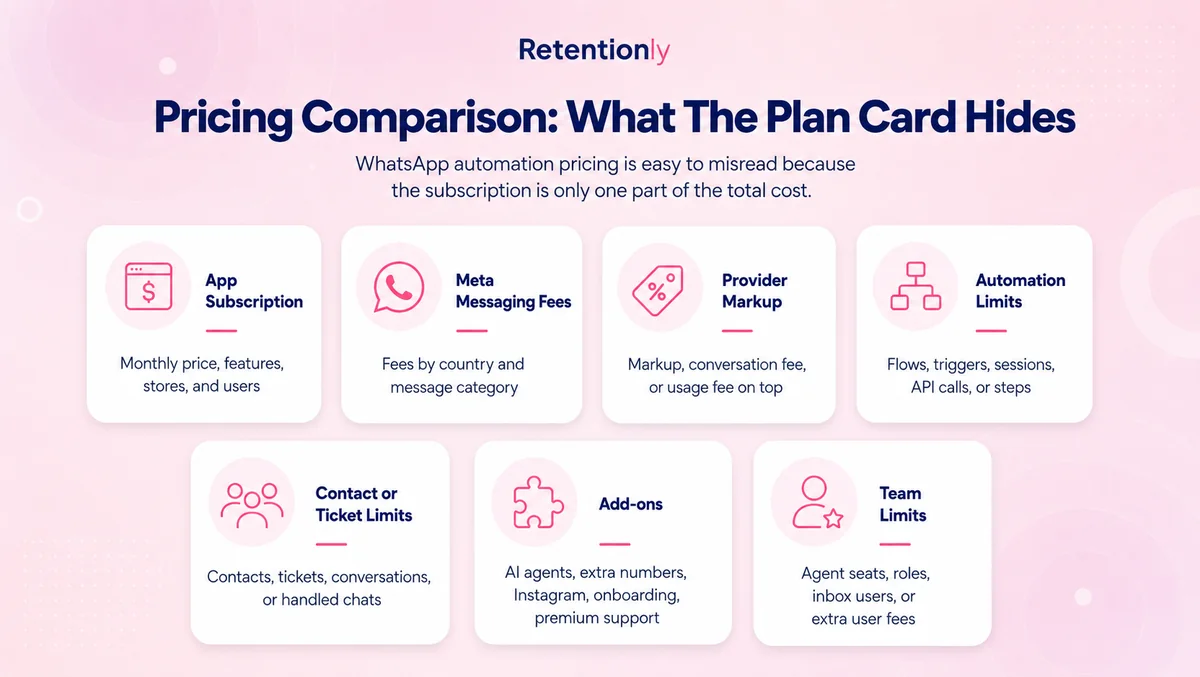
| Cost layer | What to verify |
|---|---|
| Manychat subscription | Which plan unlocks the channels, users, automations, and contact volume you need? |
| Active contacts | How does contact-based billing change as WhatsApp replies, broadcasts, and automations grow? |
| WhatsApp charges | What message or wallet charges apply for your customer countries and message categories? |
| Shopify connection | Is Shopify context native enough for cart, order, delivery, review, and repeat purchase workflows? |
| Add-ons or integrations | Do you need middleware, ecommerce integrations, AI, SMS, email, or extra inbox capacity? |
| Team time | Who will maintain flows, tags, segments, handoff rules, and reporting? |
The right comparison is not "Manychat versus Retentionly by monthly price." It is "Which cost model gets our first retention workflows live and measurable with the least operational drag?"
Manychat Vs Retentionly For Shopify Workflows
| Workflow | Manychat fit | Retentionly fit |
|---|---|---|
| Abandoned checkout recovery | Possible if Shopify checkout data, timing, message template, and purchase stop rules are wired cleanly | Core workflow |
| COD confirmation | Needs order/payment context and reply handling tied to fulfillment decisions | Core workflow |
| Order updates | Useful if order status and tracking context are available to the WhatsApp flow | Core lifecycle automation |
| Review requests | Needs delivery timing, review destination, and unhappy-reply suppression | Core post-purchase retention use case |
| Winback | Possible with segmentation and campaign logic | Growth plan includes advanced automations such as winback |
| Reorder reminders | Needs product cycle and purchase-history logic | Core repeat purchase workflow |
| Post-purchase upsell | Possible with product and customer segmentation | Core post-purchase revenue workflow |
| Broadcast campaigns | Strong fit for segmented conversation campaigns | Supported after lifecycle discipline is in place |
| Chatbot and FAQ replies | Strong fit | Useful as support around retention flows |
| Multichannel social automation | Strong fit | Not Retentionly's primary wedge |
Manychat can be the better tool if your team wants WhatsApp inside a broad chat marketing system. Retentionly is the better tool when the WhatsApp roadmap is mostly Shopify retention.
When Manychat Is The Better Fit
Choose Manychat when the team already thinks in social and conversation funnels.
That can mean Instagram comment-to-DM flows, Messenger automation, TikTok-driven engagement, lead magnets, qualification sequences, WhatsApp follow-ups, email or SMS collection, and a shared automation workspace for multiple channels. In that environment, WhatsApp is one part of a broader customer conversation system.
Manychat can also make sense when the first WhatsApp goal is to answer repeat questions, qualify inbound leads, reply outside business hours, or run campaign follow-ups where the store team is comfortable maintaining chat flows.
The key is to be honest about ownership. If a marketer or agency will actively maintain the Manychat account, tags, flow logic, and campaign calendar, the flexibility has value.
When Retentionly Is The Better Fit
Choose Retentionly when WhatsApp is supposed to improve Shopify retention metrics rather than become a broad chat automation project.
Retentionly is built around store-triggered workflows:
| Retention goal | Example WhatsApp workflow |
|---|---|
| Recover revenue | Abandoned checkout reminders with purchase stop rules |
| Reduce fulfillment waste | COD confirmation before shipment |
| Lower support load | Order and shipping updates |
| Build social proof | Review requests after delivery |
| Increase repeat purchase | Reorder reminders based on product cycles |
| Bring customers back | Winback campaigns for inactive buyers |
| Grow order value | Post-purchase upsell flows |
Retentionly's pricing is also simpler for Shopify teams to forecast: Basic at $24/month, Growth at $49/month, and Scale at $99/month. It connects directly to Meta, does not add a markup on Meta message fees, does not charge per-chat fees, and does not charge extra for added automations.
That does not make Retentionly the broadest chat platform. It makes it easier to answer the question Shopify operators care about: which WhatsApp flows are live, what do they cost, and what revenue or operational result did they produce?
Setup Checklist Before Choosing Manychat
Before choosing Manychat for WhatsApp automation, map one Shopify use case from trigger to result.
| Setup decision | What to define |
|---|---|
| First workflow | Abandoned checkout, COD confirmation, order update, review request, winback, reorder, or upsell |
| Shopify trigger | The exact event or segment that starts the message |
| WhatsApp template | Copy, variables, approval category, and fallback |
| Timing | When the message sends and how many follow-ups are allowed |
| Stop rule | Purchase completed, order canceled, customer opted out, support issue opened, or reply received |
| Reply owner | Bot answer, inbox handoff, support team, founder, or automation update |
| Measurement | Recovered revenue, confirmed COD orders, fewer support tickets, reviews collected, repeat orders |
If this map is easy to build and maintain inside Manychat, it may be a good fit. If the map requires too much middleware, manual tagging, or reporting cleanup, a Shopify-first automation app is likely the better starting point.
Common Mistakes
The first mistake is treating WhatsApp automation as a chatbot project. Chatbot replies matter, but Shopify retention depends on store events and stop rules.
The second mistake is letting social-channel logic drive ecommerce messaging. A flow that works for Instagram lead magnets may not work for COD confirmation, review requests, or repeat purchase reminders.
The third mistake is ignoring message economics. WhatsApp costs depend on plan terms, contact volume, message categories, countries, provider rules, and any wallet or markup model. Model the first three months before committing.
The fourth mistake is measuring only conversations. Ecommerce teams should measure recovered checkouts, confirmed orders, repeat purchases, support deflection, review collection, opt-outs, and revenue attribution.
The fifth mistake is buying flexibility before the first workflow is clear. A flexible builder is useful when someone owns it. It becomes overhead when the team only needs a few repeatable Shopify lifecycle flows.
Final Recommendation
Manychat WhatsApp automation is a serious option for ecommerce teams that want multichannel chat automation and are prepared to design, maintain, and measure conversation flows.
But if your reason for researching Manychat is Shopify retention, compare it against the workflows that should pay for the channel: abandoned checkout, COD confirmation, order updates, review requests, winback, reorders, and post-purchase upsells.
Retentionly is built for that second job. Install Free on Shopify if you want WhatsApp automation centered on Shopify events, retention revenue, and simpler message economics instead of a broad social automation stack.
Quick FAQs
Is Manychat good for WhatsApp automation?
Manychat can be good for WhatsApp automation when the team wants chat flows, FAQs, lead qualification, broadcasts, and multichannel conversation automation. Ecommerce teams should verify how well it handles Shopify event triggers, stop rules, and retention reporting.
Can Manychat handle Shopify abandoned cart WhatsApp messages?
Manychat may support abandoned cart-style workflows when Shopify data and automation rules are connected properly. Before relying on it, confirm checkout trigger access, cart-link variables, timing, template approval, purchase stop rules, and revenue attribution.
What should I compare before choosing Manychat for ecommerce?
Compare plan tier, active-contact billing, WhatsApp message charges, Shopify integration depth, workflow setup effort, reply handling, reporting, and whether your first use case is a social chat funnel or a Shopify retention workflow.
Is Manychat a Retentionly alternative?
Manychat can be an alternative if the buyer wants broad chat automation across several channels. Retentionly is a better alternative when the main job is Shopify WhatsApp retention automation with focused ecommerce flows.
When should a Shopify store choose Retentionly instead of Manychat?
Choose Retentionly when the store wants Shopify-triggered WhatsApp flows for abandoned checkout recovery, COD confirmation, order updates, reviews, winback, reorders, upsells, and retention broadcasts without building a broader social automation stack first.