WhatsApp CRM Software: Ecommerce Features to Compare
TL;DRWhatsApp CRM software should help an ecommerce team remember the right customer context and act on it at the right moment. For a Shopify store, that means more than storing contacts or giving agents a shared inbox. The useful CRM layer connects WhatsApp conversations to customer history, order status, checkout behavior, consent, segments, and repeat-purchase opportunities.
That distinction matters because "WhatsApp CRM" can mean several different products. Some tools are built for support teams. Some are sales inboxes. Some are broad WhatsApp Business platforms with broadcasts, chatbots, catalogs, and agent routing. Some are retention automation apps that use Shopify events to start the right WhatsApp message without turning the channel into a manual operations queue.
This guide shows ecommerce teams how to compare WhatsApp CRM software by customer data, automation depth, segmentation, handoff, reporting, pricing, and team fit.
Quick Verdict
Choose WhatsApp CRM software based on the job your team needs WhatsApp to do every week.
| Ecommerce need | Best-fit CRM layer | Why it matters |
|---|---|---|
| Recover abandoned checkouts, confirm COD orders, request reviews, trigger reorders, and win back customers | Shopify-first WhatsApp retention automation | The message should start from store behavior, not a manually updated contact list |
| Manage a high volume of support conversations | Shared inbox or ecommerce helpdesk with WhatsApp | Agents need assignments, context, macros, and escalation workflows |
| Run sales chats, catalogs, chatbots, and broadcasts from one place | Broad WhatsApp commerce platform | The team is using WhatsApp as a sales and operations channel |
| Connect WhatsApp to a custom data stack | API provider or custom CRM integration | Engineering owns the workflow logic and data model |
| Start with measurable retention before expanding | Retentionly or another Shopify retention tool | The first success metric is recovered revenue, repeat purchase, or reduced support load |
For many ecommerce teams, the best WhatsApp CRM is not the broadest one. It is the one that can turn customer moments into clean workflows: trigger, timing, segment, message, fallback, and metric.
What WhatsApp CRM Software Means For Ecommerce
WhatsApp CRM software is the system that helps a business manage customer relationships over WhatsApp. In ecommerce, that usually includes some mix of contact profiles, conversation history, customer tags, segments, team inboxes, automated messages, chatbot replies, campaign tools, and reporting.
The important question is where the CRM gets its customer memory.
If the CRM only remembers WhatsApp chat history, it can help agents reply. But it may not know enough to trigger useful ecommerce workflows. A Shopify team also needs store context: cart activity, order value, fulfillment state, payment method, product purchased, review timing, last purchase date, opt-in status, and suppression rules.
| CRM memory | Ecommerce use |
|---|---|
| WhatsApp conversation history | Understand prior replies, complaints, preferences, and open questions |
| Shopify customer profile | Personalize by customer, order count, tags, and lifetime behavior |
| Checkout and cart events | Trigger abandoned checkout recovery while purchase intent is fresh |
| Order and fulfillment status | Send order confirmations, shipping updates, delivery updates, and delay messages |
| Product and category history | Power reorder reminders, replenishment nudges, bundles, and upsells |
| Consent and opt-out state | Keep campaigns permission-based and avoid over-messaging |
| Support handoff state | Route replies, complaints, address changes, and delivery issues to the right person |
A CRM that understands these moments can do more than centralize conversations. It can help the team build a retention system.
The Main Types Of WhatsApp CRM Software
Most ecommerce buyers compare different categories under the same search. Put each option in the right box before comparing feature lists.
| Software type | What it usually does well | Watch-out |
|---|---|---|
| Shared WhatsApp inbox | Assignment, team replies, labels, saved replies, open conversations | Strong for support, but not always strong at Shopify-triggered lifecycle flows |
| Ecommerce helpdesk or CRM | Support tickets, order context, multi-channel inbox, macros, customer history | WhatsApp marketing and retention may be one feature inside a larger helpdesk |
| Broad WhatsApp platform | Broadcasts, templates, chatbots, contacts, inbox, analytics, catalog selling | Useful breadth, but setup and pricing can grow with agents, add-ons, and usage |
| Shopify WhatsApp automation app | Store triggers, lifecycle flows, message templates, revenue reporting, reply handoff | Best when retention owns WhatsApp; not meant to replace every support or sales workflow |
| API or BSP-led setup | WhatsApp API access, message delivery, webhooks, custom integrations | Flexible, but the merchant still has to build the CRM logic |
Zoko, Wati, Interakt, Dondy, and DelightChat all validate the broad market. Their content and app listings commonly mention inboxes, chatbots, broadcasts, campaigns, support, catalogs, Shopify integration, abandoned checkout recovery, order updates, and AI. That breadth can be useful, but it also makes the buying decision noisy.
For a Shopify merchant, the cleaner question is: which system should own WhatsApp customer relationships for revenue moments?
Features To Compare First
A long CRM feature list can hide weak ecommerce workflow fit. Start with features that change day-to-day outcomes.
| Feature | What good looks like | Weak version |
|---|---|---|
| Shopify data connection | Customer, order, checkout, product, tag, segment, and fulfillment context are usable in workflows | Only basic contact sync or manual imports |
| Lifecycle automation | Abandoned checkout, COD confirmation, order updates, reviews, winback, reorders, and upsells have clear triggers and stop rules | Broadcasts and generic autoresponders only |
| Segmentation | Segments use purchase behavior, recency, products, value, location, payment method, and consent | Segments are only labels or static lists |
| Reply handoff | Replies from automations reach a clear inbox or owner with order context | Messages go out, but replies become messy |
| Campaign controls | Scheduling, suppression, opt-outs, frequency control, and audience checks are built in | Easy sending without enough guardrails |
| Reporting | Flow-level results connect to replies, recovered orders, repeat purchase, COD confirmations, and support load | Only message delivery and open conversation counts |
| Pricing clarity | Software fee, Meta fees, seats, contacts, AI, add-ons, and usage charges are easy to model | Low entry price with unclear scaling costs |
If a WhatsApp CRM cannot answer these questions clearly, the team may end up with a contact database that does not improve retention.
Workflow Comparison For Shopify Teams
The best way to test WhatsApp CRM fit is to map each product against real customer moments.
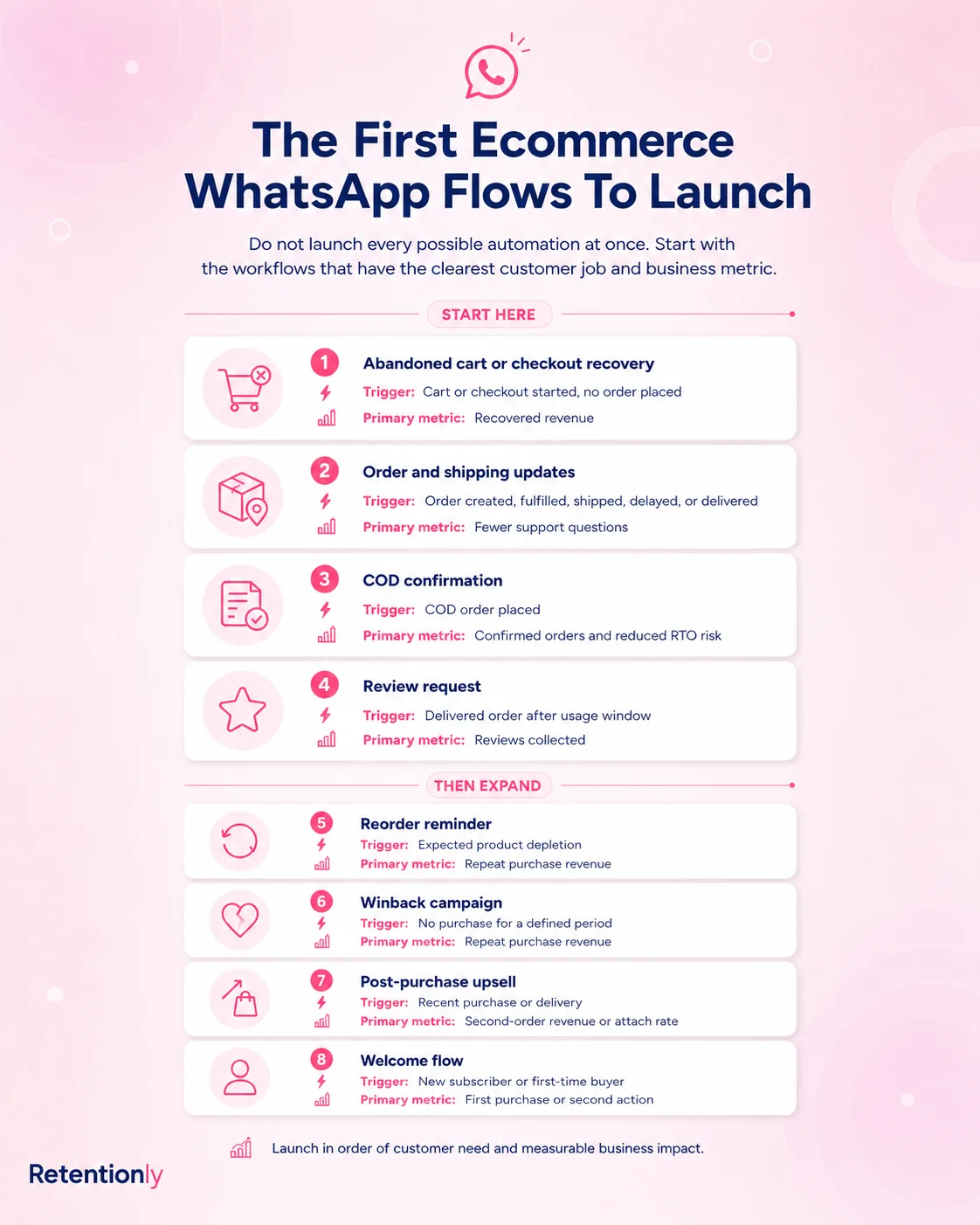
| Workflow | CRM data needed | Automation requirement | Success metric |
|---|---|---|---|
| Abandoned checkout | Cart link, checkout value, products, customer phone, prior reminders | Delay, reminder copy, stop on purchase, reply handling | Recovered revenue and conversion rate |
| COD confirmation | Payment method, order risk, address, phone, fulfillment state | Confirm, cancel, change-address, and no-response paths | Confirmed orders and lower avoidable RTO |
| Order updates | Order status, fulfillment, tracking, delivery events | Confirmation, shipping, delivery, and delay messages | Fewer "where is my order" tickets |
| Review requests | Delivery timing, review-app destination, support exceptions | Ask after delivery and route unhappy replies first | Review rate and issue recovery |
| Winback | Last purchase date, products, value, customer segment | Offer logic, suppression, timing, stop on purchase | Repeat purchase revenue |
| Reorder reminders | Product consumption cycle and purchase history | Replenishment timing, product link, frequency cap | Repeat orders |
| Post-purchase upsell | Product purchased, compatible add-ons, margin, timing | Relevant offer after purchase without interrupting fulfillment | Upsell conversion and AOV lift |
| Broadcasts | Consent, segments, campaign calendar, opt-outs | Send to the right list with reply ownership | Revenue, replies, opt-outs, unsubscribes |
For tactical examples, read the Shopify Abandoned Cart WhatsApp Recovery Guide, Shopify COD Confirmation WhatsApp Guide, and Shopify Order Updates WhatsApp Automation Guide.
CRM, Inbox, Chatbot, And Automation Are Different Jobs
WhatsApp CRM software often bundles several layers together. That can be convenient, but the layers solve different problems.
| Layer | Best job | Main risk |
|---|---|---|
| CRM profile | Store customer memory, tags, history, and context | Data sits unused if it does not trigger action |
| Shared inbox | Help agents reply, assign, label, and resolve conversations | WhatsApp becomes support-first by default |
| Chatbot | Answer repeat questions and route common replies | Wrong answers or over-automation in sensitive moments |
| Lifecycle automation | Send the right message after a Shopify customer event | Poor timing, no stop rules, or unclear ownership |
| Campaign manager | Send segmented promotions and announcements | Turning WhatsApp into a bulk sending channel |
The strongest setup combines these layers around ownership. Support should own unresolved questions. Marketing should own campaigns. Retention should own lifecycle flows. Operations may own COD confirmation and delivery exceptions.
When every team treats WhatsApp as "the CRM," customers receive too many messages. When each workflow has an owner, WhatsApp feels useful instead of noisy.
Pricing: Compare The Whole Cost Model
WhatsApp CRM software pricing has more moving parts than the monthly subscription card.
| Cost layer | What to verify |
|---|---|
| Software subscription | Monthly price, annual discount, included features, and plan limits |
| Meta messaging fees | WhatsApp Business Platform fees by message category, country, and delivery volume |
| Provider markup or usage fee | Whether the vendor passes Meta fees through or adds markup, conversation fees, wallet fees, or handled-chat charges |
| Seats and inbox users | Included agents, extra users, roles, permissions, and team routing |
| Contact or conversation limits | Active contacts, tickets, conversations, broadcast audiences, and fair-use rules |
| Automation limits | Flow count, trigger volume, campaign credits, API calls, webhooks, and custom workflow access |
| AI and chatbot add-ons | AI replies, bot sessions, training, product recommendations, and automation assistants |
| Implementation effort | Setup, templates, migration, testing, and weekly optimization time |
Retentionly keeps this simpler for Shopify WhatsApp retention automation:
| Retentionly plan | Price | Best for |
|---|---|---|
| Basic | $24/month | Basic automations and core features |
| Growth | $49/month | Broadcasts and advanced automations, including winback workflows |
| Scale | $99/month | CRM features and multi-agent chat |
Retentionly connects directly to Meta, does not add a markup on Meta messaging fees, does not charge extra for added automations, and does not charge per chat. That matters when WhatsApp moves from one test flow to multiple lifecycle workflows.
Competitor pricing can change and may depend on region, message volume, agent count, add-ons, or annual billing. Before buying any WhatsApp CRM, calculate the cost of your first three months with the workflows you actually plan to launch.
When A Broad WhatsApp CRM Is Better
A broad WhatsApp CRM can be the right choice when WhatsApp is a company-wide operating system.
Choose a broader platform when sales, support, marketing, and operations all work inside WhatsApp every day. It may also fit when catalog selling is central, live agents handle high chat volume, AI support is a major buying criterion, or the business needs WhatsApp connected to several non-Shopify systems.
In that case, inbox depth, routing, permissions, chatbot controls, analytics, and CRM integrations may matter as much as retention automations. A broad platform can justify its complexity when many teams will use the same WhatsApp workspace.
The warning is not that broad platforms are bad. The warning is that ecommerce teams often buy the broadest product before proving the first revenue workflow.
When A Shopify Retention Tool Is Better
A Shopify retention tool is the better fit when WhatsApp is primarily owned by a founder, ecommerce manager, lifecycle marketer, retention lead, or operations owner.
Choose this path when the first goals are:
Recover more abandoned checkouts.
Confirm COD orders before fulfillment.
Reduce repetitive order-status questions.
Request reviews after delivery.
Bring back dormant customers.
Trigger reorder reminders.
Send post-purchase upsells.
Run segmented broadcasts without losing lifecycle discipline.
This is where Retentionly fits. It is built around Shopify customer moments rather than a generic CRM record. The store action creates the message opportunity, the workflow controls the timing, and the result is measured in revenue, repeat purchase, support reduction, or operational confidence.
How To Evaluate Your Shortlist
Before choosing WhatsApp CRM software, give each vendor the same test scenario.
| Test question | Strong answer |
|---|---|
| Can we launch abandoned checkout recovery without custom development? | The tool supports Shopify checkout triggers, cart links, timing, purchase stop rules, and recovery reporting |
| Can we segment by purchase history? | The tool can use recency, order count, product purchased, tags, value, and customer behavior |
| Can replies from automated messages reach the right owner? | The tool has a clear inbox or handoff path with enough customer and order context |
| Can we prevent over-messaging? | The tool supports consent, opt-outs, suppression, frequency caps, and stop rules |
| Can we see what worked? | Reporting ties flows to recovered orders, repeat purchases, replies, and support reduction |
| Can our team maintain this weekly? | The workflow owner can adjust templates, timing, segments, and reporting without engineering help |
The best answer is not always the most technical one. It is the answer your team can actually operate after launch.
Common Mistakes To Avoid
The first mistake is treating WhatsApp CRM as a contact list. Ecommerce CRM value comes from behavior: what the customer viewed, started, bought, received, reviewed, ignored, or needs next.
The second mistake is buying a shared inbox when the real problem is lifecycle automation. An inbox helps with replies, but it does not automatically recover carts, confirm COD orders, time review requests, or win back dormant buyers.
The third mistake is buying a broad platform because it feels safer. More features help when the business needs them. They slow the team down when the first goal is a few high-impact retention flows.
The fourth mistake is ignoring message cost. Meta fees, provider markups, contact tiers, agents, AI add-ons, and automation limits can make two tools with similar monthly subscriptions behave very differently at scale.
The fifth mistake is leaving ownership vague. If nobody owns replies, exceptions, opt-outs, and weekly optimization, WhatsApp CRM turns into another unmanaged channel.
Final Recommendation
Choose WhatsApp CRM software by the customer relationship you want to improve first.
If WhatsApp is mainly a support desk, shortlist helpdesk-led CRM tools and shared inbox platforms. If WhatsApp is a sales channel, compare catalog, agent, chatbot, and campaign depth. If your team has developers and wants full control, compare API-first providers and custom CRM integrations.
But if WhatsApp is meant to improve Shopify retention, start with lifecycle workflows: abandoned checkout, COD confirmation, order updates, reviews, winback, reorders, and post-purchase upsells.
Retentionly is built for that job: Shopify-triggered WhatsApp automations, customer-context-aware workflows, reply handoff, and clear pricing without Retentionly markup on Meta messaging fees.
Quick FAQs
What is WhatsApp CRM software?
WhatsApp CRM software helps businesses manage customer relationships over WhatsApp. For ecommerce, it can include customer profiles, chat history, Shopify data, segmentation, broadcasts, chatbots, shared inboxes, automation workflows, and reporting.
Is WhatsApp CRM software the same as a shared inbox?
No. A shared inbox is one part of WhatsApp CRM software. A CRM layer should also help the team use customer context, segments, order history, automation rules, reporting, and handoff workflows.
What WhatsApp CRM features matter most for Shopify stores?
Prioritize Shopify customer data, abandoned checkout triggers, COD confirmation, order updates, review requests, winback and reorder flows, segmentation, consent controls, reply handoff, and revenue reporting.
Should ecommerce teams choose a broad WhatsApp CRM or a retention automation app?
Choose a broad WhatsApp CRM when sales, support, catalog, campaigns, chatbots, and agent operations all need one workspace. Choose a retention automation app when Shopify lifecycle revenue is the first job.
Where does Retentionly fit?
Retentionly fits when a Shopify or D2C team wants WhatsApp automation tied to store events and retention outcomes rather than a generic CRM database or full omnichannel helpdesk.