WhatsApp Business API Solution: BSP, Platform, or Automation App?
TL;DRA WhatsApp Business API solution is not one product category. It can mean a direct API provider, a Business Solution Provider, a broad WhatsApp sales and support platform, or a Shopify automation app that hides much of the API work behind ready-made retention flows.
That distinction matters before you buy. The wrong route can leave a Shopify team with API access but no abandoned checkout recovery, no COD confirmation, no order-update workflow, no reply ownership, and no clean way to measure repeat revenue.
Quick Decision Tree
Choose the route based on who will own WhatsApp after launch.
| If WhatsApp will be owned by... | Choose this route | Why |
|---|---|---|
| Developers, an agency, or an internal platform team | API provider or BSP | You want infrastructure control and can build the workflow layer |
| Sales, support, and operations teams | Broad WhatsApp platform | You need inboxes, agents, campaigns, catalogs, routing, and multi-team workflows |
| Shopify founders, marketers, ecommerce managers, or retention teams | Shopify automation app | You want store-event flows live without building API plumbing |
| One person answering customers manually | WhatsApp Business app | You need simple one-to-one chat, not scalable automation |
| A storefront contact entry point | Chat widget | You need an easy customer contact path, not a complete API solution |
Most ecommerce teams searching for a WhatsApp Business API solution are not really buying the API. They are buying an operating model for WhatsApp. The better question is: which route gets the team closest to the workflows it will actually run every week?
What The Solution Must Actually Solve
The WhatsApp Business Platform gives businesses scalable messaging through approved templates, customer-service windows, business phone numbers, webhooks, and message delivery. Meta pricing is based on delivered messages, recipient market, and message category, with marketing, utility, authentication, and service categories.
That platform layer is only the base. A useful solution also needs to answer practical operating questions.
| Layer | Decision to make | Ecommerce consequence |
|---|---|---|
| Account and number setup | Who creates or connects the WABA, phone number, business portfolio, permissions, and templates? | Delays here block every proactive message |
| Messaging infrastructure | Who handles API access, hosting, webhooks, billing, rate limits, and delivery? | This decides technical ownership |
| Workflow software | Who handles Shopify triggers, timing, segments, templates, stop rules, fallback paths, and reporting? | This decides whether WhatsApp becomes revenue automation |
| Reply operations | Who owns customer replies, labels, assignments, and order context? | Every automation can create a sales or support conversation |
| Cost control | Who explains Meta fees, platform fees, markups, seats, credits, contacts, AI, and add-ons? | The cheapest entry plan may not be the lowest operating cost |
If a vendor only says it provides "official API access," keep going. Official access matters, but a Shopify store still needs the layer that turns access into abandoned checkout recovery, COD confirmation, order updates, review requests, winback, reorders, upsells, and compliant broadcasts.
Route 1: API Provider Or BSP
An API provider or BSP is the most technical route. You are buying access, setup support, message delivery, billing, documentation, and sometimes partner help around WhatsApp Business Platform operations.
This can be the right choice when your team wants direct control over systems. It fits SaaS products, marketplaces, larger brands with internal engineering, custom CRM builds, agencies, and teams that need to own webhooks, data flows, message routing, and integrations themselves.
The tradeoff is that the ecommerce work still belongs to you. Someone must connect Shopify events, design template logic, build suppression rules, route replies, reconcile orders, monitor opt-outs, and create reporting.
| Strong fit | Watch the tradeoff |
|---|---|
| Custom data architecture | Longer build cycle before merchant workflows go live |
| Developer control over endpoints and webhooks | Engineering owns ongoing fixes and changes |
| Multi-system routing across CRM, warehouse, support, and custom apps | Shopify retention flows must be designed separately |
| Partner-led implementation | Scope can expand beyond the first revenue workflows |
Choose this route when infrastructure control is worth the implementation effort. Do not choose it simply because "API" sounds more official.
Route 2: Broad WhatsApp Platform
A broad WhatsApp platform packages API access with software for teams. This route usually includes a shared inbox, campaigns, customer lists, chatbots, automation builders, catalog tools, AI agents, analytics, and ecommerce integrations.
This can make sense when WhatsApp is a company-wide operating channel. Sales agents may use catalogs, support may need assignment and routing, marketers may send campaigns, and operators may want one place to manage WhatsApp conversations.
Competitor pages in this category often emphasize Shopify catalog sync, abandoned cart reminders, broadcasts, COD messages, order notifications, shared inboxes, AI assistants, and customer-support workflows. Those are useful capabilities when the team will truly use the broader platform.
The risk is overbuying. If the first job is a focused retention program, the team can spend more time configuring platform surface area than improving the flows that generate revenue.
| Strong fit | Watch the tradeoff |
|---|---|
| WhatsApp is used by sales, support, marketing, and operations | More plan variables, limits, add-ons, and team setup |
| Catalog selling inside WhatsApp matters | Retention workflows may be one module among many |
| Shared inbox and agent routing are central | Costs can scale with users, contacts, conversations, AI, or campaigns |
| Chatbots and AI agents handle repeated questions | The first workflow can take longer to isolate and measure |
Choose this route when WhatsApp is an operating workspace. Be careful when the real goal is only Shopify lifecycle automation.
Route 3: Shopify Automation App
A Shopify automation app is the product-led route. The API exists underneath, but the buyer is not trying to manage the API directly. The buyer wants Shopify events to trigger useful WhatsApp workflows.
For a retention team, this is usually the clearest route because the important unit is not the endpoint. It is the flow:
| Flow | Trigger | What the solution must own |
|---|---|---|
| Abandoned checkout | Checkout started or checkout left incomplete | Delay, cart link, reminder copy, stop-on-purchase, revenue tracking |
| COD confirmation | COD order created | Confirm/cancel reply, hold path, tags, no-response handling |
| Order updates | Order, fulfillment, shipping, delivery, or delay event | Utility template, tracking context, support-reduction metric |
| Review request | Delivered order or post-delivery window | Review-app handoff, reminder timing, suppression |
| Winback | Last purchase date or inactive segment | Offer logic, frequency cap, opt-out handling, repeat revenue |
| Reorder reminder | Product purchase cycle | Timing, segment, product context, repeat purchase tracking |
| Post-purchase upsell | Recent order and product relationship | Complementary offer, margin check, timing, conversion metric |
| Broadcast campaign | Segment, consent, and campaign calendar | Suppression, reply owner, opt-outs, revenue and reply reporting |
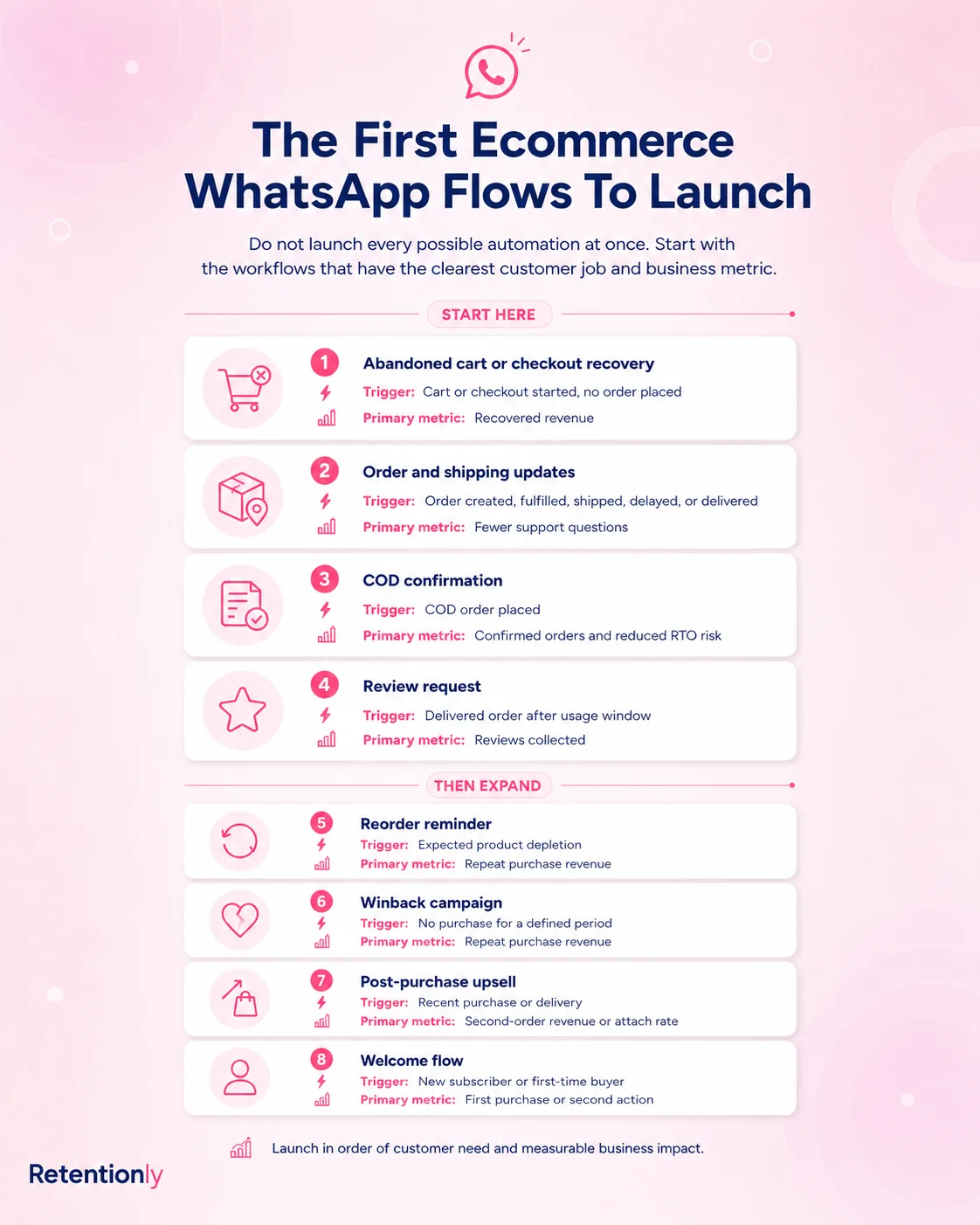
This route is strongest when the team wants practical WhatsApp retention automation without assigning engineering to build the surrounding workflow system.
Cost Comparison: The Route Changes The Bill
WhatsApp Business API cost is not one line item. Meta message fees are only one part of the model.
| Cost layer | API provider or BSP | Broad WhatsApp platform | Shopify automation app |
|---|---|---|---|
| Meta message fees | Usually visible as pass-through or rate-card based | May be pass-through, marked up, or bundled | Should be clearly separated from app pricing |
| Software subscription | Often lower if you buy only infrastructure | Usually tied to plans, users, contacts, or features | Usually tied to Shopify workflow access |
| Implementation effort | Highest unless your team already has the systems | Medium; setup depends on platform breadth | Lower when workflows are already productized |
| Seats and inbox use | Built by your team or added separately | Common pricing variable | Depends on app plan and team chat needs |
| Automation limits | Built by your team | Can depend on credits, flows, steps, or add-ons | Should map to the ecommerce flows you need |
| AI and chatbot costs | Built or bought separately | Common add-on | Useful only if tied to ecommerce reply handling |
| Reporting | Built by your team | Usually broad campaign and inbox analytics | Should connect to recovered revenue and retention metrics |
The lowest-looking option can become expensive if it pushes workflow design, implementation, maintenance, and reporting back onto your team. The best comparison includes both vendor costs and owner costs.
How To Evaluate A Shortlist
Use one real Shopify scenario before you compare abstract feature lists.
If abandoned checkout recovery is the first use case, ask each vendor to show the trigger, delay, message template, cart link, stop-on-purchase rule, reply owner, and recovered revenue metric. If COD confirmation is the first use case, ask for the confirm/cancel path, no-response handling, fulfillment decision, and RTO reporting. If order updates are the first use case, ask how utility templates, shipment events, tracking links, and support replies work.
Then score each solution route.
| Evaluation question | Why it matters |
|---|---|
| Can the workflow launch without custom development? | Determines speed to value |
| Can the business user edit timing, templates, and segments safely? | Determines whether the flow improves after launch |
| Are Meta fees, markups, credits, contacts, seats, and add-ons clear? | Prevents surprise cost after volume grows |
| Does the solution know Shopify order and customer context? | Keeps messages relevant |
| Can replies be assigned with enough order context? | Prevents automations from creating unmanaged conversations |
| Can the team measure the workflow's commercial outcome? | Keeps WhatsApp tied to revenue, support reduction, or repeat purchase |
This test keeps the decision grounded. A broad platform may win if you need an operating workspace. A BSP may win if engineering needs control. A Shopify automation app may win if lifecycle revenue is the job.
Where Retentionly Fits
Retentionly is the Shopify-first route for merchants who want WhatsApp retention automation rather than raw API ownership or a broad support workspace.
It is built around the workflows Shopify teams actually run: abandoned checkout recovery, COD confirmation, order updates, review requests, winback, reorder reminders, post-purchase upsells, welcome flows, and segmented broadcasts.
Retentionly is a strong fit when:
The buyer is a founder, marketer, ecommerce manager, or retention lead.
Shopify events should trigger WhatsApp messages without custom engineering.
The team wants lifecycle revenue, not generic bulk sending.
Replies need a clear handoff path.
Reporting should connect to recovered revenue and repeat purchase behavior.
Pricing should not add a Retentionly markup on Meta messaging fees.
Retentionly plans are straightforward:
| Plan | Price | Best for |
|---|---|---|
| Basic | $24/month | Basic automations and core features |
| Growth | $49/month | Broadcasts and advanced automations, including winback workflows |
| Scale | $99/month | CRM features and multi-agent chat |
Retentionly does not charge extra for added automations and does not charge per chat. That makes the route easier to evaluate when the store wants to expand from one flow into a broader retention program.
When Not To Choose A Shopify Automation App
A Shopify automation app is not always the right answer.
Choose an API provider or BSP when your business needs deep custom infrastructure, direct API control, non-Shopify routing, custom CRM behavior, agency-led implementation, or a technical owner who wants to design the whole messaging system.
Choose a broad WhatsApp platform when WhatsApp is a shared workspace for sales, support, campaigns, catalogs, AI agents, and multi-channel operations. If agents live in WhatsApp all day, the inbox and routing layer may matter as much as retention automation.
Choose Retentionly when the reason for buying a WhatsApp Business API solution is simpler: your Shopify store wants retention workflows live, measurable, and owned by the people responsible for revenue.
Final Recommendation
Do not choose a WhatsApp Business API solution by asking which product has the most features. Choose it by asking who will own the channel and what work must happen after the number is connected.
If engineering owns the channel, start with a BSP or API provider. If sales and support own WhatsApp as a daily workspace, compare broad platforms. If retention owns the channel and the goal is Shopify lifecycle revenue, choose a Shopify automation app.
Retentionly is built for that third route: Shopify-triggered WhatsApp workflows, retention-first automation, reply handoff, and pricing that keeps Meta message fees separate from the app subscription.
Quick FAQs
What is a WhatsApp Business API solution?
A WhatsApp Business API solution is the setup, infrastructure, software, and operating layer that lets a business use the WhatsApp Business Platform. Depending on the vendor, it may be an API provider, BSP, broad WhatsApp platform, helpdesk, or Shopify automation app.
Is a BSP the same as a WhatsApp platform?
Not always. A BSP or API provider helps with access and infrastructure. A WhatsApp platform usually adds software such as inboxes, campaigns, contacts, automations, chatbots, reporting, and team workflows.
What is the best route for Shopify stores?
For Shopify stores focused on abandoned checkout recovery, COD confirmation, order updates, reviews, winback, reorders, upsells, and repeat purchases, a Shopify automation app is usually the cleanest route. Developer-led or support-heavy teams may need a different route.
Does a Shopify automation app still use the WhatsApp Business API?
Yes, scalable proactive WhatsApp messaging usually depends on the WhatsApp Business Platform. The difference is that the app productizes setup, templates, Shopify triggers, automations, reply handling, and reporting so the merchant does not have to build those pieces directly.
When should a merchant choose Retentionly?
Choose Retentionly when the main goal is Shopify WhatsApp retention automation rather than raw API access or a broad sales and support workspace. It is built for store-event workflows that recover revenue, reduce support load, and bring customers back.