WhatsApp Business API Pricing in India: What Store Owners Should Know
TL;DRWhatsApp Business API pricing in India is not one flat monthly fee. The real bill usually combines Meta's delivered-message charges, your provider or platform fees, GST, any markup or wallet rules, and the software you use to connect WhatsApp to ecommerce workflows.
That distinction matters for Shopify stores in India. A store sending COD confirmation and order updates has a different cost profile from a brand sending abandoned checkout reminders, winback campaigns, product launches, and repeat purchase nudges.
This guide explains how to think about WhatsApp Business API pricing in India without turning it into a generic rate-card article. Use it to budget the flows that matter: abandoned checkout recovery, COD confirmation, prepaid conversion, order updates, review requests, winback, and repeat purchases.
Quick Verdict
If you only need manual WhatsApp conversations, the WhatsApp Business app may be enough. It is not the same as API-backed Shopify automation, and it does not need the same per-template-message budget.
If you need developer control, a direct API provider or BSP can work. Compare the Meta rate pass-through, phone-number or channel fees, support, throughput, wallet rules, and any per-message provider fee.
If you need a broad WhatsApp operations platform, compare subscription plans, agents, inbox features, campaigns, chatbots, AI, Shopify integrations, flow limits, and add-ons. The monthly plan is only one part of the bill.
If your real job is Shopify retention automation, start with the workflows. Retentionly is built for Shopify and D2C teams that want WhatsApp to recover revenue and reduce operational friction without managing a broad WhatsApp stack.
| Buyer type | What to compare in India | Best fit |
|---|---|---|
| Manual WhatsApp seller | Business app setup, team time, response volume | Small teams replying by hand |
| Direct API/BSP buyer | Meta India rates, number or channel fee, provider markup, support, developer effort | Engineering-led teams that want API control |
| Broad WhatsApp platform buyer | Plan, message wallet, users, automations, campaigns, inbox, AI, Shopify features | Teams using WhatsApp for sales, support, marketing, and operations |
| Shopify retention buyer | App plan, Meta fee handling, included flows, revenue tracking, setup speed | Shopify stores focused on lifecycle revenue |
How WhatsApp Business API Pricing Works In India
Meta's WhatsApp Business Platform pricing is message-based. Businesses are charged when a message is delivered, and the rate depends on the recipient market and the message category.
For Indian customers, that means you should check the India row in Meta's current rate card and the billing currency attached to your WhatsApp Business Account. India pricing is usually discussed in INR, but your final setup can still depend on the provider, billing configuration, taxes, and whether you send to customers outside India.
The four message categories matter:
| Message category | Common India ecommerce use | Budgeting note |
|---|---|---|
| Marketing | Abandoned checkout reminders, sale announcements, product recommendations, winback offers | Usually the biggest cost driver for revenue campaigns |
| Utility | Order confirmation, shipping update, payment update, delivery notification | Often lower than marketing, but template content must stay transactional |
| Authentication | OTPs, login codes, account verification | Relevant for apps and account flows, less central to most Shopify retention teams |
| Service | Replies after a customer messages the business | Currently useful for support economics, but always verify current Meta rules before budgeting at scale |
Public India-facing pricing pages in July 2026 commonly show marketing messages around the high-paise range and utility/authentication messages far lower. Treat those as directional planning inputs, not permanent numbers. Meta rates can change by market, category, currency, and volume tier, and provider pages may include their own markup or plan assumptions.
The safer budgeting rule is simple: verify Meta's current India rate card, then add the provider or software costs separately.
The Four Cost Layers Indian Stores Should Separate
The easiest way to make a bad pricing decision is to mix all WhatsApp costs into one number.
Separate the bill into four layers.
| Cost layer | What it includes | Why it matters |
|---|---|---|
| Meta message fees | Delivered messages by destination market and category | This is the base usage cost of API-backed messaging |
| Provider or BSP fees | Number hosting, channel license, provider markup, wallet rules, support | This changes a lot between vendors |
| Software or platform fees | Inbox, campaigns, automations, Shopify integration, reporting, AI, seats, flows | This determines what your team can actually launch |
| Taxes and accounting | GST, currency, invoice source, prepaid credits, reconciliation | Important for Indian finance teams and agencies managing multiple stores |
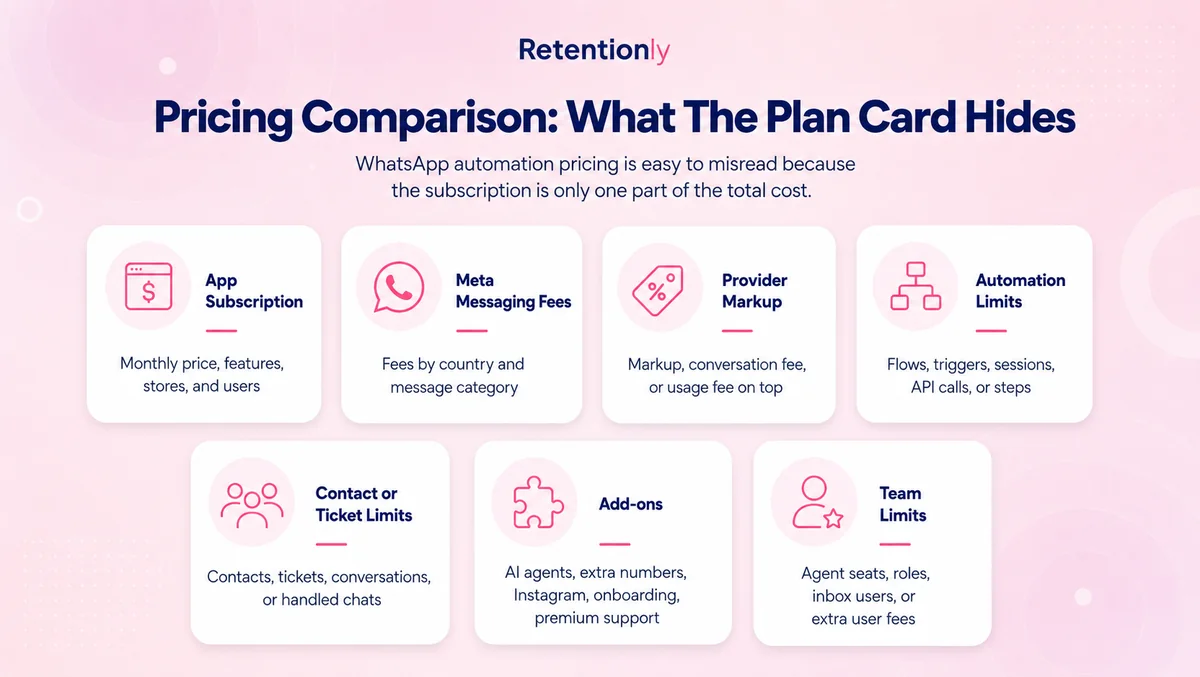
A low message rate is not automatically a low total cost. A tool can look cheap per message but require a higher plan, prepaid wallet, flow add-on, agent fee, AI usage charge, or custom implementation. Another tool can have a higher monthly subscription but include the Shopify workflows that make WhatsApp profitable.
For Shopify stores, total cost should be tied to the flows you plan to run, not only to the provider rate card.
A Shopify India Workflow Budget
Start with the first 90 days of automation. Most stores do not need to model every possible WhatsApp use case on day one.
| Shopify workflow | Common India trigger | Likely category | What to measure |
|---|---|---|---|
| Abandoned checkout recovery | Checkout started but no purchase | Marketing | Recovered orders, conversion rate, discount cost, opt-outs |
| COD confirmation | COD order created | Utility or marketing depending on template content | Confirmation rate, fake-order reduction, RTO reduction |
| COD to prepaid | COD buyer offered a prepaid incentive | Marketing or utility depending on message content | Prepaid conversion, margin saved, failed delivery reduction |
| Order updates | Order placed, shipped, out for delivery, delivered | Utility | Fewer WISMO tickets, buyer confidence, support load |
| Review request | Delivered order after a delay | Marketing or utility depending on template content | Reviews collected, repeat purchase lift, reply rate |
| Winback | No purchase after a set number of days | Marketing | Repeat orders, contribution margin, opt-outs |
| Reorder reminder | Expected replenishment window | Marketing or utility depending on template content | Repeat purchase rate, revenue per delivered message |
| Post-purchase upsell | Recent order and relevant add-on | Marketing | Upsell revenue and margin after message cost |
This workflow view is more useful than asking "What is the WhatsApp API price in India?" The same store may send thousands of order updates and only a few hundred winback messages, but the winback flow may cost more per message and produce more direct revenue.
The right question is: which delivered messages are worth paying for?
Example India Budget: Directional, Not A Permanent Rate Card
Here is a simple planning example for an Indian Shopify store.
Assume the store sends in one month:
8,000 abandoned checkout reminders.
5,000 order and shipping updates.
2,000 COD confirmation messages.
1,500 review requests.
3,000 winback messages.
The cost model should not start with one blended message rate. It should map the messages by category:
| Flow | Example volume | Pricing driver |
|---|---|---|
| Abandoned checkout | 8,000 | Marketing message rate |
| Order and shipping updates | 5,000 | Utility message rate, plus timing rules |
| COD confirmation | 2,000 | Template classification and reply handling |
| Review requests | 1,500 | Template classification and timing |
| Winback | 3,000 | Marketing message rate |
Then add:
| Additional line item | What to include |
|---|---|
| Provider or BSP fee | Channel license, platform fee, per-message provider charge, markup, wallet requirement |
| Shopify software fee | App plan, automations, campaigns, reporting, inbox, agents, AI, flow limits |
| GST | Taxes on applicable Indian invoices and provider charges |
| Implementation time | Developer time, template setup, testing, reporting, operational handoff |
This makes the decision clearer. If abandoned checkout and winback recover enough contribution margin, marketing messages can be worth the higher cost. If order updates reduce support tickets and build delivery confidence, utility messages can justify themselves operationally. If a provider adds markup at scale, the cost becomes visible before it surprises the team.
Why COD Changes The India Pricing Conversation
India stores often have a WhatsApp use case that generic global pricing guides barely discuss: cash on delivery.
COD confirmation can reduce fake orders, wrong addresses, buyer uncertainty, and avoidable RTO. That means a WhatsApp message can create value even when it does not directly generate a new order.
The budgeting mistake is to treat COD confirmation like a normal notification. A useful COD flow needs:
| Flow element | Why it matters |
|---|---|
| Trigger | Send after COD order creation, not randomly |
| Timing | Ask while the order is still actionable |
| Message content | Keep the template clear and category-appropriate |
| Reply handling | Confirm, cancel, request address correction, or route to support |
| Stop rule | Do not keep messaging after confirmation or cancellation |
| Metric | Track confirmed orders, cancellations, RTO, and fulfillment savings |
For many Indian Shopify stores, the question is not "Can we send the cheapest WhatsApp message?" It is "Can this message prevent a bad shipment or recover a sale?"
Provider Pricing Variables To Check In India
Indian WhatsApp API providers and ecommerce platforms can package pricing differently. Before choosing, ask for the full model in writing.
| Question | Why it matters |
|---|---|
| Are Meta India fees passed through at cost? | Markup compounds as message volume grows |
| Is there a phone-number or channel fee? | Direct API paths often charge per number or channel |
| Are credits prepaid? | Wallet rules can create cash-flow and reconciliation issues |
| Are templates, campaigns, or automations limited? | Shopify workflows can hit limits quickly |
| Are users, agents, or teams extra? | Support-heavy WhatsApp setups may need more seats |
| Are Shopify flows included? | Cart recovery, COD, order updates, reviews, and winback should not require surprise add-ons |
| Are AI or chatbot replies charged separately? | Support automation can become a separate usage bill |
| Is GST shown clearly? | Indian buyers need to compare invoices on the same basis |
Tools such as Wati, Interakt, Zoko, Gupshup, 360dialog, and similar providers can be useful, but they solve different jobs. Some are broad platforms. Some are closer to API access. Some are ecommerce-first. Pricing only makes sense after you decide which job the tool should own.
Direct API Vs Broad Platform Vs Retentionly
| Pricing factor | Direct API or BSP | Broad WhatsApp platform | Retentionly |
|---|---|---|---|
| Meta fees | Usually passed through or billed via provider | Usually separate, sometimes with wallet or markup rules | Direct Meta connection with no Retentionly markup |
| Monthly software cost | Channel, number, or provider fee | Subscription plans, users, campaigns, inbox, AI, add-ons | Basic $24/month, Growth $49/month, Scale $99/month |
| Shopify workflow setup | Custom integration or middleware | Platform-dependent | Built around Shopify retention flows |
| COD confirmation | Possible with templates and logic | Often possible, with plan/setup differences | Core Shopify retention workflow |
| Abandoned checkout | Custom build or integration | Often available | Core recovery workflow |
| Order updates | Custom build or integration | Often available | Built for Shopify order events |
| Winback and reorder | Custom segmentation needed | Platform-dependent | Built for lifecycle retention |
| Best fit | Teams with developers and custom needs | Teams running broad WhatsApp operations | Shopify/D2C teams focused on retention revenue |
The deciding question is not which option has the most features. It is which option owns the workflows your store will actually run.
Where Retentionly Fits For Indian Shopify Stores
Retentionly is a stronger fit when the buyer wants WhatsApp to become a Shopify retention channel, not a broad customer operations project.
Use Retentionly when your first WhatsApp goals are:
Recovering abandoned checkouts.
Confirming COD orders before fulfillment.
Nudging COD buyers toward prepaid where appropriate.
Sending order and shipping updates.
Requesting reviews after delivery.
Winning back inactive customers.
Sending reorder reminders and post-purchase upsells.
Retentionly pricing is simple:
| Plan | Price | Best for |
|---|---|---|
| Basic | $24/month | Core automations and early WhatsApp retention workflows |
| Growth | $49/month | Broadcasts and advanced automations, including winback workflows |
| Scale | $99/month | CRM features and multi-agent chat |
Meta message fees still apply when WhatsApp Business Platform messages are delivered. The difference is that Retentionly connects directly to Meta, does not add a markup on Meta fees, does not charge per-chat fees, and does not charge extra for added automations.
That pricing structure is useful for Indian stores because WhatsApp usually expands. A team may start with abandoned checkout recovery, then add COD confirmation, order updates, review requests, winback, reorder reminders, and post-purchase upsells. The cleaner the pricing model, the easier it is to judge whether each flow is paying for itself.
How To Keep WhatsApp API Costs Predictable In India
Cost control should not mean sending fewer valuable messages. It should mean cutting waste.
Start with better segmentation. Do not send winback offers to customers who bought recently. Do not send discount-heavy broadcasts to every contact when only a narrow segment is likely to convert.
Use stop rules. Stop cart recovery messages after purchase. Stop COD confirmation after the customer confirms or cancels. Stop review requests when the review is already submitted. Respect opt-outs immediately.
Keep templates honest. Do not force promotional content into a utility template just because utility rates look lower. Classification problems can create approval delays and compliance risk.
Measure contribution margin. For abandoned checkout, winback, reorder, and upsell, compare recovered margin after message cost and discount cost. For COD confirmation and order updates, compare operational savings, RTO reduction, fewer tickets, and improved buyer confidence.
Review the bill monthly by workflow. If your spend rises, identify whether the increase came from marketing campaigns, order volume, support replies, provider markup, AI usage, or add-ons.
Final Recommendation
For WhatsApp Business API pricing in India, do not ask for one universal price. Build the bill from the bottom up.
First, verify Meta's current India rate card for the categories you will use. Then add provider fees, software fees, GST, markup, wallet rules, and implementation effort. Finally, compare that total against the value of the Shopify workflows you want to launch.
If you need full API control, choose a provider path and budget for developer ownership. If WhatsApp is a broad support, sales, catalog, and CRM channel, a larger platform may justify the extra variables. If your store wants WhatsApp for Shopify retention, choose the tool that gets revenue workflows live quickly and keeps message economics clear.
Retentionly is built for that path. Install Retentionly free on Shopify to launch WhatsApp automations for abandoned checkout, COD confirmation, order updates, reviews, winback, and repeat purchases with direct Meta fee handling.
Quick FAQs
What is WhatsApp Business API pricing in India?
WhatsApp Business API pricing in India depends on Meta's delivered-message rates for Indian recipients, the message category, your provider or platform fees, GST, and any software plan or markup. Always verify Meta's current India rate card before budgeting at scale.
Is WhatsApp Business API free in India?
The WhatsApp Business app is available separately for manual business messaging, but API-backed messaging has costs. With the WhatsApp Business Platform, delivered business messages can create Meta charges, and your provider or software platform may charge additional fees.
Which WhatsApp messages cost the most in India?
Marketing messages are usually the category Shopify teams watch most closely because they include abandoned checkout reminders, offers, winback campaigns, launches, and promotional broadcasts. Utility and authentication messages are usually lower, but rates and rules should be checked against the current rate card.
Do Indian Shopify stores need the WhatsApp Business API?
Not always. If your team only replies manually, the WhatsApp Business app may be enough. If you need automated abandoned checkout recovery, COD confirmation, order updates, reviews, winback, and repeat purchase flows, API-backed automation becomes much more useful.
How should I compare WhatsApp API providers in India?
Compare Meta fee handling, provider markup, monthly platform cost, GST clarity, prepaid wallet rules, Shopify integration, included automations, agent seats, AI charges, support, and whether the tool is built for your actual workflows.