Twilio WhatsApp Pricing vs WhatsApp Automation Apps
TL;DRTwilio WhatsApp pricing looks simple at first: pay for WhatsApp messages as you use them. For a Shopify store, the harder question is whether that price covers the full job you actually need done: abandoned checkout recovery, COD confirmation, order updates, review requests, winback campaigns, post-purchase upsells, and repeat purchase reminders.
Twilio is strong when your team wants programmable communications infrastructure. A WhatsApp automation app is usually stronger when your team wants Shopify retention workflows without building and maintaining the workflow layer around the API.
This guide compares the pricing models so you can decide whether Twilio WhatsApp pricing or a Shopify-first automation app is the cleaner fit.
Quick Verdict
Choose Twilio when you have developers, need API-level control, and want WhatsApp to sit inside a broader custom communications stack.
Choose a Shopify WhatsApp automation app when the main job is launching retention flows quickly, measuring revenue, and keeping message costs tied to ecommerce outcomes.
| Buyer question | Twilio WhatsApp | Shopify automation app |
|---|---|---|
| What are you buying? | Programmable messaging infrastructure | Ready-made ecommerce workflows |
| Main price model | Usage-based API pricing plus Meta WhatsApp fees | Monthly software plan plus Meta WhatsApp fees |
| Best-fit owner | Engineering, product, or platform team | Founder, marketer, retention manager, ecommerce operator |
| Hidden cost to model | Build time, maintenance, data wiring, reporting, handoff | Plan limits, Meta fees, feature fit, automation coverage |
| Best use case | Custom messaging systems and cross-channel infrastructure | Shopify lifecycle automation and repeat revenue |
The cheapest line item is not always the cheapest operating model. If a store spends weeks building the workflows it could have launched from an app, the API rate alone is not the full cost.
What Twilio WhatsApp Pricing Usually Includes
Twilio prices WhatsApp as a communications API. The cost stack starts with Twilio's own WhatsApp messaging fee and Meta's WhatsApp Business Platform fees.
As of the pricing page reviewed for this guide, Twilio lists a WhatsApp per-message fee of $0.005 for inbound or outbound messages. Meta template fees are separate and are passed through by Twilio. Those Meta fees depend on the customer's country, message category, and current Meta rate card.
That means a Shopify team should not ask only, "What does Twilio charge per WhatsApp message?" The better question is:
| Cost layer | What to check |
|---|---|
| Twilio messaging fee | Twilio's current inbound and outbound WhatsApp per-message fee |
| Meta fees | Current Meta rates by market and template category |
| Product path | Programmable Messaging, Conversations, Flex, Verify, or another Twilio product |
| Sender setup | WhatsApp Business Account, phone number, templates, approvals, and compliance setup |
| Shopify integration | How checkout, order, customer, delivery, and product events will reach Twilio |
| Workflow logic | Timing, suppression, segmentation, reply handling, and fallbacks |
| Reporting | Recovered revenue, repeat purchase, RTO reduction, support deflection, and opt-outs |
Twilio can be economical when those layers are already part of your engineering roadmap. It becomes harder to compare when the team only wants Shopify WhatsApp automations and has to build the ecommerce layer from scratch.
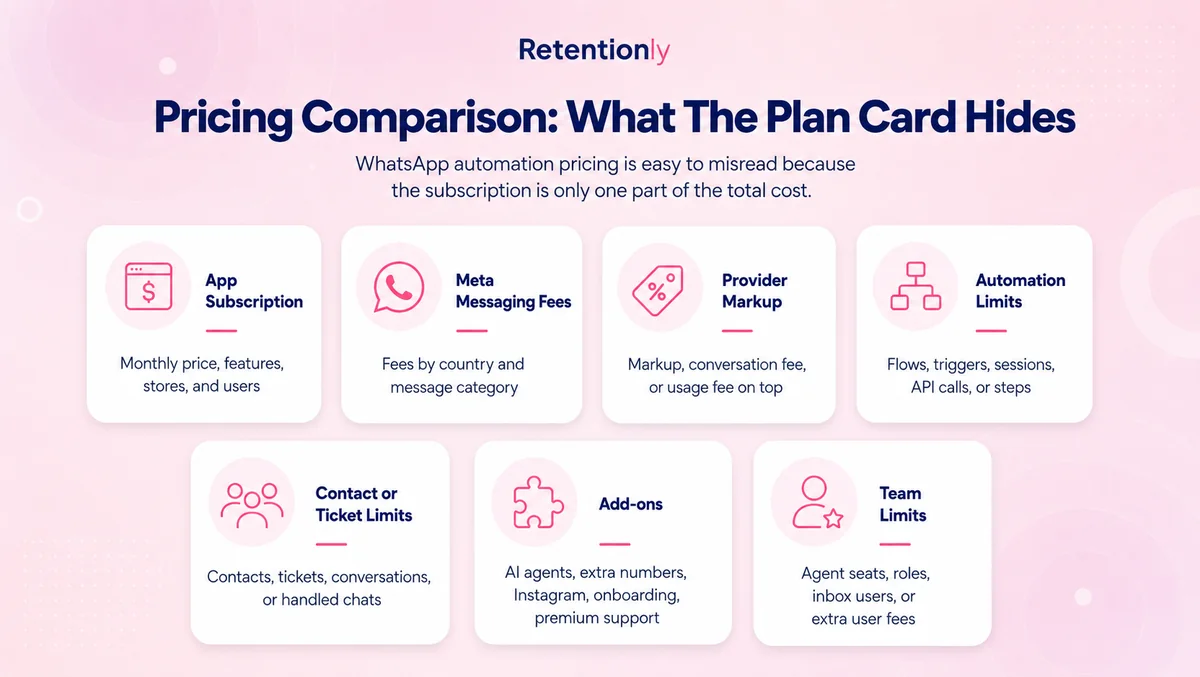
Twilio Pricing vs Retentionly Pricing
Retentionly is priced as Shopify WhatsApp automation software, not a raw API. The point is not to expose every messaging primitive. The point is to help Shopify teams launch and manage retention workflows.
| Pricing factor | Twilio WhatsApp | Retentionly |
|---|---|---|
| Base model | Pay-as-you-go communications API | Monthly Shopify app plans |
| Entry price | Usage-based; verify the current Twilio pricing calculator | Basic at $24/month |
| Higher plans | Depends on products used, usage, support, and implementation path | Growth at $49/month and Scale at $99/month |
| Meta WhatsApp fees | Passed through separately by Twilio | Meta fees apply with no Retentionly markup |
| Message markup | Twilio charges its own WhatsApp fee in addition to Meta fees | Retentionly does not add a markup on Meta messaging fees |
| Automation fees | Depends on what the team builds or buys around Twilio | No extra charge for added automations |
| Per-chat fees | Product-dependent if using broader conversation tooling | No per-chat fees |
| Developer cost | Often a real part of total cost | Lower for Shopify teams using built-in flows |
| Reporting cost | Build or connect separately | Built around Shopify retention workflows |
Retentionly's current plans are:
| Plan | Price | Best for |
|---|---|---|
| Basic | $24/month | Basic automations and core features |
| Growth | $49/month | Broadcasts and advanced automations, including winback workflows |
| Scale | $99/month | CRM features and multi-agent chat |
For a Shopify store, this pricing is easier to model because the software cost is tied to the workflows the team wants to run. Meta fees still matter, but Retentionly does not add a markup on those Meta fees, does not charge extra for added automations, and does not charge per chat.
Build A Shopify Workflow Budget Before Comparing Tools
A useful WhatsApp budget starts with the flows you will actually launch. That keeps the pricing conversation tied to revenue, not only message volume.
| Shopify workflow | What drives cost | What proves value |
|---|---|---|
| Abandoned checkout recovery | Number of abandoned checkouts, reminder count, marketing template fees | Recovered revenue and conversion rate |
| COD confirmation | COD order volume, confirmation templates, reply handling | Lower RTO, fewer fake orders, cleaner fulfillment |
| Order updates | Order and shipping volume, utility templates, customer service windows | Fewer support tickets and better delivery experience |
| Review requests | Delivered orders, review timing, template category | More reviews without over-messaging buyers |
| Winback campaigns | Lapsed customer segment size and offer frequency | Repeat purchases and contribution margin |
| Post-purchase upsell | Recent buyer volume, product affinity, stop rules | Add-on revenue without hurting trust |
| Reorder reminders | Purchase-cycle timing and repeatable products | Replenishment revenue and repeat purchase rate |
Twilio can power these messages, but your team has to own the Shopify event logic, template mapping, customer state, reply handling, suppression rules, and reporting. That is a good tradeoff when you want a custom communications system. It is often overkill when the first priority is proving WhatsApp retention revenue.
The Hidden Costs In Twilio WhatsApp Pricing
Twilio's public rate is only one part of the decision. The surrounding costs are where Shopify teams usually feel the difference.
The first hidden cost is implementation. A developer has to connect Shopify events to Twilio, decide what happens after each trigger, submit templates, handle user replies, and maintain the system as the store changes.
The second hidden cost is reporting. Sending a WhatsApp message is not the same as knowing whether it recovered a checkout, prevented a COD loss, reduced a support ticket, or created a repeat order. That attribution layer matters if WhatsApp is being evaluated as a revenue channel.
The third hidden cost is product selection. Twilio pricing can change depending on whether the team uses Programmable Messaging, Conversations, Flex, Verify, or other Twilio products. Conversations, for example, can add monthly active user pricing on top of channel costs. That may be exactly right for a support or conversation product, but it should not be ignored in a Shopify retention budget.
The fourth hidden cost is operational maintenance. Someone needs to monitor templates, opt-outs, failures, message quality, customer replies, fallback rules, and data changes. If nobody owns that layer, the API may be cheap but the workflow will stall.
When Twilio Pricing Is The Right Fit
Twilio pricing can be the right fit when your team wants infrastructure and control.
Choose Twilio when WhatsApp is part of a larger product or operations architecture. Examples include custom marketplaces, logistics workflows, fintech notifications, support systems, account alerts, authentication, voice or SMS fallback, and multi-channel customer communication.
Twilio also makes sense when the cost of engineering is already in the plan. If your team wants to build a custom messaging layer, control every event, own every template decision, and connect WhatsApp to internal systems, Twilio's API model is an advantage.
In that case, compare Twilio's current WhatsApp fees, Meta fees, product-specific charges, support needs, and your team's build cost. The API price is one input, not the full conclusion.
When A WhatsApp Automation App Is The Better Pricing Fit
A WhatsApp automation app is usually the better fit when the store wants revenue workflows instead of infrastructure.
For a Shopify founder or marketer, the first WhatsApp question is rarely, "Which API gives us the most control?" It is usually, "Which flow can we launch this week that will recover revenue, reduce avoidable support, or bring customers back?"
That changes the pricing comparison. A slightly lower API message cost does not help if the store still needs to build abandoned checkout timing, COD confirmation replies, review timing, winback segments, reorder logic, Shopify reporting, and handoff rules.
Retentionly is built around those Shopify/D2C workflows. The monthly plan is predictable, Meta fees are still separated, and the app keeps workflow ownership closer to the ecommerce team.
How To Compare Twilio Against Retentionly
Use a practical checklist before choosing.
| Question | If the answer is yes | Likely fit |
|---|---|---|
| Do we have developers assigned to build and maintain WhatsApp workflows? | Yes | Twilio may fit |
| Do we need WhatsApp inside a broader custom communications platform? | Yes | Twilio may fit |
| Do we want abandoned checkout, COD confirmation, reviews, winback, upsell, and reorder flows without building them? | Yes | Retentionly may fit |
| Do we need simpler software pricing around Shopify workflows? | Yes | Retentionly may fit |
| Do we need deep API control more than ecommerce workflow speed? | Yes | Twilio may fit |
| Do we care most about retention revenue and repeat purchase workflows? | Yes | Retentionly may fit |
The deciding question is not whether Twilio can send WhatsApp messages. It can. The deciding question is whether your store wants to pay for a build path or an app path.
Pricing Mistakes To Avoid
Do not compare only one published rate. Meta fees, Twilio fees, product-specific charges, and software costs all matter.
Do not assume all WhatsApp messages cost the same. Marketing, utility, authentication, and service messages are treated differently, and Meta rates vary by market and category. Pricing can also change, so always verify the live Twilio calculator and Meta rate card before committing budget.
Do not ignore customer service windows and free entry points. They can reduce some Meta charges in specific situations, but they do not remove the need to budget for outbound marketing and retention templates.
Do not separate cost from launch speed. A custom Twilio setup can be the better investment for a technical team. For a Shopify team without dedicated engineering time, the app that gets the revenue flow live may be the better economic choice.
Final Recommendation
Use Twilio if your team needs programmable WhatsApp infrastructure and has the engineering capacity to build the surrounding Shopify workflows.
Use Retentionly if your Shopify team wants WhatsApp to become a retention channel without turning pricing, implementation, and reporting into a custom API project.
Start with one high-value workflow: abandoned checkout recovery, COD confirmation, order updates, review requests, winback, upsell, or reorder reminders. Then compare tools by total cost to launch, total cost to maintain, and revenue the workflow can prove.
Quick FAQ
How much does Twilio WhatsApp cost?
Twilio WhatsApp pricing includes Twilio's WhatsApp fee plus Meta WhatsApp Business Platform fees. Twilio's pricing page reviewed for this guide listed $0.005 per inbound or outbound WhatsApp message, with Meta template fees passed through separately. Always verify the live Twilio calculator before budgeting.
Does Twilio include Meta WhatsApp fees?
Meta fees are separate from Twilio's own WhatsApp fee and are passed through to the Twilio account. Meta fees vary by destination market, message category, and current rate card.
Is Twilio cheaper than a WhatsApp automation app?
Twilio can be cheaper on message infrastructure for teams that already have developers and need custom control. A Shopify automation app can be cheaper operationally when the store would otherwise need to build checkout triggers, templates, segments, reporting, and reply handling around Twilio.
What should Shopify stores include in a Twilio WhatsApp budget?
Include Twilio fees, Meta fees, product-specific charges, WhatsApp sender setup, Shopify integration work, template approval, automation logic, reporting, support handoff, and ongoing maintenance.
When should I choose Retentionly instead of Twilio?
Choose Retentionly when the main goal is Shopify WhatsApp retention automation: abandoned checkout recovery, COD confirmation, order updates, reviews, winback, post-purchase upsells, and repeat purchase reminders. It is built for ecommerce teams that want workflows, not a raw API project.