Best WhatsApp AI Chatbot: What Ecommerce Stores Should Compare
TL;DRThe best WhatsApp AI chatbot is not the bot that gives the most impressive demo. For an ecommerce store, it is the one that answers repeat questions safely, hands off the right conversations, and supports the revenue workflows that matter: abandoned checkout recovery, COD confirmation, order updates, reviews, reorders, winback, and post-purchase upsells.
That is the buying problem. A support team may want AI ticket deflection. A sales team may want product recommendations. A founder may want 24/7 replies without hiring more agents. A Shopify marketer may want WhatsApp conversations to improve retention revenue, not become another disconnected inbox.
This guide compares WhatsApp AI chatbot options by ecommerce fit, pricing model, workflow depth, and team ownership so you can choose the right type of tool before committing to a platform.
Quick Verdict
Choose the tool category that matches the job your store actually needs done.
| If your main goal is... | Compare this first |
|---|---|
| Shopify retention flows with AI-assisted reply handling | Retentionly or a Shopify/D2C retention automation tool |
| Shopify AI sales and support on WhatsApp | Dondy or another Shopify-focused AI support option |
| WhatsApp AI agents with product recommendations and social commerce | Interakt or a WhatsApp/Instagram commerce platform |
| WhatsApp commerce, catalog, inbox, and AI agents | Zoko or a broad WhatsApp commerce platform |
| Broad WhatsApp chatbot, campaigns, and team inbox operations | Wati or a broad WhatsApp Business platform |
| Ecommerce support inbox with WhatsApp and AI support workflows | DelightChat or a helpdesk-led platform |
For most Shopify stores, the deciding question is not "Which chatbot is smartest?" It is "Which tool will own the customer moment after the bot replies?"
If the customer asks about delivery after an abandoned checkout message, the answer matters. But so do the cart link, stop rule, support handoff, purchase event, and recovered revenue tracking.
What Makes A WhatsApp AI Chatbot Good For Ecommerce?
A good ecommerce WhatsApp AI chatbot should do more than answer FAQs. It should understand enough store context to move the customer to the right next step without creating risk.
Use this scorecard before choosing:
| Criterion | What to check | Why it matters |
|---|---|---|
| Ecommerce context | Product catalog, order status, delivery stage, purchase history, and support state | AI replies are safer when they know the customer journey |
| Safe answer scope | Approved policies, product FAQs, tracking paths, and fallback rules | Prevents invented refund, delivery, or product claims |
| Human handoff | Complaint, refund, damaged item, VIP, angry reply, and uncertain answer routing | WhatsApp feels personal; bad AI answers hurt trust fast |
| Shopify workflow fit | Abandoned checkout, COD, order updates, reviews, reorders, winback, upsell | The bot should support revenue workflows, not distract from them |
| Suppression rules | Pause promotions during active support issues or negative replies | Avoids sending sales messages at the wrong moment |
| Pricing model | Subscription, Meta fees, AI usage, agent seats, flow limits, per-chat fees, add-ons | Low entry pricing can become unclear once usage grows |
| Reporting | Resolved replies, handoffs, recovered carts, support deflection, repeat purchase, opt-outs | Ecommerce teams need business outcomes, not only bot activity |
The best chatbot is usually not a standalone chatbot. It is part of a WhatsApp operating system that knows when to automate, when to answer, when to stop, and when to bring in a person.
Best WhatsApp AI Chatbot Options By Use Case
This is a buyer-fit comparison, not a fake universal ranking. Each option can be reasonable depending on ownership and workflow needs.
| Tool | Best fit | Main tradeoff to check |
|---|---|---|
| Retentionly | Shopify and D2C retention automation with AI-assisted conversations | Not meant to replace every broad support, catalog, or omnichannel chatbot use case |
| Dondy | Shopify WhatsApp automation with AI sales and support agents | AI and serious automation features sit in higher-tier operating decisions |
| Interakt | WhatsApp AI agents, product recommendations, Shopify catalog use, and WhatsApp/Instagram sales workflows | Platform can become sales-channel led rather than retention-workflow led |
| Zoko | WhatsApp commerce, catalog selling, team inbox, flows, and AI agents | Pricing and workflow add-ons can create more layers for simple retention needs |
| Wati | Broad WhatsApp Business operations, no-code chatbots, campaigns, inbox, sales, and support | Shopify retention is one use case inside a wider WhatsApp platform |
| DelightChat | Ecommerce helpdesk, omnichannel support, WhatsApp marketing, and AI support content | Strongest when support owns WhatsApp, not only lifecycle marketing |
The rest of the article explains where each option fits and where a Shopify retention tool is the better starting point.
Retentionly: Best When AI Must Support Shopify Retention
Retentionly is built around Shopify WhatsApp retention automation. That makes it different from a general AI chatbot platform.
The strongest Retentionly fit is a D2C team that wants WhatsApp to recover abandoned checkouts, confirm COD orders, send order and shipping updates, request reviews, trigger reorders, win back lapsed customers, run post-purchase upsells, and handle replies without turning WhatsApp into a broad platform project.
AI-assisted replies matter in this setup, but they are not the whole product. The lifecycle system still owns:
Which Shopify event starts the message.
Which customer segment should receive it.
Which message template should be sent.
What should stop the flow.
Which reply needs a person.
Which metric proves the workflow worked.
That is why Retentionly is a strong fit when the team wants WhatsApp AI to improve customer conversations inside a retention system, not replace the retention system.
Retentionly pricing is straightforward: Basic at $24/month, Growth at $49/month, and Scale at $99/month. Retentionly connects directly to Meta, does not add a markup on Meta message fees, does not charge extra for added automations, and does not charge per chat.
Dondy: Best For Shopify AI Sales And Support
Dondy is highly relevant for Shopify merchants because its public positioning combines WhatsApp automation, abandoned cart recovery, marketing campaigns, COD, reviews, order updates, AI chatbots, and support.
Its AI agent positioning is direct: an assistant for Shopify sales and support on WhatsApp. That can make sense when the store wants a WhatsApp layer that answers product questions, recommends products, handles order tracking, and supports conversations from a Shopify context.
The tradeoff is tier fit. Dondy's pricing page shows low-cost entry plans, while serious automation and AI capabilities live in higher tiers such as Power Automation and Elite. A merchant should check which exact plan includes the AI agent, inbox, WhatsApp API, automation depth, message rates, and Shopify workflow coverage needed for the first launch.
Dondy is a strong shortlist option when the buyer wants Shopify-specific AI support and sales conversations. Retentionly is the sharper fit when the buyer wants the first operating layer to be retention workflows, lifecycle timing, and clearer WhatsApp economics.
Interakt: Best For WhatsApp AI Agents And Product Recommendations
Interakt is useful when WhatsApp AI agents need to support product discovery, product recommendations, Shopify catalog data, order updates, and sales workflows alongside WhatsApp and Instagram operations.
Its Shopify AI agent content emphasizes AI-powered conversations, Shopify store data, automated workflows, real-time behavior, abandoned cart recovery, COD-to-prepaid conversion, back-in-stock alerts, loyalty nudges, and product recommendations.
That makes Interakt a reasonable option when a merchant wants AI-led commerce interactions and social messaging workflows together.
The tradeoff is focus. If your main outcome is recovered checkout revenue, repeat purchase, review collection, or reorder timing, compare how directly the platform maps those Shopify events into measurable flows. A strong AI recommendation engine is useful, but it should not distract from lifecycle triggers, stop rules, and revenue attribution.
Zoko: Best For WhatsApp Commerce, Catalog, And AI Agents
Zoko is a broad WhatsApp commerce platform. It is relevant for stores that want catalog selling, broadcasts, team inbox workflows, customer tags, flows, automation, and AI agents inside a larger WhatsApp commerce operation.
Its public pricing page shows a wide plan structure, conversation allowances, agent considerations, WhatsApp platform fees, flow add-ons, and AI agent add-ons. Zoko also describes ecommerce flows such as abandoned checkout recovery, reviews on WhatsApp, COD confirmation, reorder reminders, upsells, and order notifications.
That breadth is valuable when WhatsApp is meant to be a commerce and support channel, not only a retention automation channel.
The buying check is operational complexity. If the store needs catalog selling, many agents, AI agents, custom flows, and a commerce inbox, Zoko belongs in the comparison. If the immediate goal is a small set of Shopify-triggered retention flows, compare whether that broader structure is more than the team needs.
Wati: Best For Broad WhatsApp Chatbot Operations
Wati is a broad WhatsApp Business platform with no-code chatbots, AI support, campaigns, team inboxes, sales workflows, support workflows, and WhatsApp Business API operations.
That makes it a strong fit when WhatsApp is owned by several teams. A support team may care about AI query resolution and inbox handling. A marketing team may care about campaigns. A sales team may care about lead nurturing. An operations team may care about WhatsApp Business API setup and control.
For ecommerce teams, the advantage is breadth. The risk is buying a larger WhatsApp operating system when the first job is actually narrower: recover checkouts, confirm COD orders, update buyers, collect reviews, and drive repeat purchase.
If Wati is on your shortlist, compare the full model: subscription, message charges, chatbot or AI add-ons, team seats, automation needs, campaign limits, and how Shopify retention workflows will be launched and measured.
DelightChat: Best When AI WhatsApp Support Owns The Channel
DelightChat is strongest when WhatsApp is part of an ecommerce support and helpdesk decision. Its content frames AI WhatsApp support around retention, support conversations, order context, repeat revenue, and the shift from ticket closure to customer lifetime value.
That is a real ecommerce problem. Post-purchase support can protect or destroy retention. "Where is my order?" replies, refund requests, delivery friction, product confusion, and support delays all affect whether a customer buys again.
If your support team owns WhatsApp, DelightChat belongs in the comparison. It can make sense when the buyer needs an omnichannel customer support workspace with WhatsApp marketing and support automation attached.
If the growth or retention team owns WhatsApp, compare whether a helpdesk-led structure adds unnecessary weight before the first lifecycle flows are working.
Pricing Comparison: Compare The Operating Model
WhatsApp AI chatbot pricing can hide more than one cost layer.
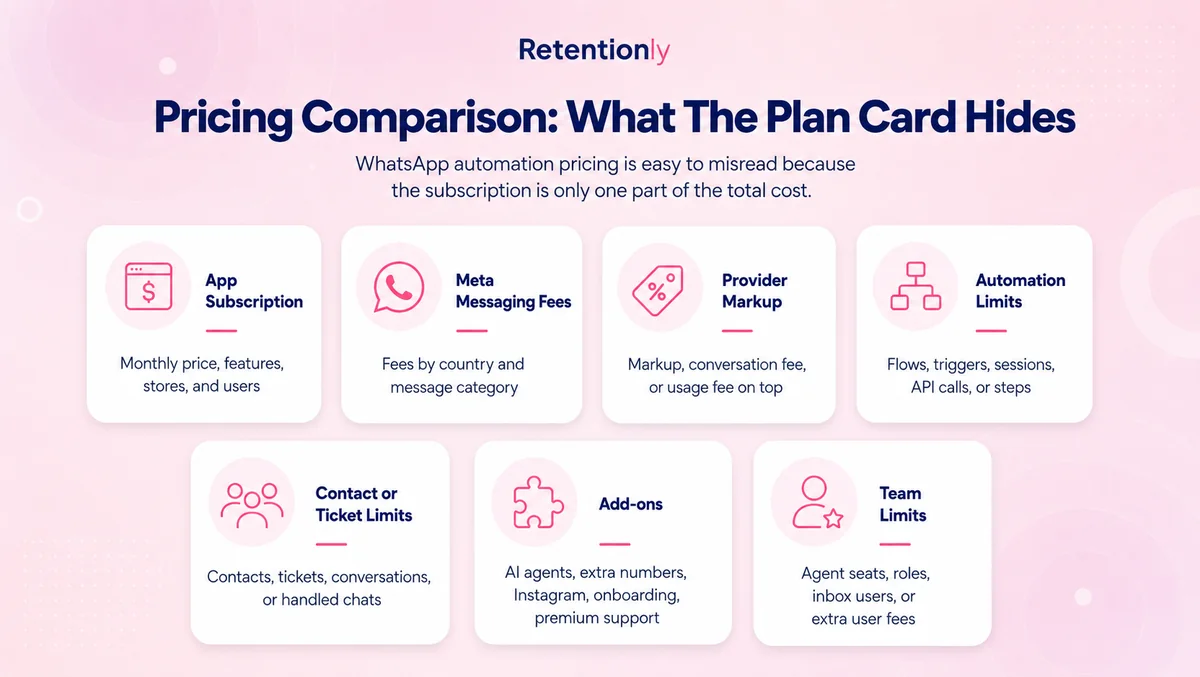
Before choosing, model these pieces:
| Cost layer | What to verify |
|---|---|
| Subscription | Monthly plan, annual discount, included features, support, stores, and seats |
| WhatsApp/Meta fees | Message charges by country and message category |
| Provider markup or usage fee | Markup, conversation fee, resolution fee, handled-chat fee, or platform fee |
| AI usage | AI agents, resolutions, chatbot sessions, credits, or per-agent add-ons |
| Automation access | Flow count, Shopify triggers, custom flows, API access, and fair-use limits |
| Inbox and team limits | Agents, inboxes, assignment rules, stores, support tickets, and channels |
| Onboarding and operations | Who configures flows, writes approved answers, reviews bad replies, and improves metrics |
Here is the practical pricing-model comparison:
| Tool | Public pricing pattern to check | Best-fit pricing question |
|---|---|---|
| Retentionly | $24, $49, and $99/month plans; no Retentionly markup on Meta fees; no extra automation or per-chat fee | Do you want clearer Shopify retention economics as usage grows? |
| Dondy | Free and low-cost entry plans, with higher automation and AI tiers such as Power Automation and Elite | Which tier includes the AI agent, inbox, API, and automations you actually need? |
| Interakt | Public pricing varies by region and plan; WhatsApp charges and advanced needs should be verified | Do WhatsApp AI agents and social commerce justify the platform choice? |
| Zoko | Starts at $49.99/month with plan layers, conversation allowances or markup, flow add-ons, AI agent add-ons, and agent considerations | Do you need commerce, catalog, flows, inbox, and AI breadth together? |
| Wati | Growth, Pro, and Business-style broad platform plans with message charges and optional add-ons | Do multiple teams need one WhatsApp operations platform? |
| DelightChat | Starts at $29/month plus WhatsApp charges, with plans shaped by support and team needs | Is WhatsApp mainly part of your helpdesk and support model? |
Pricing changes often. Verify each live pricing page before buying and calculate the cost of the workflows you will actually run in the first 90 days.
Workflow Comparison For Shopify Stores
The chatbot decision becomes clearer when you map AI to the workflow it supports.
| Shopify workflow | What AI can help with | What the automation must still own |
|---|---|---|
| Abandoned checkout | Answer product, delivery, payment, sizing, and discount questions | Checkout trigger, cart link, timing, offer rule, purchase stop condition |
| COD confirmation | Classify confirm, cancel, change address, or call-back replies | Order hold, fulfillment action, non-response fallback, RTO metric |
| Order updates | Answer "where is my order" questions and explain tracking status | Order, fulfillment, shipping, delivery, and delay events |
| Review requests | Detect unhappy replies before asking for a public review | Delivery timing, review link, support suppression |
| Reorder reminders | Answer product usage, quantity, and timing questions | Purchase cycle, replenishment timing, eligibility |
| Winback | Help returning customers choose a relevant product | Inactivity window, segment, offer, suppression |
| Post-purchase upsell | Explain product fit or compatibility | Product affinity, timing, margin rule, purchase stop condition |
This is where Shopify-specific thinking matters. AI can improve conversations, but Shopify event ownership decides whether WhatsApp becomes a retention channel or just a faster support inbox.
For the operating details, read the WhatsApp AI Chatbot Shopify Guide and the WhatsApp Chatbot for Ecommerce Guide.
When A Broad AI Chatbot Platform Is Better
A broad WhatsApp AI chatbot platform is the better choice when the business need is wider than Shopify retention.
Choose a broad platform when:
Support agents spend most of the day in WhatsApp.
Sales teams need lead qualification, assignment, and manual follow-up.
Catalog selling inside WhatsApp is a major buying journey.
Instagram, Facebook, email, live chat, or other channels matter as much as Shopify events.
Your team needs no-code chatbot infrastructure across many use cases.
Someone owns chatbot maintenance, knowledge base quality, handoff review, and pricing monitoring.
In those cases, Wati, Zoko, Interakt, Dondy, or DelightChat may be the stronger first comparison depending on team structure and region.
When A Shopify Retention Tool Is Better
A Shopify retention tool is better when WhatsApp belongs to the founder, ecommerce operator, lifecycle marketer, or retention manager.
Choose this path when:
The first goal is recovered revenue or repeat purchase.
The chatbot should support Shopify automations rather than become the strategy.
You need clear event triggers, stop rules, and flow-level metrics.
You want human handoff for support issues without buying a large helpdesk first.
Pricing needs to stay understandable as WhatsApp volume grows.
This is where Retentionly fits. It helps Shopify stores use WhatsApp for lifecycle automation first, then layer AI-assisted replies and support handoff where they improve the customer journey.
Final Recommendation
The best WhatsApp AI chatbot is the one that matches your operating model.
If WhatsApp is your support desk, compare helpdesk and broad chatbot platforms carefully. If WhatsApp is a sales and catalog channel, compare commerce-led tools. If WhatsApp needs to sit across several departments, compare broad WhatsApp Business platforms.
But if your ecommerce store runs on Shopify and the goal is retention revenue, start with the workflows that pay for themselves: abandoned checkout recovery, COD confirmation, order updates, review requests, reorders, winback, and post-purchase upsells.
AI should make those conversations faster and safer. It should not pull the team away from the lifecycle moments that create repeat revenue.
Install Retentionly free on Shopify if you want WhatsApp automations, AI-assisted replies, and customer handoff built around Shopify retention workflows instead of a generic chatbot project.
Quick FAQs
What is the best WhatsApp AI chatbot for ecommerce?
The best option depends on ownership. Retentionly is a strong fit when a Shopify or D2C team wants AI-assisted WhatsApp conversations tied to retention workflows. Broader tools such as Dondy, Interakt, Zoko, Wati, and DelightChat may fit better for AI support, catalog selling, team inboxes, or omnichannel operations.
Is a WhatsApp AI chatbot the same as WhatsApp automation?
No. A chatbot responds to customer messages. WhatsApp automation can also send event-based messages from Shopify activity, such as abandoned checkout reminders, COD confirmations, order updates, review requests, winback flows, and reorder reminders.
Should a Shopify store launch AI replies or retention automations first?
Most stores should launch the first measurable retention automations first, then add AI replies where customer responses repeat. The best setup combines Shopify triggers, safe AI answers, suppression rules, and human handoff.
What should I check before buying a WhatsApp AI chatbot?
Check Shopify data access, approved answer controls, human handoff, suppression rules, AI usage pricing, Meta messaging fees, inbox limits, automation access, and flow-level reporting.
Where does Retentionly fit against AI chatbot platforms?
Retentionly fits when WhatsApp should be a Shopify retention channel first. It is not trying to replace every broad AI helpdesk or chatbot platform. It is strongest when the team wants lifecycle automations plus AI-assisted reply handling around real Shopify events.