Best AiSensy Alternative for WhatsApp Automation in 2026
TL;DRIf you are looking for an AiSensy alternative, you are probably not deciding whether WhatsApp matters. You are deciding which tool should own your WhatsApp growth system: a broad WhatsApp marketing platform, or a Shopify-first automation layer built around retention revenue.
AiSensy is a broad WhatsApp Business API and marketing platform. It covers broadcasts, chatbots, live chat, Click to WhatsApp ads, payments, forms, catalog-style ecommerce use cases, and integrations. That breadth can make sense when WhatsApp needs to support many departments and many business models.
But a Shopify founder, marketer, or ecommerce manager usually has a narrower job to solve first. Recover abandoned checkouts, confirm COD orders, send order updates, win back lapsed customers, request reviews, drive post-purchase upsells, and bring customers back for repeat purchases. That is where Retentionly is the sharper AiSensy alternative.
Quick Verdict
Choose AiSensy if you want a broad WhatsApp Business API platform for broadcasts, chatbots, live chat, ads, payments, forms, and general engagement across several use cases.
Choose Retentionly if you want WhatsApp automation to sit inside your Shopify retention strategy, with lifecycle flows, simpler plan economics, no Retentionly markup on Meta messaging fees, and no per-chat fees.
| Best fit | AiSensy | Retentionly |
|---|---|---|
| Primary use case | WhatsApp marketing, API access, broadcasts, chatbots, live chat, ads, payments, and forms | Shopify/D2C retention automation and lifecycle revenue workflows |
| Strongest buyer | Teams that want WhatsApp as a broad engagement platform | Shopify founders, marketers, and ecommerce managers focused on retention revenue |
| Core question | "How do we run more WhatsApp engagement from one platform?" | "How do we recover and grow Shopify revenue with automated flows?" |
| Main advantage | Wide WhatsApp product surface and official API-led positioning | Focused Shopify workflow ownership and cleaner operating economics |
Pricing Comparison: Compare The Operating Model
Do not compare WhatsApp tools only by the headline subscription price. The real cost model includes subscription fees, Meta or WhatsApp message charges, add-ons, chatbot or AI costs, number fees, support seats, usage limits, automation limits, and whether the tool charges per chat or marks up messaging.
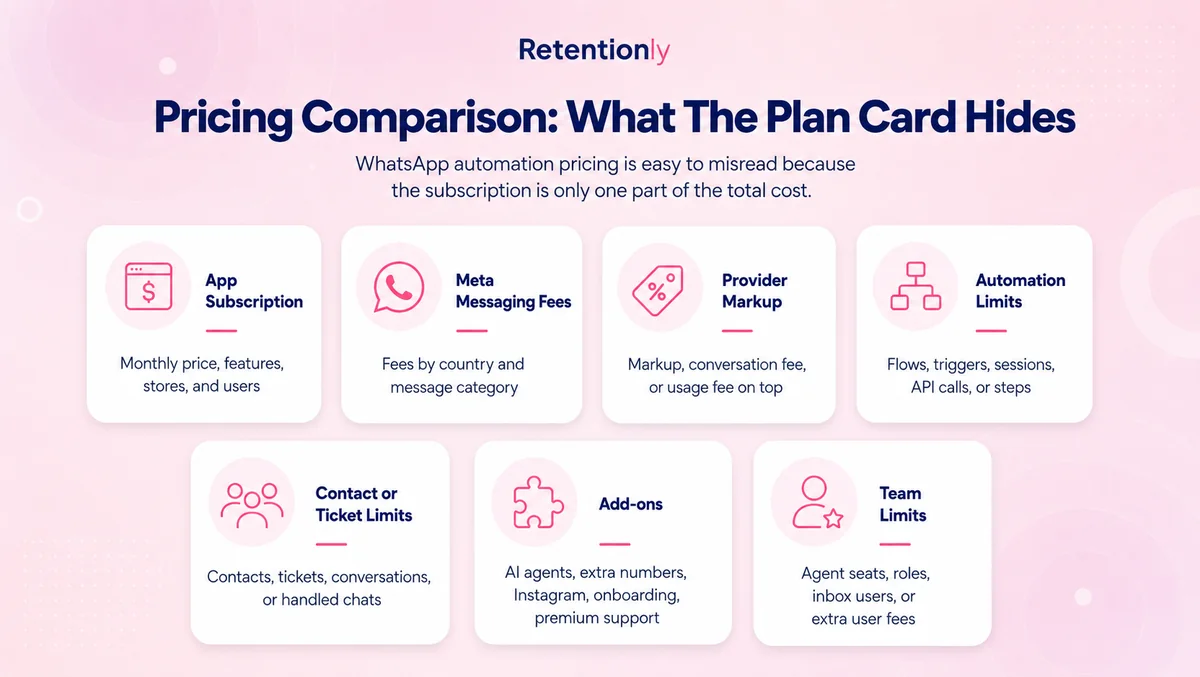
AiSensy's public pricing is built around prepaid subscription plans, with WhatsApp Conversation Credits managed separately. Its pricing page also lists separate chatbot and AI add-ons, plus a virtual number add-on for Indian businesses. Buyers outside India should verify the international pricing page and current message rates before deciding.
Retentionly pricing is intentionally simple:
| Retentionly plan | Price | Best for |
|---|---|---|
| Basic | $24/month | Basic automations and core features |
| Growth | $49/month | Broadcasts and advanced automations, including winback workflows |
| Scale | $99/month | CRM features and multi-agent chat |
Retentionly connects directly to Meta and does not add a markup on Meta messaging fees. It also does not charge extra for added automations and does not charge per-chat fees. For Shopify teams, that makes WhatsApp easier to forecast as automation volume grows.
| Pricing question | AiSensy | Retentionly |
|---|---|---|
| Base subscription | Prepaid platform plans; verify current India or international pricing before purchase | Basic starts at $24/month |
| Message fees | WhatsApp credits are managed separately; rates vary by country and message category | Meta rates apply with no Retentionly markup |
| Chatbot and AI cost | Chatbot and AI agent add-ons are listed separately on public pricing | Included according to Retentionly plan fit and workflow needs |
| Virtual number or setup items | Public pricing lists separate virtual number options for Indian businesses | Buyer should compare setup needs based on their Meta account and Shopify store |
| Automation economics | Buyer should compare plan limits, chatbot add-ons, AI usage, and message credits | No extra cost for added automations |
| Per-chat fees | Buyer should verify current chat, agent, and fair-use terms | No per-chat fees |
| Best pricing fit | Teams that need a wider WhatsApp platform and are comfortable modeling add-ons and credits | Teams that want predictable Shopify retention automation economics |
The takeaway is not that AiSensy is the wrong tool. The takeaway is that a Shopify team should model the cost against the flows that will pay for it. If the first goal is abandoned checkout recovery, COD confirmation, winback, and repeat purchase revenue, Retentionly is easier to evaluate because the plans are tied to retention workflow ownership.
Feature Comparison
AiSensy and Retentionly overlap around WhatsApp automation, but they are organized around different jobs. AiSensy is broad: API access, broadcasts, chatbots, ads, payments, forms, live chat, catalog use cases, and multi-industry engagement. Retentionly is focused: Shopify-triggered flows that protect revenue and grow repeat purchases.
| Feature or buying criterion | AiSensy | Retentionly |
|---|---|---|
| WhatsApp Business API access | Core part of the platform | Connected as part of Shopify automation setup |
| Shopify integration | Public Shopify integration and ecommerce pages | Built around Shopify and D2C retention workflows |
| Abandoned checkout recovery | Possible through Shopify/ecommerce automation setup | Core revenue workflow |
| COD confirmation | Buyer should verify the exact workflow setup | Core Shopify/D2C workflow |
| Order updates | Possible through ecommerce and Shopify event setup | Core lifecycle automation |
| Winback automation | Possible through broadcast, segment, chatbot, or automation setup | Growth plan includes advanced automations such as winback |
| Post-purchase upsell | Possible through ecommerce campaigns and chatbot flows | Designed as a retention and repeat revenue flow |
| Review requests | Buyer should verify setup through workflows or integrations | Built into lifecycle retention thinking |
| Broadcast campaigns | Strong public positioning | Included in Growth plan |
| Chatbots and AI agents | Strong public positioning with separate add-on structure | Useful when tied to Shopify customer experience and retention |
| Live chat and shared inbox | Strong public positioning | Multi-agent chat available on Scale |
| Payments, forms, ads, and catalog use cases | Strong public positioning | Not the primary wedge |
| Pricing simplicity for retention flows | More plan, credit, add-on, and fair-use items to compare | Simple plans, no Meta markup, no per-chat fees |
| Best-fit team | Teams that want a broad WhatsApp engagement platform | Teams that want Shopify retention automation as the center of gravity |
This is a fit comparison. AiSensy can make sense when WhatsApp is expected to support marketing, lead generation, support, forms, payments, ads, and general customer engagement. Retentionly is stronger when WhatsApp is primarily a Shopify lifecycle channel.
Strengths And Weaknesses
AiSensy's strength is breadth. It gives teams a wide WhatsApp product surface: broadcasts, live chat, chatbots, AI agents, Click to WhatsApp ads, forms, payments, catalog-oriented ecommerce use cases, analytics, and official API-led setup. That is useful when the buyer wants one WhatsApp platform for several departments or business types.
The tradeoff is evaluation complexity. A Shopify team has to decide which parts matter, which add-ons are needed, how message credits work, how Shopify events are mapped, what the chatbot or AI layer costs, and whether the team will actually use the broader platform.
Retentionly's strength is focus. It starts from the Shopify lifecycle and asks which WhatsApp flows should protect margin, recover revenue, and increase LTV: abandoned checkout, COD confirmation, order updates, winback, post-purchase upsell, reviews, replenishment, and repeat purchase reminders.
The tradeoff is specialization. Retentionly is not trying to replace every broad WhatsApp marketing, ads, payments, forms, or chatbot use case. It is strongest when the merchant wants WhatsApp automation to be owned by the growth, retention, or ecommerce team rather than becoming a general messaging workspace.
Shopify And D2C Workflow Comparison
The best AiSensy alternative should be judged by the workflows your team will run every week. Feature breadth matters, but only after the revenue flows are clear.
| Workflow | What the tool needs to understand | Better fit when Shopify retention is the goal |
|---|---|---|
| Abandoned checkout | Checkout state, cart context, discount rules, stop conditions, recovered revenue | Retentionly |
| COD confirmation | COD order status, reply handling, confirmation path, cancellation risk, RTO prevention | Retentionly |
| Order updates | Fulfillment status, delivery timing, support fallback, customer anxiety | Retentionly |
| Winback | Last purchase date, product category, buyer segment, repeat purchase timing | Retentionly |
| Post-purchase upsell | Purchased item, complementary offer, send timing, attach rate | Retentionly |
| Review requests | Delivery timing, satisfaction path, review collection, support fallback | Retentionly |
| Repeat purchase reminders | Replenishment cycle, historical buying behavior, LTV impact | Retentionly |
| Click to WhatsApp ads | Ad click, lead capture, qualification, handoff | AiSensy when acquisition is the main requirement |
| Payments and forms | Native WhatsApp data collection and payment paths | AiSensy when in-chat forms or payments matter most |
| Broad chatbot operations | FAQ routing, lead qualification, catalog conversations, agent handoff | AiSensy when general chatbot coverage is the main requirement |
That table is the heart of the decision. AiSensy is strong when WhatsApp is a broad engagement layer. Retentionly is stronger when WhatsApp is primarily a retention automation channel connected to Shopify revenue events.
Setup And Team Fit
Shopify teams rarely fail because they lack another messaging feature. They fail because the right flows are not live, measured, or owned by anyone.
AiSensy fits teams that want a flexible WhatsApp platform and are willing to configure the mix of broadcasts, chatbots, ads, payments, forms, live chat, and ecommerce workflows. It can make sense when WhatsApp is a central customer engagement layer across many campaigns and teams.
Retentionly fits teams that want to launch WhatsApp around the Shopify lifecycle. A founder, marketer, retention lead, or ecommerce manager can think in flows: recover checkout, confirm COD, update the buyer, win back the lapsed customer, ask for the review, recommend the next product, and bring the customer back before paid acquisition has to do all the work again.
The difference is operational ownership. Retentionly is easier to evaluate when the buyer wants WhatsApp to sit inside a revenue and retention motion, with simpler economics and fewer unrelated decisions.
When AiSensy Is Still The Better Fit
AiSensy can still be the better choice if your team wants a broad WhatsApp Business API and marketing platform with broadcasts, chatbots, Click to WhatsApp ads, forms, payments, live chat, catalog-style ecommerce journeys, and multi-industry flexibility.
AiSensy is also worth evaluating if your acquisition team is heavily invested in Click to WhatsApp ads, if your support or sales team needs a flexible chatbot and live chat layer, or if WhatsApp payments and forms are central to your customer journey.
When Retentionly Is The Better AiSensy Alternative
Retentionly is the better AiSensy alternative when your main job is Shopify retention.
That means your team is less concerned with running every possible WhatsApp engagement use case and more concerned with the flows that protect margin and grow LTV: abandoned checkout recovery, COD confirmation, order updates, winback, post-purchase upsell, review requests, and repeat purchase reminders.
It is also the stronger fit when pricing clarity matters. Retentionly's no-markup Meta fee model, no per-chat fees, and no extra cost for added automations make the economics easier to understand as WhatsApp becomes a larger revenue channel.
Final Recommendation
If you need a broad WhatsApp platform for API access, broadcasts, chatbots, ads, forms, payments, live chat, and general engagement, AiSensy is a serious product to evaluate.
If you are choosing an AiSensy alternative because your real goal is Shopify retention and D2C repeat revenue, Retentionly is the focused challenger. It gives you simpler plan economics and automations built around the lifecycle moments that matter most to a Shopify brand.
Start with the flows that can pay for themselves first: abandoned checkout recovery, COD confirmation, order updates, winback, reviews, post-purchase upsell, and repeat purchase. Install Free on Shopify and launch WhatsApp as a retention channel, not another disconnected inbox.
Quick FAQs
Is Retentionly a direct replacement for AiSensy?
Retentionly is an AiSensy alternative for Shopify retention use cases. It is not trying to replace every AiSensy workflow around ads, payments, forms, chatbots, live chat, or general WhatsApp marketing.
Which is better for Shopify abandoned checkout recovery?
Retentionly is the stronger fit if abandoned checkout recovery is part of a broader Shopify retention strategy. AiSensy can support ecommerce and Shopify workflows, but Retentionly is built around lifecycle revenue and repeat purchase workflows from the start.
Does Retentionly charge a markup on Meta messaging fees?
No. Retentionly connects directly to Meta and does not add a markup on Meta messaging fees. That matters as WhatsApp message volume grows.
When should I choose AiSensy instead?
Choose AiSensy if your team wants a broad WhatsApp Business API and engagement platform with broadcasts, chatbots, Click to WhatsApp ads, forms, payments, live chat, and general multi-industry flexibility.
What should Shopify stores compare before choosing?
Compare total cost structure, Shopify workflow depth, Meta or WhatsApp message fees, chatbot and AI add-ons, automation limits, inbox requirements, setup effort, and whether the tool is built around broad WhatsApp engagement or focused D2C retention automation.