Zoko Pricing: Costs and Alternatives to Compare
TL;DRZoko pricing is not only the monthly subscription on its pricing page. For a Shopify or D2C team, the real monthly cost can include the plan, WhatsApp fees, conversation markup or no-markup thresholds, agents, automation flows, flow steps, AI agents, support resolution charges, and whether Zoko is being used as a broad WhatsApp commerce platform or a focused retention channel.
That distinction matters because Zoko is a serious ecommerce WhatsApp platform. It can make sense when a team wants Shopify catalog sync, sales conversations, a shared inbox, support workflows, broadcasts, AI assistants, and automation flows in one place. But if the buying job is narrower, the better pricing question is simpler: what does it cost to recover abandoned checkouts, confirm COD orders, send order updates, request reviews, win back customers, and drive repeat purchases?
This guide explains how to evaluate Zoko pricing, what Shopify merchants should model before choosing a plan, and when a focused alternative like Retentionly is easier to forecast.
Quick Verdict
Zoko is worth evaluating if your team wants a broad WhatsApp commerce and operations platform for Shopify sales, catalog selling, broadcasts, support conversations, shared inbox ownership, AI agents, and advanced workflow automation.
Retentionly is the stronger fit if your main job is Shopify WhatsApp retention automation with simpler plan economics, direct Meta connection, no Retentionly markup on Meta messaging fees, no per-chat fees, and no extra cost for added automations.
| Buying question | Zoko | Retentionly |
|---|---|---|
| Main use case | Broad WhatsApp commerce, sales, support, inbox, and automation | Shopify and D2C retention automation |
| Pricing model to compare | Plan, WhatsApp fees, conversation markup thresholds, agents, flows, steps, AI, and add-ons | Fixed plan, Meta fees passed through without Retentionly markup, no per-chat fees |
| Best-fit team | Ecommerce teams that want WhatsApp to run sales, support, catalog, and customer conversations | Shopify founders, marketers, ecommerce managers, and retention teams |
| Main tradeoff | More ecommerce breadth, more pricing variables to model | Narrower scope, clearer retention workflow economics |
How Zoko Pricing Works
Zoko's public pricing is unusually detailed for a WhatsApp platform, which is useful for buyers. The important point is that the base plan is only the starting layer.
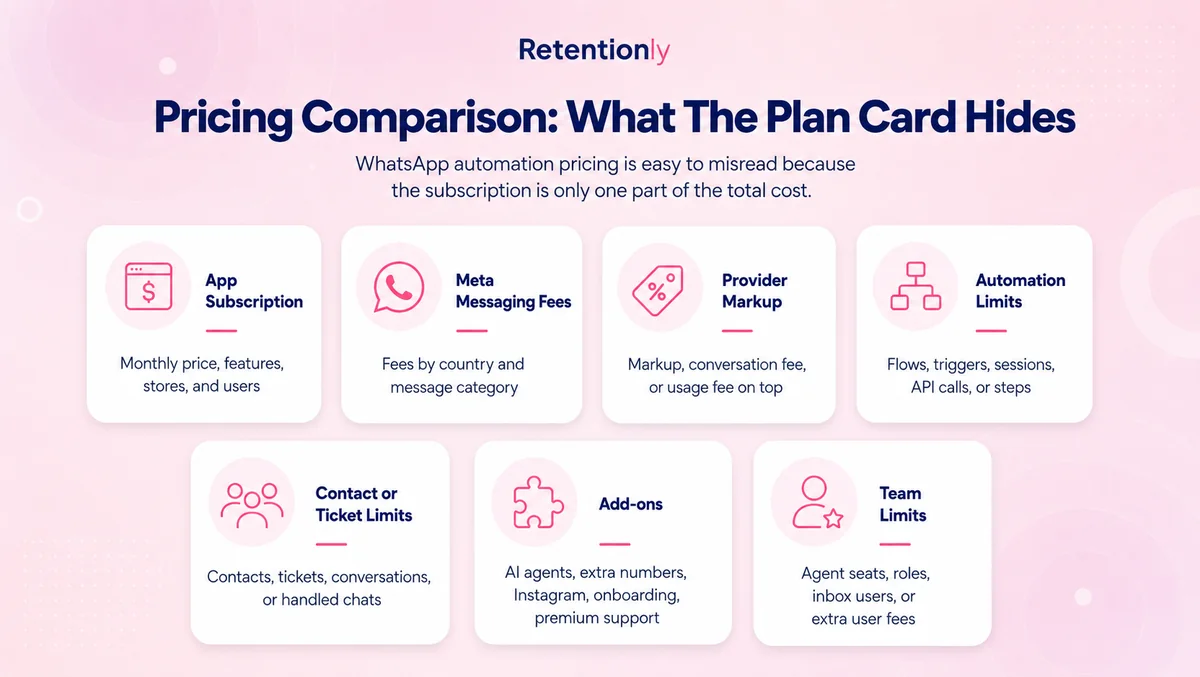
Its current public pricing page shows four main monthly plans: Starter, Plus, Elite, and Max. It also separates WhatsApp platform fees from the software plan, links WhatsApp fees to Meta's rate card, and lists several usage-based or add-on charges around conversations, agents, premium flows, flow steps, AI agents, support resolutions, and order-taking AI.
For Shopify teams, the practical cost model looks like this:
| Cost layer | What to verify |
|---|---|
| Subscription plan | Which Zoko plan is required for your team size, volume, and feature needs? |
| WhatsApp fees | What Meta rates apply for your customer countries and message categories? |
| Conversation markup | Which plan has markup, no-markup allowances, and overage rates? |
| Agents | How many inbox users are included, and what happens when you add more? |
| Essential flows | Which ecommerce flows are included in all plans? |
| Premium flows | Which custom or advanced flows are priced per flow? |
| Flow steps | How many monthly flow steps are included before overage applies? |
| AI agents and resolutions | Will Guru, Wismo, Sello, or other AI agents become part of your monthly bill? |
| Instagram or other channels | Will you pay for non-WhatsApp channel fees too? |
If WhatsApp is only one small retention experiment, this may feel like more model than you need. If WhatsApp is becoming a daily sales and support channel, these details are exactly what you should forecast.
Zoko Pricing Details Shopify Stores Should Notice
The first detail is conversation markup. Zoko's public page shows Starter with markup on all conversations, while higher plans include no-markup conversation allowances before small per-conversation overage charges apply. That makes the right plan depend partly on message volume, customer countries, and whether WhatsApp is mainly for campaigns, automated retention, support, or sales conversations.
The second detail is agents. Starter lists free agents, while Plus, Elite, and Max include a fixed number of agents and then charge for additional agents. This matters if WhatsApp is a team inbox. It matters less if your store mainly needs automated lifecycle messages with occasional support handoff.
The third detail is flows. Zoko lists essential ecommerce flows as included in all plans, including abandoned checkouts, WhatsApp reviews, COD confirmation, COD-to-prepaid, reorder reminders, product upsell automation, and order notifications. It also lists premium flows separately with a per-flow monthly price and a fair-use policy for monthly steps.
That is a strong ecommerce surface. It also means a Shopify buyer should map the exact workflows it needs before assuming the plan price is the full cost.
| Zoko pricing item | Why it matters for Shopify |
|---|---|
| Starter, Plus, Elite, and Max plans | The plan changes conversation markup, agent capacity, and operating fit. |
| WhatsApp fees separate from plan | Meta fees still need to be modeled by country and message type. |
| No-markup allowances on higher plans | Higher volume stores should compare total conversation economics, not only subscription price. |
| Agent limits and overage | Support-heavy teams may need more inbox seats. |
| Essential ecommerce flows | Useful if the included flows match the first workflows you need. |
| Premium flows and step overage | Advanced or custom automation can change the monthly budget. |
| AI agent pricing | Useful for support and selling automation, but not always needed for retention-first teams. |
| Annual volume discounts | Larger brands should verify whether committed volume changes the economics. |
This does not mean Zoko pricing is bad. It means Zoko is priced like a broader WhatsApp commerce and operations platform, so the buyer should compare the complete model.
Zoko Pricing Vs Retentionly Pricing
Retentionly pricing is intentionally simpler for Shopify and D2C teams.
| Retentionly plan | Price | Best for |
|---|---|---|
| Basic | $24/month | Basic automations and core features |
| Growth | $49/month | Broadcasts and advanced automations, including winback workflows |
| Scale | $99/month | CRM features and multi-agent chat |
Retentionly connects directly to Meta and does not add a markup on Meta messaging fees. It also does not charge extra for added automations and does not charge per-chat fees.
That changes the comparison. Instead of deciding how much WhatsApp commerce, shared inbox, AI, catalog selling, and custom workflow capacity your team needs, you can start with the Shopify flows that should pay for the tool: abandoned checkout recovery, COD confirmation, order updates, review requests, winback, upsells, and repeat purchase reminders.
| Pricing area | Zoko | Retentionly |
|---|---|---|
| Platform plan | Four public plans with volume, agent, and markup differences | Three Shopify-focused plans |
| Meta or WhatsApp fees | WhatsApp fees apply separately, with plan-specific markup or no-markup allowances | Direct Meta connection with no Retentionly markup |
| Shopify workflows | Strong ecommerce flow coverage and catalog/sales use cases | Core reason to buy the product |
| Automation cost | Essential flows included; premium flows and step limits may matter | No extra cost for added automations |
| Inbox and agents | Strong fit for shared inbox and support operations | Scale plan includes CRM features and multi-agent chat |
| AI and selling agents | Broader AI support and sales add-ons | Best when automation is tied to Shopify retention and support handoff |
| Best cost comparison | Total WhatsApp commerce and operations cost | Shopify retention workflow cost and recovered revenue |
The deciding question is not which product has more features. It is which product owns the workflows your store will actually run.
What To Model Before Choosing Zoko
Before choosing Zoko for Shopify, model the first 90 days of usage instead of comparing only monthly plan cards.
| Question | Why it matters |
|---|---|
| Which flows go live first? | Abandoned checkout, COD confirmation, order updates, reviews, and winback have different message volume and setup needs. |
| Which countries will receive WhatsApp messages? | WhatsApp fees depend on destination country and message category. |
| How many people need the inbox? | Agent pricing matters when WhatsApp is a team support or sales channel. |
| Do you need catalog selling? | Zoko's Shopify catalog and WhatsApp ordering strengths are more valuable when sales conversations happen inside WhatsApp. |
| Do you need premium or custom flows? | Premium flows and step overage can change the real monthly cost. |
| Do you need AI agents? | AI support, order status, FAQ, and selling agents can be useful but should be budgeted separately. |
| Which metrics prove ROI? | A Shopify team should track recovered revenue, confirmed COD orders, support deflection, repeat purchases, and campaign revenue. |
If the answers point to broad WhatsApp commerce and support operations, Zoko belongs on the shortlist. If the answers keep coming back to Shopify retention revenue, a simpler tool may be the better economic fit.
When Zoko Is Worth Paying For
Zoko can make sense when WhatsApp is central to how the store sells, supports, and manages customer conversations.
That can include a shared inbox for multiple agents, WhatsApp catalog selling, customer support, broadcasts, click-to-WhatsApp ads, Shopify order conversations, abandoned checkout recovery, COD confirmation, review collection, and AI-assisted customer interactions. For a team that wants all of that in one WhatsApp commerce platform, the broader pricing model can be reasonable.
Zoko is also worth evaluating when the team expects many manual or semi-manual conversations. If sales agents, support agents, catalog questions, order tracking, and WhatsApp chat ownership are central to the operating model, agent limits and inbox workflows are not extra noise. They are part of the core value.
When Zoko Pricing Can Feel Heavy For Retention
Zoko pricing can feel harder to reason about when the Shopify team mainly wants lifecycle revenue flows.
If your first use cases are abandoned checkout recovery, COD confirmation, order updates, winback, review requests, and repeat purchase reminders, a broad WhatsApp commerce platform can create extra decisions before the core revenue workflows are live. You may find yourself comparing conversation markup, no-markup thresholds, agents, premium flows, flow steps, AI agents, Instagram fees, catalog selling, and shared inbox workflows before answering a simpler question: which WhatsApp flow will recover or retain revenue this month?
Retentionly starts from that simpler question.
| Shopify moment | Retentionly angle |
|---|---|
| Checkout abandoned | Recover the cart before intent fades |
| COD order placed | Confirm the order and reduce avoidable RTO |
| Order shipped | Keep the buyer updated and reduce support tickets |
| Product delivered | Ask for a review at the right moment |
| Customer inactive | Trigger a winback flow based on last purchase timing |
| Repeat purchase window | Send a reorder or upsell message when it is commercially relevant |
The goal is not to buy the widest WhatsApp feature set. The goal is to launch the messages that protect and grow Shopify revenue.
Feature And Workflow Comparison
| Feature or workflow | Zoko | Retentionly |
|---|---|---|
| Shopify integration | Strong ecommerce surface, including catalog, order, and flow use cases | Built around Shopify retention workflows |
| Abandoned checkout recovery | Included in Zoko's ecommerce flow set | Core workflow |
| COD confirmation | Included in Zoko's ecommerce flow set | Core workflow |
| Order updates | Included in Zoko's ecommerce flow set | Core lifecycle automation |
| Review requests | Included in Zoko's ecommerce flow set | Core post-purchase retention use case |
| Winback | Possible through flows, tags, broadcasts, and customer segmentation | Growth plan includes advanced automations such as winback |
| Reorder reminders | Included in Zoko's ecommerce flow set | Core repeat purchase workflow |
| Product upsell | Included in Zoko's ecommerce flow set | Core post-purchase revenue workflow |
| Shared inbox | Strong sales and support fit | Available with CRM and multi-agent chat on Scale |
| Catalog selling | Stronger fit | Not the current primary wedge |
| AI agents | Broader AI support and selling surface | Useful when tied to Shopify customer experience and support handoff |
| Pricing simplicity for retention | More variables to model | Simpler plans and no Retentionly markup on Meta fees |
| Best-fit team | WhatsApp-heavy ecommerce sales, support, and commerce teams | Shopify founders, marketers, ecommerce managers, and retention teams |
This is not an argument that Zoko is too broad for everyone. It is a reminder that pricing only makes sense when the product scope matches the job.
Example: Compare One Abandoned Checkout Flow
Take abandoned checkout recovery. A Shopify team should compare:
| Cost or value item | What to estimate |
|---|---|
| Monthly subscription | The minimum plan needed for the abandoned checkout workflow |
| WhatsApp fees | Number of reminders sent by country and message type |
| Conversation markup | Whether the plan adds markup or gives enough no-markup allowance |
| Automation setup | Whether the included flow is enough or a premium/custom flow is needed |
| Flow steps | Whether checkout volume creates meaningful step usage |
| Support workload | Whether replies need an agent, auto reply, AI answer, or handoff |
| Revenue recovered | Carts recovered and order value recovered |
If Zoko is also powering support, catalog selling, team inbox ownership, broadcasts, and AI customer interactions, this flow is only one part of the platform value. If abandoned checkout is one of several retention flows you want live quickly, Retentionly is easier to compare against recovered revenue.
The same logic applies to COD confirmation, winback, review requests, order updates, and repeat purchase reminders. Pricing only makes sense when it is tied to the workflow it supports.
If you are still mapping the first flows, start with the Shopify WhatsApp Automation Guide, then compare specific revenue workflows such as Shopify Abandoned Cart WhatsApp Recovery, Shopify COD Confirmation WhatsApp, and Shopify Order Updates WhatsApp. Those pages make the pricing comparison easier because you can estimate cost against real Shopify outcomes.
Final Recommendation
If you need a broad WhatsApp commerce platform for Shopify catalog selling, shared inbox ownership, support, sales conversations, broadcasts, advanced flows, and AI agents, evaluate Zoko carefully and model the full monthly cost.
If you are researching Zoko pricing because your real goal is Shopify retention automation, start with a narrower question: which tool gets the right Shopify-triggered flows live with clear economics?
Retentionly is built for that job. It gives Shopify and D2C teams simple plans, direct Meta connection without Retentionly markup on Meta fees, no per-chat fees, no extra cost for added automations, and workflows focused on the customer moments that drive repeat revenue.
Install Free on Shopify and start with the flows that can pay for themselves first: abandoned checkout, COD confirmation, order updates, winback, reviews, and repeat purchase.
Quick FAQs
What is Zoko pricing for Shopify?
Zoko pricing for Shopify depends on the selected plan, WhatsApp fees, conversation markup or no-markup thresholds, agent needs, essential versus premium flows, flow steps, AI agents, and whether the store needs broader WhatsApp commerce or focused retention automation.
Does Zoko charge separately for WhatsApp messages?
Zoko's public pricing page separates WhatsApp platform fees from the subscription and links WhatsApp fees to Meta's rate card. Buyers should verify current Meta rates for their customer countries and message categories.
Is Zoko good for Shopify WhatsApp automation?
Zoko has strong Shopify and ecommerce WhatsApp coverage, including abandoned checkout, COD confirmation, order notifications, reviews, reorder reminders, upsell, catalog selling, and shared inbox workflows. It is strongest when a team wants broader WhatsApp commerce and operations in one platform.
When is Retentionly a better fit than Zoko?
Retentionly is a better fit when the main goal is Shopify WhatsApp retention automation rather than a broad WhatsApp commerce, catalog, inbox, and AI operations platform. It is designed around abandoned checkout, COD confirmation, order updates, winback, reviews, upsells, and repeat purchase workflows.
What should I compare before choosing Zoko?
Compare the subscription, WhatsApp fees, conversation markup, agent limits, essential flows, premium flows, step usage, AI add-ons, support needs, and whether the first retention flows can recover enough revenue to justify the setup.