Gupshup WhatsApp API Pricing: Costs and Alternatives for Merchants
TL;DRGupshup WhatsApp API pricing is easiest to understand when you separate three things: Gupshup's own message fee, Meta's WhatsApp Business Platform fee, and the software or workflow layer your team still needs to run revenue automations.
That last part matters for Shopify merchants. A WhatsApp API provider can help you send messages, manage templates, and connect to Meta. But abandoned checkout recovery, COD confirmation, order updates, review requests, winback campaigns, upsells, and reorder reminders still need triggers, timing, segmentation, reply handling, stop rules, and revenue tracking.
This guide breaks down the Gupshup pricing model in practical terms and compares it with a Shopify-first WhatsApp automation app like Retentionly.
Quick Verdict
Gupshup pricing is a good fit when you want API-led WhatsApp access, wallet-based usage billing, broad conversational engagement tools, and the flexibility to build or integrate your own workflows.
Retentionly pricing is a better fit when your team is buying Shopify retention automation: ready-made WhatsApp flows connected to store events, customer lifecycle moments, and repeat revenue outcomes.
| Buyer question | Gupshup WhatsApp API pricing | Retentionly pricing |
|---|---|---|
| What are you mainly buying? | WhatsApp API access, platform messaging, and usage-based delivery | Shopify WhatsApp retention automation |
| Main cost layers | Gupshup fee, Meta WhatsApp fee, possible feature or markup cases | App subscription plus Meta fees |
| Best-fit owner | Developer, platform, campaign, or operations team | Founder, marketer, ecommerce manager, retention team |
| Setup responsibility | Your team configures the workflow layer around the API | Workflows are packaged around Shopify use cases |
| Pricing risk to model | Message category, market, wallet deductions, marketing endpoint choice, implementation effort | Plan fit, message volume, workflow ROI |
The right comparison is not "API provider or app?" It is whether your team wants to own a WhatsApp messaging foundation or launch Shopify revenue flows with less assembly.
What Gupshup WhatsApp API Pricing Usually Includes
Gupshup's public self-serve WhatsApp pricing presents two major usage layers: WhatsApp fees and Gupshup fees. The WhatsApp fee is passed through based on Meta's pricing model, while Gupshup lists its own fee as a per-message platform charge.
As reviewed on July 29, 2026, Gupshup's public self-serve pricing page showed a standard Gupshup fee of $0.001 for outgoing template text messages and $0.001 for outgoing and incoming session text messages. It also states that WhatsApp fees are billed at actuals.
That means a merchant should think in components:
| Pricing component | What it means | What to verify before buying |
|---|---|---|
| Gupshup fee | Gupshup's own platform/message fee | Whether your message type, channel path, region, and plan have the same fee |
| Meta WhatsApp fee | Meta's fee based on delivered message category and recipient market | Current Meta rate card, currency, category, and volume tier |
| Wallet balance | Usage deductions often run through a prepaid or wallet model | Funding process, reconciliation, invoice detail, and alerting |
| Marketing path | Some Cloud API marketing cases can carry additional Gupshup markup | Whether your WABA uses MM Lite, regular endpoints, or a transition case |
| Workflow software | The tools needed to run ecommerce flows above the API | Shopify integration, templates, reporting, support handoff, and automation ownership |
The headline 0.001 USD fee is useful, but it is not the full WhatsApp automation budget. Shopify teams still need to account for Meta fees and for the cost of creating and maintaining the workflows.
The Meta Fees Are Separate
Meta charges businesses on the WhatsApp Business Platform by delivered message, market, and category. The core categories are marketing, utility, authentication, and service.
For a Shopify store, those categories map to different jobs:
| Store message | Likely pricing category to plan for | Why it matters |
|---|---|---|
| Abandoned checkout reminder | Marketing | Usually promotional or conversion-oriented |
| Winback campaign | Marketing | Re-engagement and repeat-purchase messaging |
| Price drop alert | Marketing | Offer-driven customer nudge |
| Order confirmation | Utility | Transactional update tied to the order |
| Shipping update | Utility | Post-purchase operational update |
| Login or OTP | Authentication | Account verification |
| Support reply inside the service window | Service or non-template response | Often treated differently from outbound templates |
Meta's current pricing model charges per delivered marketing template, per delivered authentication template, and per delivered utility template sent outside the customer service window. Utility templates sent inside the right customer service window can avoid Meta charges, and service messages are treated separately under the current model.
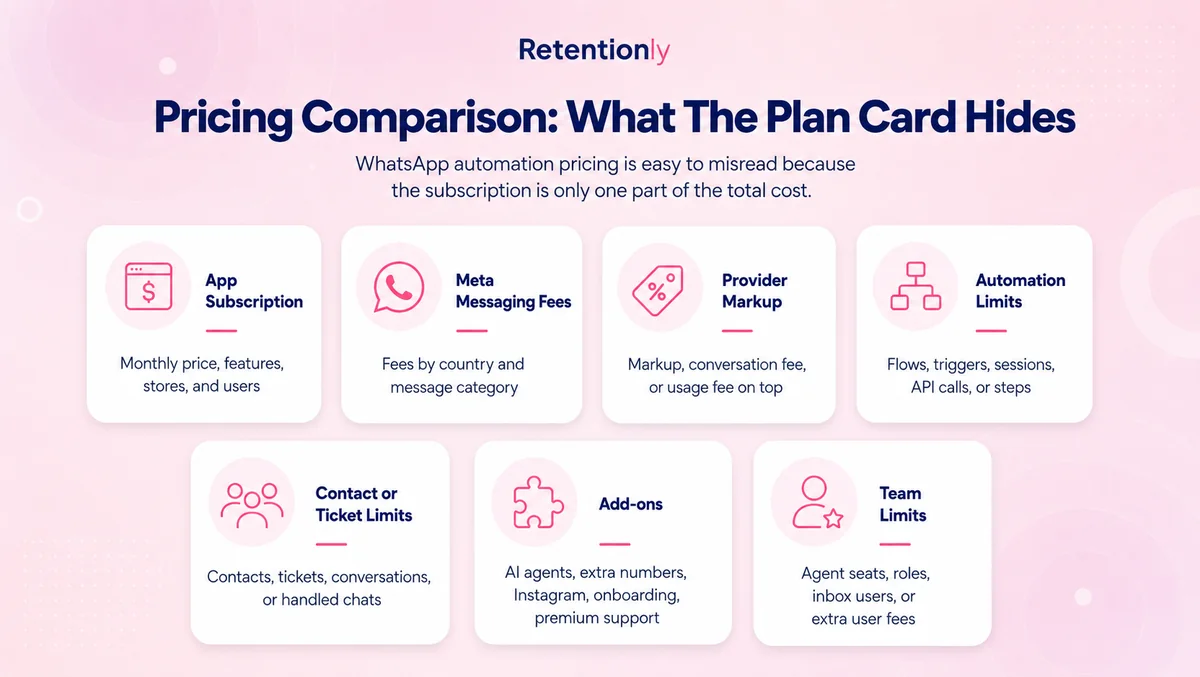
The key point is simple: Gupshup's fee and Meta's fee are different. If you send a paid marketing template through Gupshup, your budget may include the Gupshup platform fee plus Meta's market/category rate. If you send a utility update in the right customer service window, the Meta side may be different, but the platform and workflow cost still need to be understood.
Watch The 2026 Marketing Message Markup Case
Gupshup also published a 2026 support update for certain Cloud API marketing messages. The practical takeaway is not that every Gupshup customer has the same extra charge. It is that buyers should verify the exact marketing path they are using.
For specific Cloud API marketing cases that continue outside MM Lite routing, Gupshup says it will charge an extra 6% markup on the WhatsApp marketing fee from January 1, 2026. The support article also says new WhatsApp account onboardings for V2 users continue through MM Lite and that some V3/MM Lite cases are not changing.
For a merchant, this becomes a checklist question:
| Question to ask | Why it matters |
|---|---|
| Are my marketing templates routed through MM Lite or regular Cloud API endpoints? | It can affect whether the extra marketing markup applies |
| Is my WABA old, migrated, partner-managed, or newly onboarded? | The support update describes different cases |
| Will the markup appear as a Gupshup fee in wallet statements or analytics? | It affects reconciliation and reporting |
| Are abandoned checkout and winback flows mostly marketing templates? | Shopify retention programs often rely on marketing-category sends |
Do not build a pricing forecast from a single line item. Ask for the exact endpoint path, WABA state, message categories, and billing event details.
Gupshup Pricing vs Retentionly Pricing
Retentionly is priced as a Shopify WhatsApp automation app, not as a raw API provider. That distinction changes what the monthly software cost is supposed to cover.
| Pricing factor | Gupshup | Retentionly |
|---|---|---|
| Base model | Usage-led WhatsApp API/platform pricing | Monthly Shopify app plans |
| Entry usage fee | Public self-serve page shows $0.001 Gupshup fee for text template and session messages | Basic starts at $24/month |
| Meta fees | Added separately at actuals based on Meta pricing | Meta fees apply with no Retentionly markup |
| Marketing markup | Some Cloud API marketing cases can carry an extra Gupshup markup | No Retentionly markup on Meta fees |
| Wallet or invoice model | Buyer should verify prepaid wallet, deductions, reports, and invoices | Simpler app subscription model |
| Workflow layer | Built by your team, developer, partner, or connected tools | Included around Shopify retention use cases |
| Additional automation cost | Depends on implementation and product path | No extra charge for added automations |
| Per-chat fee | Buyer should verify by plan and product path | No per-chat fees |
| Best pricing fit | Teams that want API flexibility and can manage total usage economics | Shopify teams that want clearer workflow economics |
Retentionly's current plans are straightforward:
| Retentionly plan | Price | Best for |
|---|---|---|
| Basic | $24/month | Basic automations and core features |
| Growth | $49/month | Broadcasts and advanced automations, including winback workflows |
| Scale | $99/month | CRM features and multi-agent chat |
Meta message fees still need to be modeled in either path. The difference is what the software layer owns. With Gupshup, you may be buying a flexible provider layer. With Retentionly, you are buying Shopify retention workflows.
Build A Shopify WhatsApp Budget Around Flows
For ecommerce, the cleanest budget starts with the flows you will actually run.
| Workflow | Cost drivers | What proves ROI |
|---|---|---|
| Abandoned checkout | Checkout volume, reminder count, marketing template rate, country mix, Gupshup fee | Recovered revenue and conversion rate |
| COD confirmation | COD order volume, confirmation template cost, reply handling, cancellation rules | Lower RTO and fewer fake orders |
| Order updates | Order and shipment volume, utility category pricing, service-window behavior | Fewer support tickets and better delivery experience |
| Review requests | Delivered orders, review-link timing, repeat-send rules | More reviews and stronger post-purchase feedback |
| Winback | Lapsed customer segment size, offer frequency, marketing message rate | Repeat purchases and contribution margin |
| Post-purchase upsell | Recent buyer volume, offer logic, template category | Add-on revenue after purchase |
| Reorder reminder | Product replenishment timing, customer segment, message frequency | Repeat purchase revenue |
This is where the API path and app path diverge. Gupshup can provide the WhatsApp API foundation for those sends. Your team still needs to connect Shopify events, choose templates, manage suppression rules, handle replies, attribute revenue, and maintain the logic over time.
Retentionly starts from those Shopify flows. That can make pricing easier to defend because the monthly app cost is tied to the revenue or operational outcome the flow is supposed to create.
When Gupshup Pricing Is A Good Fit
Gupshup can be a strong fit when WhatsApp is an API or platform decision. If your team wants custom messaging infrastructure, broad conversational engagement, integrations across systems, campaign tooling, AI use cases, or multi-channel customer communication, a provider platform can be the right foundation.
It also makes sense when the business has technical ownership for API setup, template operations, data mapping, reconciliation, and custom journey logic. Usage-based pricing can be efficient if the team understands its message categories and has the systems to forecast spend.
The tradeoff is ownership. A low per-message platform fee does not automatically create a revenue workflow. Someone still has to define the trigger, delay, segment, message, reply path, fallback, suppression rule, and metric for each Shopify flow.
When Retentionly Is The Better Pricing Fit
Retentionly is usually the better pricing fit when the main job is Shopify retention automation.
That means the team wants WhatsApp connected to store events without building an API program first. The priority is not only message delivery. It is abandoned checkout recovery, COD confirmation, order and shipping updates, review requests, winback campaigns, post-purchase upsells, and repeat purchase reminders.
The economics are also easier to understand. Retentionly has clear monthly plans, does not add a markup on Meta messaging fees, does not charge extra for added automations, and does not charge per-chat fees. For a Shopify merchant, that keeps the budget closer to outcomes the team actually tracks: recovered revenue, repeat purchases, reduced RTO, support deflection, and customer retention.
If you are comparing Gupshup WhatsApp API pricing because you only need API access, evaluate it as a provider. If you are comparing it because you want ecommerce revenue workflows, compare the total cost to launch and maintain those workflows.
Pricing Mistakes To Avoid
Do not compare only the $0.001 Gupshup fee. It is one layer, not the whole budget. Meta fees, marketing endpoint choices, wallet deductions, implementation effort, and workflow software can all change the real cost.
Do not assume every WhatsApp message has the same cost. Marketing, utility, authentication, and service messages behave differently. Rates can also vary by customer market and volume tier.
Do not ignore category mix. A store sending mostly order updates may have a different cost profile from a store sending high-volume abandoned checkout and winback messages.
Do not separate pricing from ownership. A lower API delivery cost can still become expensive if nobody owns Shopify event wiring, template management, reply handling, revenue attribution, and ongoing improvements.
Do not treat support-window rules as an afterthought. Utility messages inside an active customer service window can behave differently from proactive utility sends, so timing and reply flow design can affect cost.
Final Recommendation
Use Gupshup when your team needs WhatsApp API access, platform flexibility, usage-based billing, custom integrations, or a broader conversational engagement stack.
Use Retentionly when your Shopify team wants WhatsApp to operate as a retention channel without building the workflow layer around an API provider.
The practical next step is to map your first three flows, estimate delivered messages by category and market, then compare total cost to launch and maintain. If those flows are abandoned checkout, COD confirmation, order updates, reviews, winback, upsell, or reorder reminders, Retentionly is the cleaner place to start.
Quick FAQs
How much does Gupshup WhatsApp API cost?
As reviewed on July 29, 2026, Gupshup's public self-serve WhatsApp pricing page showed a standard Gupshup fee of $0.001 for outgoing template text messages and $0.001 for outgoing and incoming session text messages, with WhatsApp fees billed separately at actuals. Always verify live pricing before purchase.
Does Gupshup pricing include Meta WhatsApp fees?
No. Gupshup separates its own fee from Meta's WhatsApp fee. Meta fees depend on delivered message category, recipient market, currency, and current rate card.
Is Gupshup cheaper than a Shopify WhatsApp app?
It depends on what you need. Gupshup can be efficient when your team wants API access and can build the automation layer. A Shopify WhatsApp app can be cheaper operationally when it includes the workflows, reporting, and setup your team would otherwise build.
What hidden costs should merchants compare with Gupshup?
Compare Meta fees, Gupshup fees, marketing endpoint choices, wallet reconciliation, implementation work, Shopify event wiring, template operations, reply handling, support needs, and reporting. The per-message platform fee is not the whole budget.
When should a Shopify store choose Retentionly instead?
Choose Retentionly when the goal is Shopify retention automation rather than API infrastructure. It is built around abandoned checkout recovery, COD confirmation, order updates, reviews, winback, upsells, and repeat purchase workflows, with simple app pricing and no Retentionly markup on Meta fees.