Best WhatsApp Business API Solution: What Ecommerce Teams Should Compare
TL;DRThe best WhatsApp Business API solution is not always the biggest WhatsApp platform or the cheapest API provider. It is the option that owns the work your team actually needs done: setup, templates, message costs, customer replies, Shopify triggers, automations, and reporting.
That distinction matters for ecommerce teams because the WhatsApp Business API is only the messaging foundation. A store still needs abandoned checkout recovery, COD confirmation, order updates, review requests, winback campaigns, post-purchase upsells, and repeat purchase reminders to turn the channel into revenue.
This guide compares the main solution types, the buying criteria that matter, and when a Shopify-first WhatsApp automation app like Retentionly is the cleaner choice.
Quick Verdict
Choose a WhatsApp Business API solution based on ownership, not only access.
| If your main need is... | Best-fit solution type |
|---|---|
| Direct API access, custom systems, developer control, or partner-led implementation | API provider or BSP |
| Shared inbox, broad campaigns, chatbots, sales, support, and multi-channel operations | WhatsApp platform |
| Shopify-triggered retention flows such as abandoned checkout, COD, order updates, reviews, winback, upsell, and reorders | Shopify WhatsApp automation app |
| Simple manual customer conversations on one phone | WhatsApp Business app |
| Storefront contact button only | Lightweight WhatsApp chat widget |
Most ecommerce teams searching for the best WhatsApp Business API do not want the API as an endpoint. They want the business result the API makes possible. If the first goal is Shopify retention revenue, evaluate tools by the flows they can launch and measure, not only by API access.
What A WhatsApp Business API Solution Really Includes
The WhatsApp Business API gives businesses a scalable way to send and receive WhatsApp messages through the WhatsApp Business Platform. It supports message templates, customer replies, webhooks, phone numbers, and business account setup.
But the API does not automatically provide a finished ecommerce workflow. A complete solution usually includes several layers:
| Layer | What it does | Why ecommerce teams should care |
|---|---|---|
| Meta and WhatsApp setup | Business verification, WABA, phone number, templates, policies | Determines whether the account can send approved messages |
| Provider or platform layer | API access, hosting, billing, inbox, campaigns, support, compliance help | Changes setup effort, cost, and operating ownership |
| Software workflow layer | Shopify events, segments, automations, stop rules, reply handling, reporting | Turns message delivery into revenue and retention |
| Team process | Who approves templates, reviews replies, monitors costs, and improves flows | Prevents WhatsApp from becoming an unmanaged broadcast channel |
This is why "best API" lists can be misleading. Twilio, 360dialog, Gupshup, Wati, Interakt, Zoko, Dondy, DelightChat, and Retentionly can all sit somewhere around WhatsApp Business API access. They are not bought for the same job.
The Main Solution Types
There are three serious options for a growing ecommerce business.
| Solution type | What you are buying | Strong fit | Tradeoff |
|---|---|---|---|
| API provider or BSP | WhatsApp infrastructure, phone-number setup, API access, delivery, billing, technical control | Developer-led teams, SaaS products, agencies, custom CRM setups | Your team still builds the ecommerce workflow layer |
| Broad WhatsApp platform | Inbox, broadcasts, campaigns, chatbot builder, contacts, sales and support workflows | Teams using WhatsApp across marketing, sales, support, and operations | More pricing variables and setup surface if retention is the only job |
| Shopify retention automation app | Store-event automations, templates, lifecycle flows, reply handoff, revenue reporting | Shopify founders, marketers, ecommerce managers, retention teams | Not meant to replace every broad sales, support, or developer API use case |
The best choice depends on who will own WhatsApp after launch. If engineering owns the channel, an API provider can make sense. If support and sales own WhatsApp all day, a broad platform may fit. If marketing or retention owns Shopify lifecycle revenue, a Shopify automation app is usually easier to justify.
Buying Criteria That Actually Matter
Start with the work your team will need to run after the account is connected.
| Buying criterion | What to check | Why it matters |
|---|---|---|
| Setup path | Business verification, phone number migration, WABA creation, template approval, onboarding support | API setup problems delay every campaign and automation |
| Message template operations | Template creation, category guidance, approval status, localization, edits, and quality monitoring | Ecommerce flows depend on reliable approved templates |
| Shopify integration depth | Checkout, order, fulfillment, delivery, customer, tag, segment, and product events | Automations need real store context |
| Automation ownership | Trigger, timing, audience, message, fallback, stop rules, and metric | This is where revenue workflows succeed or fail |
| Reply handling | Inbox, assignment, handoff, labels, team ownership, and customer context | Automated messages create real conversations |
| Pricing transparency | Subscription, Meta fees, markups, seats, contacts, automations, messages, and add-ons | A low entry plan can become expensive when volume grows |
| Reporting | Recovered revenue, conversion, confirmed COD orders, replies, opt-outs, failed sends, and repeat purchases | The team needs to know which flows are worth scaling |
| Compliance controls | Opt-ins, opt-outs, template categories, frequency control, and suppression logic | Protects account health and customer trust |
If a vendor only talks about sending bulk messages, keep digging. A useful ecommerce solution should explain how messages are triggered, when they stop, how replies are handled, and how the store measures the outcome.
Pricing Is A Model, Not A Single Number
WhatsApp Business API pricing has multiple layers. Meta charges businesses for delivered messages based on market and message category. Providers and platforms may add subscriptions, usage fees, markups, add-ons, seats, inbox charges, AI fees, or implementation costs.
For ecommerce, message categories usually map like this:
| Store message | Typical planning category | Buying implication |
|---|---|---|
| Abandoned checkout reminder | Marketing | Forecast volume carefully because it can be a frequent revenue send |
| Winback campaign | Marketing | Segment tightly so the message cost matches expected margin |
| Product recommendation or promotion | Marketing | Avoid generic blasting; tie sends to purchase intent |
| Order confirmation | Utility | Useful for reassurance and support reduction |
| Shipping or delivery update | Utility | Often high-volume, so category and service-window rules matter |
| OTP or login code | Authentication | Usually relevant for account verification use cases |
| Customer-initiated support reply | Service | Depends on the active customer service window |
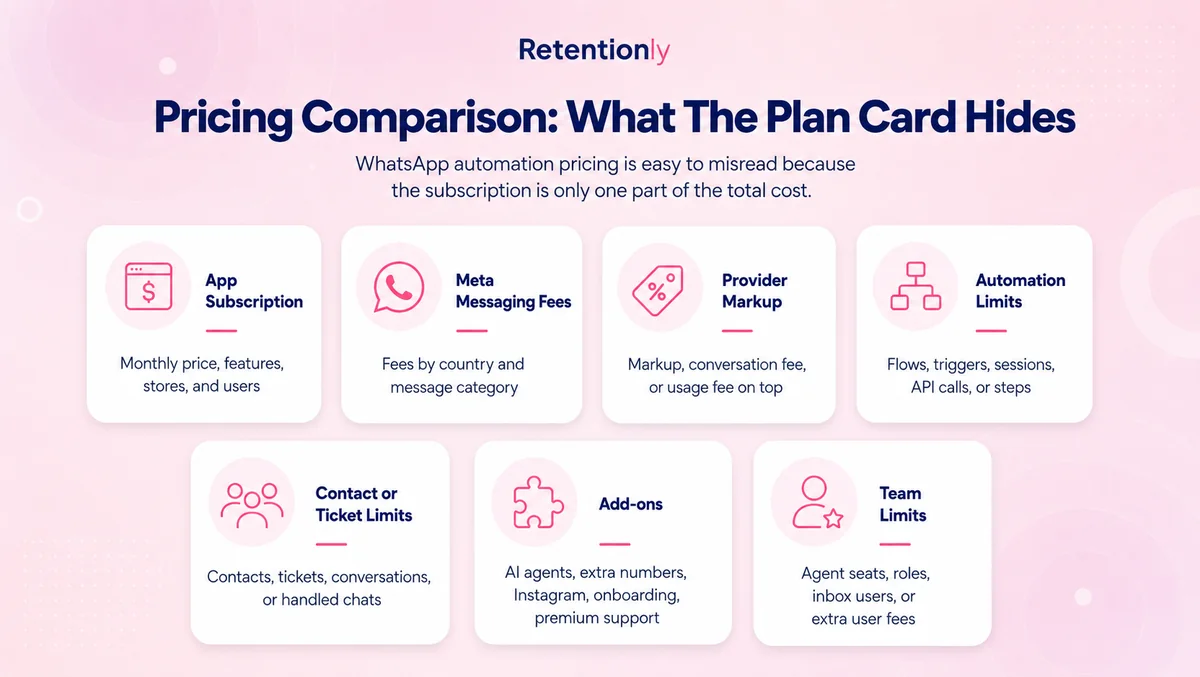
The practical question is not "What is the cheapest WhatsApp API?" It is "What will it cost to launch, run, and improve the flows that generate revenue or reduce support load?"
Best WhatsApp Business API Solution Options By Use Case
There is no honest universal winner. Use the shortlist below by buyer type.
| Option or category | Strongest fit | What ecommerce teams should verify |
|---|---|---|
| Retentionly | Shopify WhatsApp retention automation for abandoned checkout, COD, order updates, reviews, winback, upsell, and repeat purchase | Whether your first workflows fit the Basic, Growth, or Scale plan |
| Zoko | WhatsApp commerce, Shopify catalog, broadcasts, shared inbox, and ecommerce playbooks | Conversation fees, flow add-ons, agents, AI add-ons, and whether you need the broader platform |
| Wati | Broad WhatsApp operations with inbox, campaigns, automations, AI, and ecommerce use cases | Message charges, add-ons, automation credits, users, and Shopify-specific costs |
| Interakt | WhatsApp and Instagram sales, marketing, support, catalogs, and campaigns | Plan limits, conversation charges, chatbot needs, Shopify actions, and team fit |
| Dondy | Shopify WhatsApp automation, abandoned cart recovery, campaigns, AI support, and chat | Whether automation and AI features require higher tiers for your use case |
| DelightChat | Omnichannel ecommerce support with WhatsApp marketing and automations | Support ticket limits, marketing contacts, helpdesk ownership, and channel needs |
| 360dialog, Gupshup, Twilio, and similar providers | Direct API access, infrastructure, partner builds, custom workflows, and developer control | Who will build Shopify events, automations, templates, reply handling, and reporting |
The right comparison is not "which vendor has the longest feature list?" It is "which vendor starts closest to the workflows my team will maintain?"
Retentionly: Best When Shopify Retention Is The Job
Retentionly is built for Shopify and D2C teams that want WhatsApp to drive retention and lifecycle revenue.
The core workflows are abandoned checkout recovery, COD confirmation, order and shipping updates, review requests, winback campaigns, reorder reminders, post-purchase upsells, and welcome flows. These are the moments where WhatsApp is most useful because each message is tied to a real customer action or purchase stage.
Retentionly is a strong fit when the team wants:
Shopify-first triggers and lifecycle workflows.
Revenue-focused automation instead of generic bulk sending.
Clear setup for founders, marketers, ecommerce managers, and retention teams.
No Retentionly markup on Meta messaging fees.
No extra charge for added automations.
No per-chat fees.
Retentionly's current plans are straightforward:
| Retentionly plan | Price | Best for |
|---|---|---|
| Basic | $24/month | Basic automations and core features |
| Growth | $49/month | Broadcasts and advanced automations, including winback workflows |
| Scale | $99/month | CRM features and multi-agent chat |
Retentionly is not trying to be a raw API provider or a full omnichannel support suite. That is the point. If the job is Shopify retention automation, the product starts closer to the outcome.
When A Broad WhatsApp Platform Is Better
A broad WhatsApp platform can be the better choice when WhatsApp is a company-wide operating channel, not only a retention channel.
Choose this path when support agents spend much of the day in WhatsApp, sales teams need lead assignment, catalogs are central to the buying journey, chatbot builders matter, or multiple departments need one customer communication workspace.
Tools such as Wati, Zoko, Interakt, Dondy, and DelightChat can be sensible shortlists depending on region, budget, feature needs, and team ownership. Many of them support ecommerce workflows, inboxes, campaigns, catalogs, and automation. The buyer's job is to check whether those broad capabilities make the first revenue flows faster or simply add more setup surface.
For a Shopify retention team, the danger is overbuying. A platform can be powerful and still be heavier than the job requires if the immediate goal is recovering checkouts, confirming COD orders, and sending lifecycle messages.
When An API Provider Is Better
Choose an API provider or BSP when WhatsApp is an infrastructure decision.
This path fits teams with developers, an agency, a systems integrator, or an internal platform owner. It can also fit SaaS products, marketplaces, large brands, or businesses that need direct control over templates, webhooks, routing, data storage, custom CRM integration, or multi-region messaging architecture.
The tradeoff is assembly. API providers can help you access WhatsApp, but they do not automatically create Shopify retention workflows. Someone still needs to build or connect:
Checkout and order triggers.
Template logic and category planning.
Customer segmentation and suppression rules.
Reply handling and support handoff.
Attribution and revenue reporting.
Ongoing monitoring of delivery, opt-outs, and cost.
If your team wants that control, the API route can be the right decision. If your team wants working Shopify automations, an app-led path is usually simpler.
Workflow Comparison For Ecommerce
Use workflows to compare solutions after the feature list starts to blur.
| Workflow | What the solution must handle | Why it matters |
|---|---|---|
| Abandoned checkout | Checkout trigger, cart link, delay, follow-up, stop on purchase, recovery tracking | Usually the fastest revenue test |
| COD confirmation | COD order trigger, confirm or cancel replies, tagging, fulfillment hold, RTO reporting | Reduces fake orders and fulfillment waste |
| Order updates | Order, fulfillment, shipping, delivery, and delay events | Reduces support load and improves trust |
| Review requests | Delivery-based timing, review app handoff, product-use window, suppression rules | Converts fulfilled orders into social proof |
| Winback | Last purchase date, segment, offer logic, frequency control, opt-out handling | Brings lapsed customers back |
| Reorder reminders | Product replenishment cycle, purchase history, customer segment | Drives repeat purchases for consumable products |
| Post-purchase upsell | Product purchased, complementary product, timing, margin check | Grows revenue after the first order |
| Broadcast campaigns | Segment, consent, calendar, campaign goal, reply owner | Useful later, risky if it replaces lifecycle logic |
If a solution cannot show how it handles trigger, timing, audience, message, fallback, and metric for your first flows, it may be a messaging tool rather than an ecommerce automation solution.
Common Buying Mistakes
The first mistake is buying API access without assigning workflow ownership. A connected WhatsApp number does not recover carts by itself.
The second mistake is comparing only monthly subscription prices. WhatsApp costs can include Meta message fees, provider fees, conversation markups, contacts, agents, AI add-ons, automation credits, implementation work, and support.
The third mistake is choosing a broad platform because it has more features. More features help only when the team will use them. If the first job is retention automation, setup clarity and flow depth matter more than feature count.
The fourth mistake is treating WhatsApp like a bulk sender. Ecommerce WhatsApp works best when messages are tied to customer intent: an abandoned checkout, a recent order, a delivery event, a product-use cycle, or a lapsed customer segment.
The fifth mistake is ignoring replies. Every good WhatsApp automation should assume some customers will ask questions, negotiate, complain, or need help. The solution should make the handoff obvious.
Final Recommendation
If you need custom infrastructure, choose an API provider or BSP. If you need WhatsApp to run across sales, support, catalogs, campaigns, and inbox workflows, compare broad WhatsApp platforms carefully.
If your team is choosing a WhatsApp Business API solution because you want Shopify retention revenue, start with the workflows. The strongest first use cases are abandoned checkout recovery, COD confirmation, order updates, review requests, winback campaigns, reorders, and post-purchase upsells.
Retentionly is the cleaner fit when those workflows are the reason you are buying WhatsApp in the first place.
Quick FAQs
What is the best WhatsApp Business API solution?
The best solution depends on your use case. API providers are best for custom technical control, broad WhatsApp platforms are best for sales and support operations, and Retentionly is a strong fit for Shopify teams that want retention automation.
Do I need a WhatsApp Business API provider for Shopify?
You need access to the WhatsApp Business Platform to send scalable template-based messages. For Shopify, you can get that through a provider, a broad platform, or a Shopify automation app that handles the WhatsApp setup and workflow layer.
What should ecommerce teams compare before choosing?
Compare setup support, template management, Meta fee handling, Shopify triggers, automation depth, inbox handoff, reporting, opt-out controls, add-ons, usage limits, and total cost after message volume grows.
Is a raw WhatsApp API cheaper than a Shopify WhatsApp app?
Sometimes the API layer looks cheaper, but it can require more implementation work. A Shopify WhatsApp app can be cheaper operationally when it includes the triggers, templates, automations, reporting, and support handoff your team would otherwise build.
When should a store choose Retentionly?
Choose Retentionly when the goal is Shopify retention automation rather than broad WhatsApp infrastructure. It is built around abandoned checkout recovery, COD confirmation, order updates, reviews, winback, upsells, and repeat purchase workflows.